He was 16 and wanted to take his girlfriend to a drive-in movie
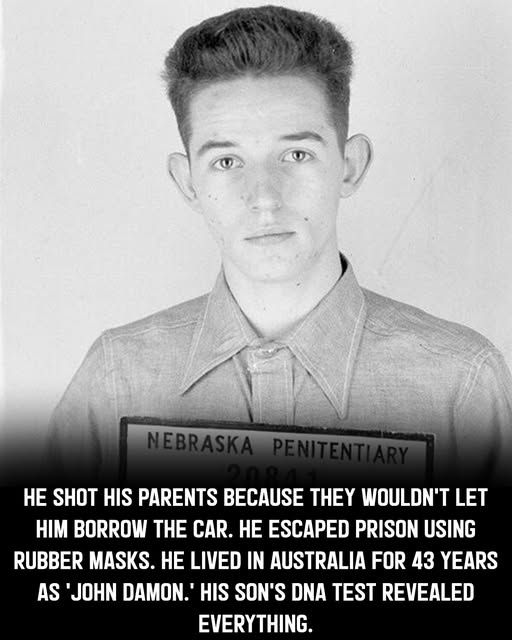
He was 16 and wanted to take his girlfriend to a drive-in movie. His parents said no. So he shot them both, buried them in the backyard, and went to school the next day like nothing happened. Fifty-three years later, his son took a DNA test.
September 27, 1958. Omaha, Nebraska.
William Leslie Arnold was 16 years old and wanted to borrow the family car to take his girlfriend to see The Undead, a horror movie playing at the local drive-in. His parents, Bill and Opal Arnold, said no.
Most teenagers would have sulked. Maybe slammed a door. Shouted unfair things they’d regret later.
William walked into his parents’ bedroom, retrieved his father’s rifle, and confronted his mother in the dining room.
“What are you going to do, shoot me?” Opal laughed.
William pulled the trigger six times.
Minutes later, his father Bill walked through the front door carrying bags of groceries. The two struggled. William shot him dead.
Then William Leslie Arnold, 16 years old, dragged both bodies to the backyard, dug shallow graves, and buried his parents in the dirt.
The next day, he went to school.
For two weeks, William lived his normal teenage life. He attended classes at Central High School where he played saxophone in the band. He hung out with friends. He went on dates with his girlfriend. When teachers asked where his parents were, he smiled and said they were “on vacation.”
Nobody suspected a thing.
Until inconsistencies in his story started piling up. When police questioned him on October 11, 1958, William confessed immediately and led investigators to the backyard. They dug up Bill and Opal Arnold’s bodies right there, with William standing handcuffed between two detectives, pointing to the graves.
Black-and-white photos from that day show a slight boy surrounded by police officers in the family garden. Bullet holes still visible in the dining room wall.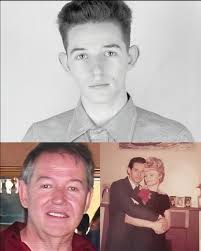
In 1959, William pleaded guilty to two counts of second-degree murder and received a life sentence at Nebraska State Penitentiary. He was 16 years old.
In prison, William was described as a “model inmate.” He excelled in academic programs, participated in vocational training, and by all accounts seemed to be rehabilitating. Prison officials suggested he might even qualify for early release someday.
But William had other plans.
On July 14, 1967—eight years into his sentence—William and another inmate, 32-year-old James Edward Harding, executed one of the most audacious prison escapes in Nebraska history.
They’d been communicating with a recently paroled friend on the outside using newspaper classified ads. The friend tossed saw blades and rubber masks into the prison yard during a visit. William and James collected them.
They spent weeks sawing through the bars of a window in the prison music room, then using chewing gum to hold the bars in place so guards wouldn’t notice during inspections. They fashioned the rubber masks into crude faces and attached them to their pillows to fool guards during nightly head counts.
On the night of July 14, they pulled out the sawed bars, slipped through the window, and scaled a 12-foot barbed-wire fence using a T-shirt slung over the razor wire for protection.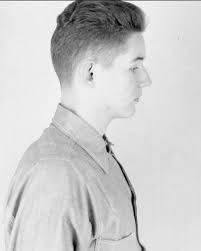
They were gone.
Prison Warden Maurice Sigler told the Omaha World-Herald: “We haven’t even had one rumor” about where the fugitives might be.
William Leslie Arnold had vanished.
The FBI launched a massive manhunt. Investigators followed leads across the country. Tips came in from multiple states. But every lead went cold. James Harding was recaptured within a year and told investigators he and William had made it to Chicago but then “parted ways.”
William seemed to have disappeared into thin air.
The FBI worked the case into the 1990s before handing it to the Nebraska Department of Corrections, who eventually passed it to the US Marshals Service. Decades passed. Leads dried up. The case went cold.
William Leslie Arnold became a ghost story—Nebraska’s most enigmatic fugitive.
What nobody knew was that William was very much alive.
Three months after his escape, in November 1967, a man named “John Vincent Damon” married Jeanne Bouvia, a divorced mother of four, in Chicago. John worked in a restaurant. He was kind, dependable, a loving stepfather to Jeanne’s children.
When people asked about his past, John said he was an orphan from Chicago. No family. No history.
It was technically true. He had killed his parents, making himself an orphan.
Over the years, John and his family moved—Cincinnati, Miami, Los Angeles. In 1978, they divorced. John moved to New Zealand, then eventually settled in Tamborine Mountain, Queensland, Australia.
There, John Damon remarried, had children of his own, and worked as a salesman. He was known in his community as a good provider, a dedicated father who loved music and instilled strong values in his kids. He was intelligent, driven, warm.
Nobody suspected the friendly Australian salesman was an escaped American murderer.
On August 6, 2010, John Vincent Damon died in Australia at age 69 from complications from blood clots. He was buried at Tamborine Mountain Cemetery. His family mourned a beloved husband, father, and grandfather.
And William Leslie Arnold’s secret died with him.
Or so it seemed.
In 2020, Deputy US Marshal Matthew Westover in Omaha was assigned the cold case of William Leslie Arnold. He became obsessed with it, reading old files, tracking down former investigators.
Westover drove five hours to find James Arnold—William’s younger brother, who’d been 13 years old and not home when the murders happened. James, now in his 70s, agreed to provide a DNA sample, which Westover uploaded to a public ancestry database.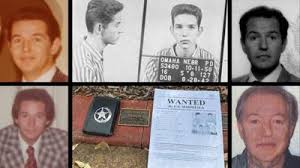
Nothing came back. The trail was still cold.
Then, in August 2022, Westover received an alert: James Arnold’s DNA had matched with another sample. A close relative.
The match came from a man in Australia who’d submitted his DNA to learn more about his father, John Damon, who’d died in 2010. The man knew only that his father had been an orphan from Chicago and wanted to discover his family history.
He had no idea he’d just emailed a US Marshal hunting for an escaped murderer.