JOHN CARTER 2: GODS OF MARS (2026) – The War for Barsoom Reignites
JOHN CARTER 2: GODS OF MARS (2026) – The War for Barsoom Reignites
John Carter 2: Gods of Mars marks a thunderous return to Barsoom, expanding the myth, scale, and emotional weight of the original into a full-blown sci-fi epic where gods walk among mortals and planets hang in the balance. Years after leaving Mars behind, John Carter (Taylor Kitsch) has tried to bury his destiny on Earth, but Barsoom has not forgotten its warlord.
When an ancient Thern artifact awakens during a violent cosmic storm, the fragile balance of Mars collapses. Carter is violently pulled back to a dying world where prophecy is no longer myth, and survival is no longer guaranteed. The planet is darker, crueler, and closer to extinction than ever before.
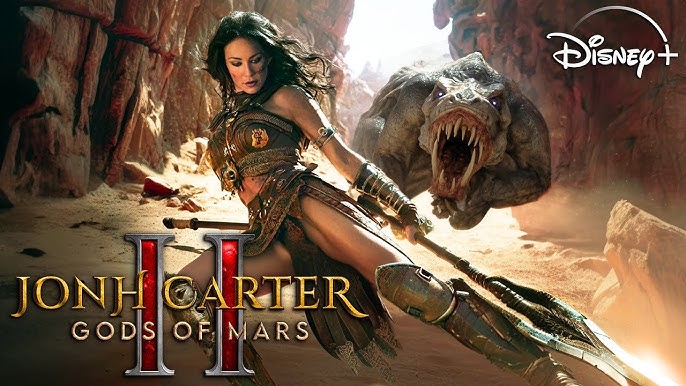
At the heart of the chaos is Dejah Thoris (Lynn Collins), now captured by forces older and more merciless than any army Carter has faced. Her imprisonment is not merely strategic—it is ritualistic, tied to powers that predate Barsoom itself. Lynn Collins returns with regal intensity, making Dejah both a symbol of hope and a weapon coveted by gods.
Carter’s journey across Mars is nothing short of staggering. He moves through floating sky-cities, descends into underground sacrificial pits, and crosses forbidden lands where evolution went wrong. The world-building is richer and more dangerous, making Barsoom feel alive, ancient, and constantly hostile.
The enemies this time are not just armies, but existential threats. White apes thunder through ruined temples, plant men stalk crimson jungles, and entire civilizations crumble under the shadow of beings who see mortals as tools. Mars itself feels like it is screaming under the weight of forgotten sins.
Mark Strong returns as Matai Shang, colder and more terrifying than before, now fully revealed as a master manipulator serving immortal agendas. His presence anchors the film’s darker tone, reminding us that intelligence and cruelty are far more dangerous than brute force.
Adding a new layer of intrigue is Joseph Gordon-Levitt, whose mysterious character walks the line between ally and enemy. His motivations are deliberately obscured, his allegiance uncertain, and every scene he appears in deepens the sense that truth on Barsoom is as lethal as any blade.
What elevates Gods of Mars is its emotional depth. Carter is no longer just a warrior—he is a man haunted by loss, responsibility, and the fear that every world he touches is doomed. Taylor Kitsch delivers his most nuanced performance yet, balancing raw power with quiet despair.
The film also dares to explore divinity as tyranny. The god-like Issus and the immortal Therns are not saviors but parasites, feeding on belief, war, and obedience. The question the film asks is brutal and timeless: what happens when gods are exposed as monsters?
Visually, John Carter 2 is breathtaking. Crimson deserts, alien architecture, cosmic storms, and large-scale battles are rendered with a painterly sense of scale. Every action sequence feels earned, massive, and emotionally charged rather than empty spectacle.
By the time the final clash erupts, this is no longer just a sequel—it is a reckoning. John Carter 2: Gods of Mars redefines sci-fi adventure as a story about rebellion, love, and the cost of destiny. Barsoom does not need a god. It needs a man willing to defy them all.