The Fragile Fighter
When Eliana was born in Texas, she was a “micro-preemie,” arriving at just 23 weeks and weighing a mere 450 grams—barely more than a loaf of bread. Her world was an incubator, and her struggle was simply to breathe.
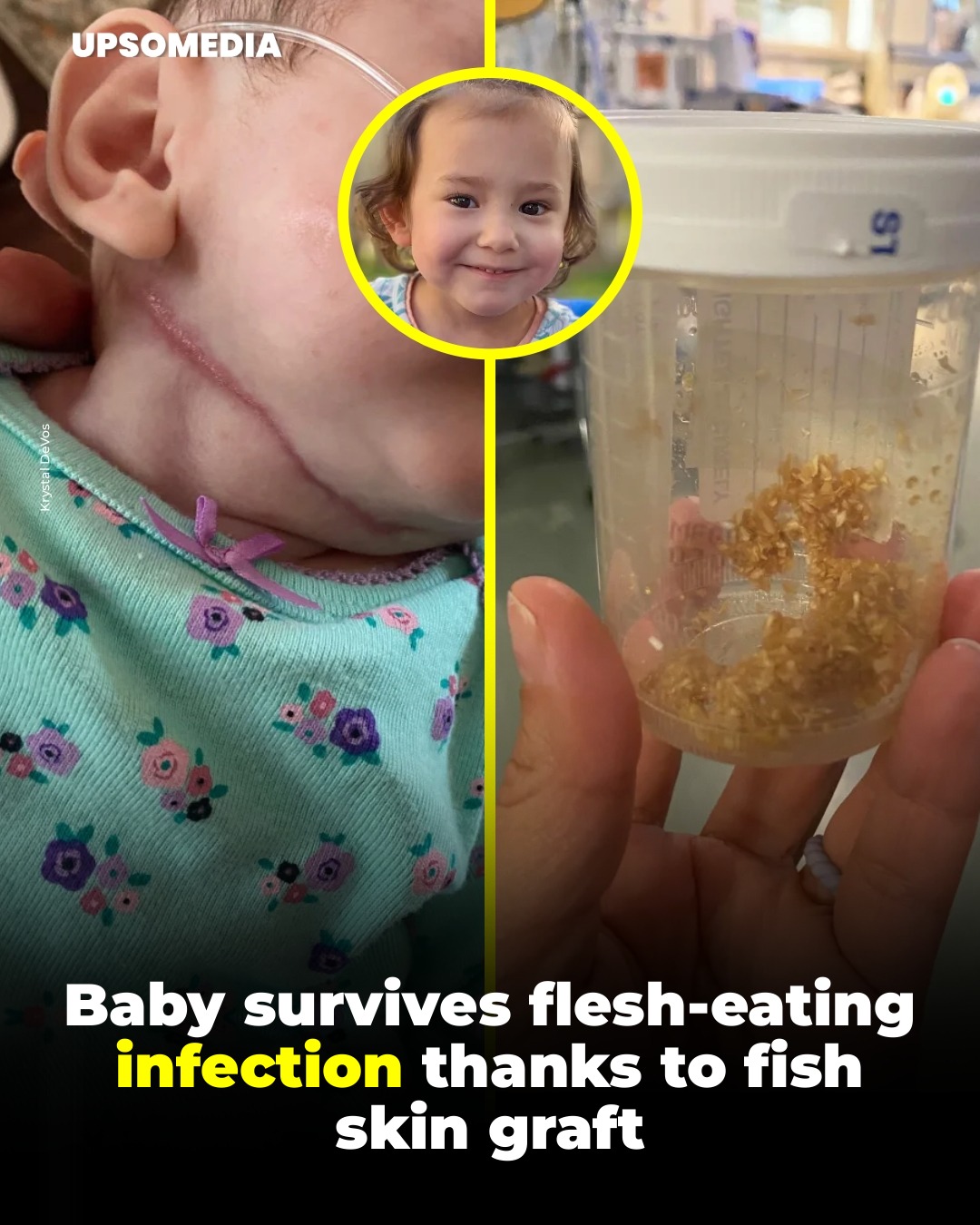
However, a new shadow fell over her survival: a necrotizing (flesh-eating) infection began to consume the delicate skin of her neck. For a baby so small, traditional surgery was a death sentence; her body was too fragile to withstand the trauma of the knife or the harvesting of skin from elsewhere on her tiny frame.
 An “Unthinkable” Solution
The medical team at Driscoll Children’s Hospital reached for a radical innovation from the icy waters of the North Atlantic. They turned to Kerecis, an Icelandic technology that uses sterilized cold-water cod skin as a biological graft.
The science behind it is as fascinating as the result:
-
Omega-3 Power: The fish skin is rich in fatty acids that reduce inflammation and accelerate healing.
-
The Perfect Scaffold: Unlike human or pig grafts, cod skin has no risk of viral transfer to humans and closely mimics the structure of human tissue.
-
A Natural Fusion: The graft doesn’t just cover the wound; it encourages the body’s own cells to migrate into the fish skin, eventually replacing it with living human tissue.
The Ten-Day Miracle
What seemed like science fiction became reality in record time. Within just 10 days, the “fish skin” had fused with Eliana’s, healing a wound that should have been fatal or left her severely scarred for life.
Today, three years later, Eliana is a thriving toddler. Her mother, Krystal DeVos, looks at her daughter not just as a survivor, but as a pioneer. The scars are minimal, but the story is legendary.
“She is my little mermaid,” Krystal says with pride. “A part of the ocean helped her stay on this earth.” 🧜♀️🌊