The Alchemist’s Reactor: Turning Nuclear Waste into Clean Power
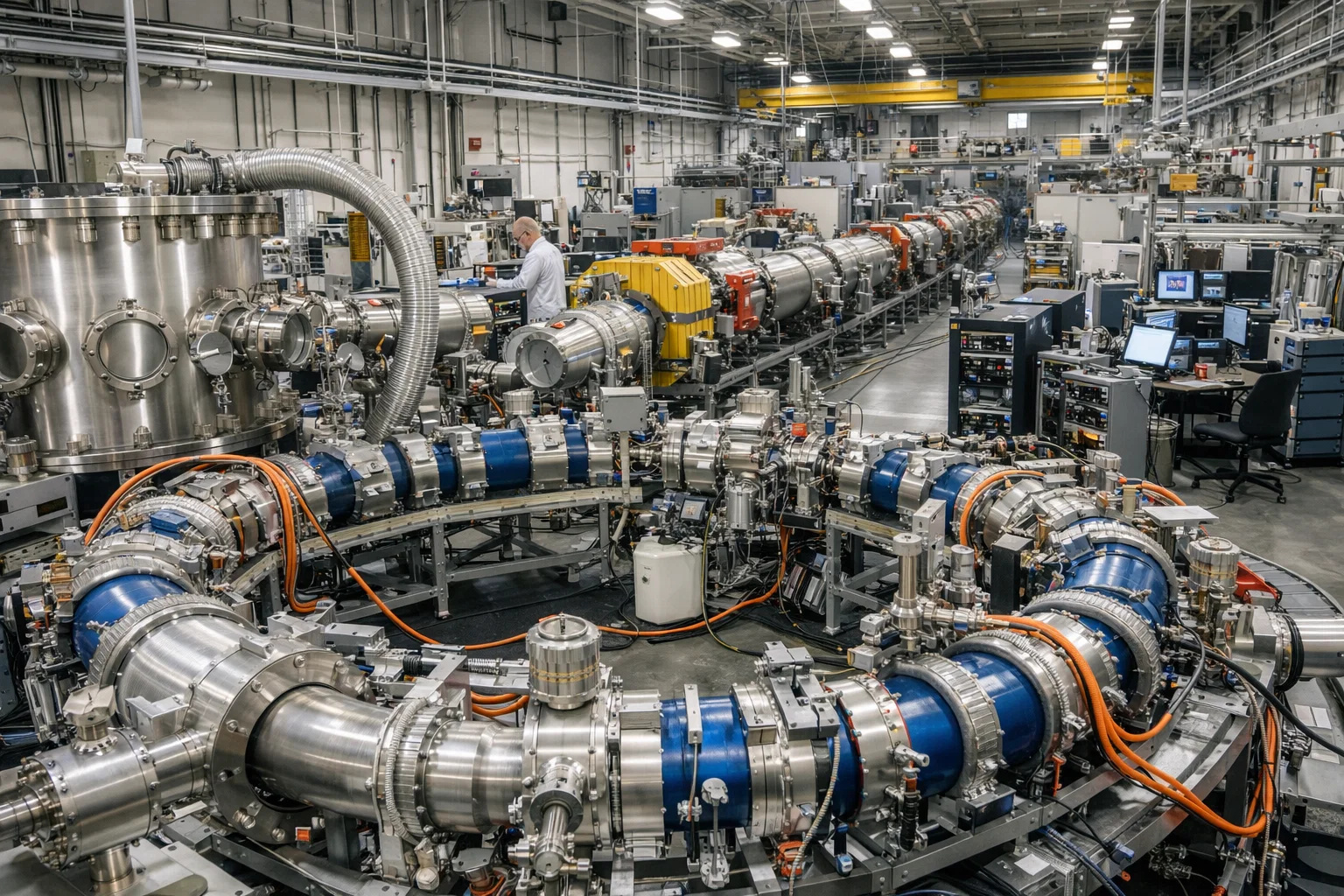
By using high-energy particle accelerators, scientists are finally solving the “forever problem” of nuclear energy—transforming dangerous waste into a sustainable fuel source.
Beyond Deep Burial
For decades, the Achilles’ heel of nuclear power has been its waste. Long-lived isotopes like Plutonium and Americium require secure storage for hundreds of millennia. But a new frontier in physics is moving away from “storing” and toward “transforming.”
Through Nuclear Transmutation, we are no longer just hiding our mess; we are cleaning it up with the power of subatomic physics.
How it Works: The Neutron Hammer
Traditional nuclear reactors rely on a self-sustaining chain reaction. Transmutation is different. It uses a Particle Accelerator to provide an external source of neutrons.
Proton Blast: An accelerator fires protons at nearly the speed of light into a heavy metal target.
Neutron Rain: This collision releases a flood of neutrons.
The Breakdown: These neutrons strike the long-lived radioactive waste, “burning” it up and forcing it to decay into stable or short-lived elements.
Closing the Fuel Cycle
The most exciting part of this technology is its efficiency. The energy released during transmutation can be harvested to generate electricity. This creates a Circular Nuclear Economy: the waste from today’s reactors becomes the fuel for tomorrow’s accelerator-driven systems.
By reducing the radioactive lifespan of waste by over 99%, we effectively eliminate the need for massive geological repositories like Yucca Mountain, shifting the burden of waste management from geological timeframes to human ones.
The Road to 2030 and Beyond
While the theory has been proven in laboratories like Los Alamos (USA) and through projects like MYRRHA in Europe, the challenge now is scaling this to a commercial level. As the world demands carbon-free energy, the ability to recycle nuclear waste into “green” electricity could be the final piece of the puzzle for a fully sustainable power grid.