345-Million-Year-Old “Sea Lily” Fossil Amazes Scientists 🌊🦑
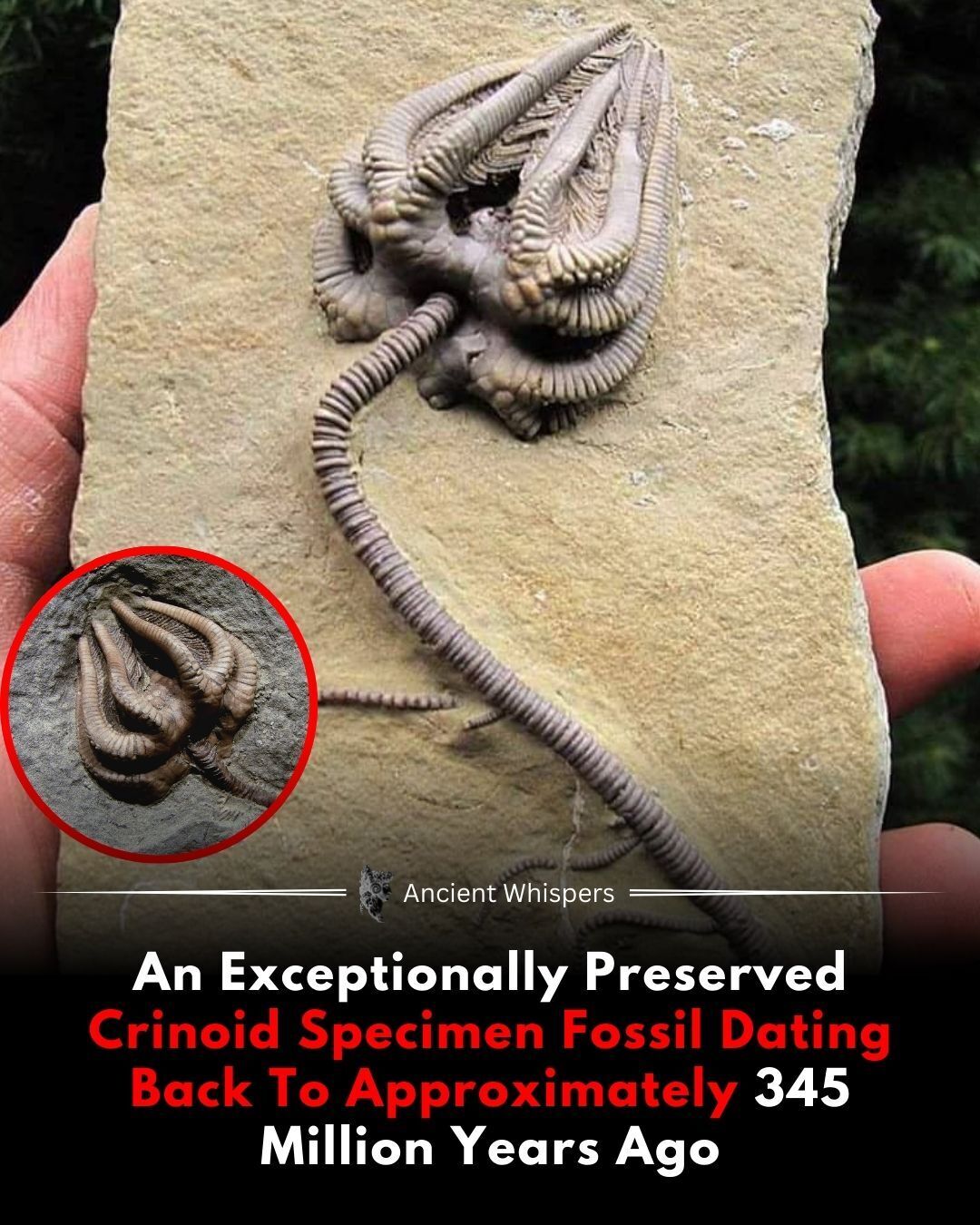
Scientists have recently uncovered an exceptionally well-preserved crinoid fossil dating back approximately 345 million years, providing a remarkable window into life during the Paleozoic era. Crinoids, often referred to as sea lilies, are marine echinoderms related to starfish and sea urchins. They are known for their feathery, delicate arms, which were used to filter particles from the water, and their long stalked stems that anchored them to the seafloor. Fossils of this quality are extraordinarily rare because the skeletons of crinoids are extremely fragile; over millions of years, most specimens disarticulate, leaving behind only partial fragments. The discovery of a fully articulated specimen allows paleontologists to study the creature’s anatomy in unparalleled detail, offering new insights into its evolutionary development and ecological role in ancient marine ecosystems.
The fossil’s fine preservation reveals intricate features, including the detailed arrangement of arms, the articulation of the stem, and the structure of the calyx, which housed the organism’s internal organs. These details are critical for understanding not only the biology of crinoids but also their functional morphology how they fed, moved, and interacted with their environment. Crinoids were suspension feeders, capturing plankton and other small particles from the water column, and their presence in Paleozoic seas provides evidence of the complex trophic dynamics and rich biodiversity that existed long before the age of dinosaurs. By examining features such as arm branching patterns, skeletal flexibility, and attachment structures, scientists can reconstruct how these animals thrived in different marine habitats, from shallow coastal waters to deeper oceanic environments.
In addition to revealing anatomical details, this fossil contributes to understanding the broader ecological context of the time. The Paleozoic era, particularly the Carboniferous period when this crinoid lived, was characterized by vast, shallow tropical seas teeming with diverse life forms, including brachiopods, trilobites, early fishes, and corals. Crinoids were integral components of these ecosystems, forming dense “crinoid meadows” that provided structure and habitat for smaller organisms. Exceptional fossils like this one allow researchers to study community interactions, population density, and evolutionary adaptations. They also provide clues about environmental conditions such as water temperature, sedimentation rates, and nutrient availability.
The discovery underscores the importance of fossil preservation in understanding evolutionary history. Most crinoid fossils are fragmentary, which limits the ability to interpret their functional anatomy and evolutionary relationships. Fully articulated specimens like this provide a complete picture of morphology, enabling paleontologists to compare species across geological time, trace lineage diversification, and examine patterns of extinction and adaptation. These data are essential for reconstructing the history of echinoderms and understanding how marine ecosystems responded to environmental changes over hundreds of millions of years.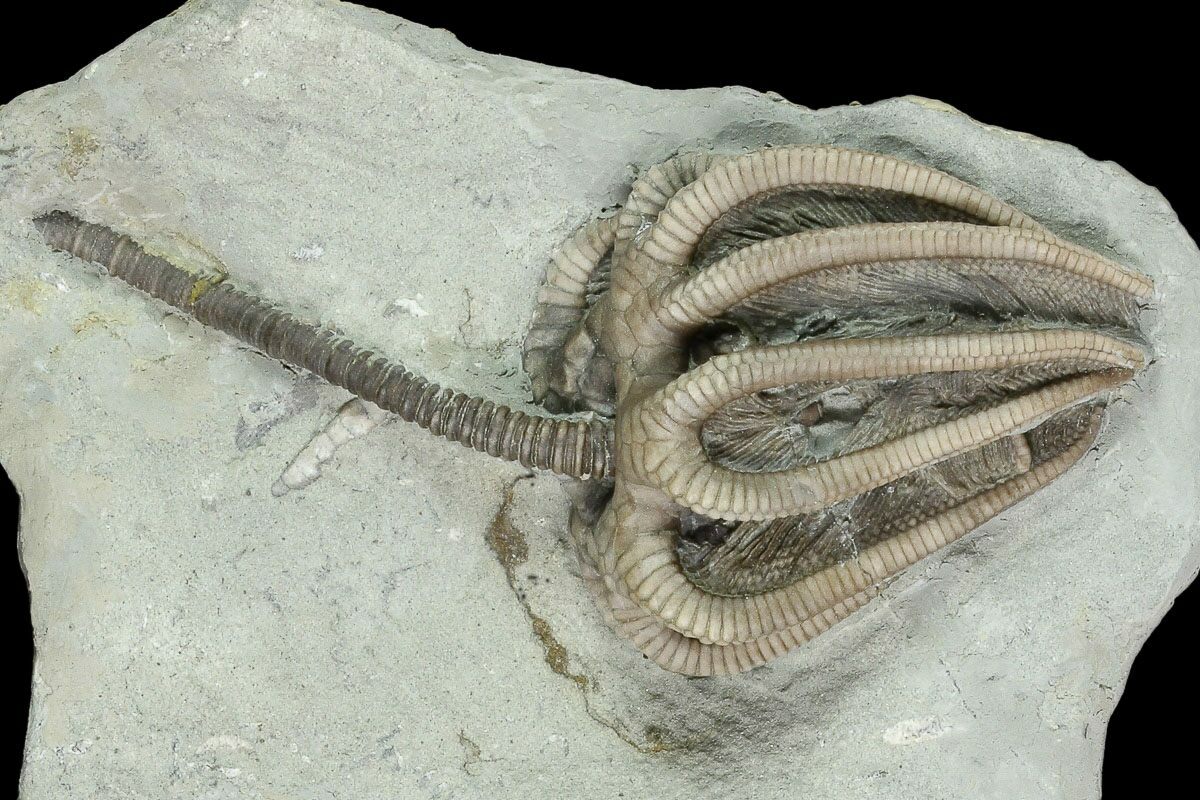
Furthermore, crinoid fossils have a broader significance in the study of ancient biodiversity and paleoecology. Each well-preserved specimen acts as a snapshot of prehistoric life, capturing the form and function of organisms that existed long before the first dinosaurs appeared. By analyzing multiple specimens from different sites and time periods, scientists can infer patterns of species distribution, environmental specialization, and ecological resilience. Such studies reveal that marine ecosystems were already highly complex during the Paleozoic, with intricate food webs and specialized ecological niches that supported diverse communities.
The exceptional quality of this fossil also offers an opportunity for public education and engagement. Specimens that retain fine structural details allow museum visitors, students, and enthusiasts to appreciate the beauty, complexity, and evolutionary significance of prehistoric life. Exhibiting such fossils emphasizes the continuity of life on Earth, illustrating how modern echinoderms relate to their ancient relatives and how ecosystems have evolved over hundreds of millions of years. They also serve as tangible reminders of the fragility of fossilization, highlighting why discoveries of intact specimens are so extraordinary.
Finally, this crinoid fossil highlights the resilience and adaptability of marine life over deep time. Despite environmental fluctuations, including changes in sea level, climate, and ocean chemistry, crinoids persisted and diversified for hundreds of millions of years. Studying these fossils provides insight into evolutionary strategies that allowed organisms to survive in dynamic environments, informing not only paleontology but also modern ecology and conservation biology. Each well-preserved specimen contributes a piece of the puzzle, helping scientists understand both the history of life and the long-term processes that shape biodiversity.
The discovery of this 345-million-year-old crinoid fossil offers an extraordinary glimpse into the Paleozoic seas, showcasing the intricate anatomy, ecological role, and evolutionary history of these remarkable marine animals. Its exceptional preservation allows detailed study of arms, stems, and calyx, providing insights into feeding strategies, environmental adaptation, and community interactions. Beyond anatomy, the fossil illuminates broader ecological and evolutionary patterns, demonstrating the complexity, resilience, and beauty of ancient marine ecosystems. As both a scientific treasure and a window into the deep past, this crinoid underscores the value of paleontological research in reconstructing the history of life on Earth and deepening our appreciation for the enduring diversity of marine organisms.