THE TEXAS CHAIN SAW MASSACRE: REBORN

THE TEXAS CHAIN SAW MASSACRE: REBORN – Some Nightmares Never Die
In THE TEXAS CHAIN SAW MASSACRE: REBORN (2026), horror doesn’t begin with a scream—it begins with silence. A quiet road stretches endlessly through the heart of nowhere, leading to a town that time seems to have abandoned. No signs. No people. Just empty buildings and a suffocating stillness that feels… wrong.
What starts as a simple road trip quickly spirals into something far more sinister when a group of travelers takes a wrong turn into this forgotten place. At first, it feels like an accident. A detour. A delay. But the deeper they go, the more it becomes clear—this isn’t somewhere you stumble upon. It’s somewhere you’re led to.

The town breathes with a presence that cannot be seen but is always felt. Doors creak open without warning. Footsteps echo where no one should be. Shadows stretch unnaturally across walls, shifting when no light moves. Every instinct screams to leave, yet every road seems to circle back to where they started. Escape is no longer a direction—it’s an illusion.
At the center of this nightmare stands a figure rooted in pure, unrelenting terror. Bill Moseley delivers a haunting performance tied to the legacy of horror itself, embodying a presence that is both human and something far beyond it. He is not just a killer—he is a continuation of something older, darker, and deeply embedded in the bones of this place.
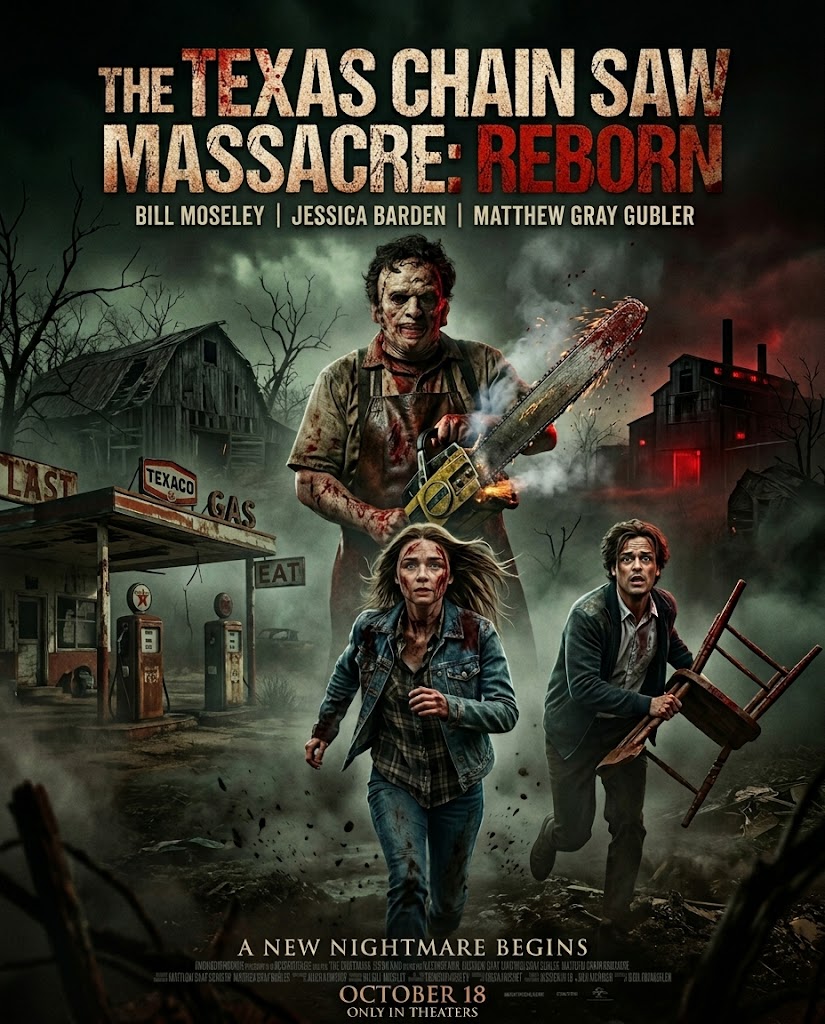
Jessica Barden anchors the story with raw emotion and desperation, portraying a character who refuses to break even as fear closes in from every side. Her journey is not just about survival, but about understanding the horror surrounding her—why it exists, and why it won’t let go. Meanwhile, Matthew Gray Gubler brings an unsettling unpredictability to the screen, blurring the line between victim and something far more disturbing. His presence adds a psychological edge that makes every moment feel unstable, as if reality itself could collapse at any second.
The violence in REBORN is not just brutal—it is intimate. The roar of a chainsaw doesn’t just signal death; it tears through the silence like a warning that comes too late. Panic spreads quickly, infecting every decision, every movement. There is no safety, no pause, no mercy. But what makes this story truly terrifying is not the bloodshed—it’s the realization that the horror is not confined to a single person.
This place remembers.
Beneath the cracked floors and rotting walls lie secrets that were never meant to be uncovered. The past is not gone—it lingers, festering, waiting. And as the group fights to survive, they begin to understand that they are not just being hunted. They are being absorbed into something far more sinister, something that feeds not only on flesh, but on fear, memory, and despair.
Every attempt to escape only pulls them deeper into the nightmare. The town shifts, the paths change, and the line between reality and madness begins to blur. What was once a fight to stay alive becomes something far more desperate—a fight to hold on to who they are before the place consumes them entirely.
As the story builds toward its suffocating climax, the truth emerges: this is not a nightmare you wake up from. It is a cycle that continues, feeding on those who enter, ensuring that the horror never truly ends.