When Predators Were Giants: Unveiling the Massive T. Rex
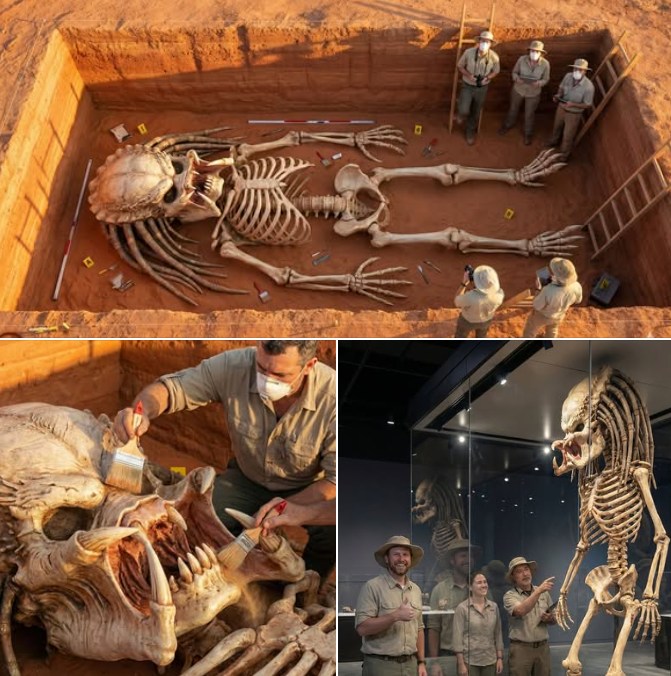
In a stunning revelation that has sent ripples through the paleontological community, a newly unearthed Tyrannosaurus rex fossil has provided us with an even more awe-inspiring glimpse into the size and dominance of these prehistoric predators. This specimen, potentially surpassing 43 feet in length, highlights just how massive and formidable the T. rex truly was. With a skull stretching over 5 feet in length, this newly discovered fossil may even dwarf some of the most famous T. rex specimens, like Sue and Scotty, which were previously considered the largest examples of the species.
As excavation continues, scientists are not just marveling at the sheer size of this giant predator but also at the strength and complexity of its body. From its thick limb bones to its wide hips and massive vertebrae, the fossil reveals that this T. rex wasn’t just a long creature — it was a living fortress, perfectly adapted for a life of dominance and survival in a harsh, competitive world.
A T. Rex Built Like a Fortress
The newly uncovered T. rex specimen stands out not only because of its size but also because of its physical build, which appears to be even more robust than previously believed. Thick limb bones, broad hips, and massive vertebrae suggest that this individual was a specimen built for both power and agility. It wasn’t just about length; this creature’s frame indicates that it was a heavyweight fighter of its time, capable of taking on rivals and hunting down prey with unparalleled efficiency.
The sheer scale of the limb bones alone is astonishing, pointing to a creature capable of powerful, earth-shaking movements. The massive vertebrae hint at a strong core, necessary for maintaining such a formidable structure and enabling the T. rex to withstand the physical demands of being the top predator in its environment. This discovery is providing scientists with more details about the musculature and physical capabilities of the T. rex than ever before.
A Dominant, Late-Life T. Rex?
One of the most intriguing aspects of this discovery is the possibility that this particular T. rex was a dominant individual in its later years. Researchers speculate that this fossil might represent a late-life T. rex that survived through numerous territorial battles and challenges from rivals. Its large size, combined with the strength of its bones, suggests that it may have spent its final years ruling its ecosystem, a true apex predator in the waning days of the dinosaur age.
This theory aligns with previous findings suggesting that T. rex could have been an extraordinarily long-lived species, capable of surviving into its later years while maintaining its position at the top of the food chain. The newly unearthed fossil could provide crucial insights into how T. rex evolved and adapted throughout its life cycle.
Unveiling the Giant: A New Understanding of Prehistoric Predators
With each layer of earth removed from the site, the story of this prehistoric giant becomes clearer. This discovery is not just a milestone in understanding the Tyrannosaurus rex, but it’s also providing a deeper look at the scale of predation during the Cretaceous period. As paleontologists continue to analyze the fossil, they are uncovering new aspects of T. rex biology and behavior that challenge previous assumptions about the species.
What’s most exciting about this discovery is the potential it holds for rewriting the history of dinosaurs. Every new finding about the T. rex is a step closer to fully understanding how it dominated its environment, from its size and strength to its role as a top predator in a world teeming with other dangerous species.
The Legacy of the Giant
This massive T. rex fossil is a reminder that the dinosaur kingdom was once home to some of the largest and most terrifying creatures to ever walk the earth. The sheer scale of these ancient giants continues to astonish, and as more fossils are uncovered, the story of T. rex will continue to captivate our imagination and deepen our understanding of the prehistoric world.