Unearthing a Legend — Or Exposing a Truth Buried for Ages?
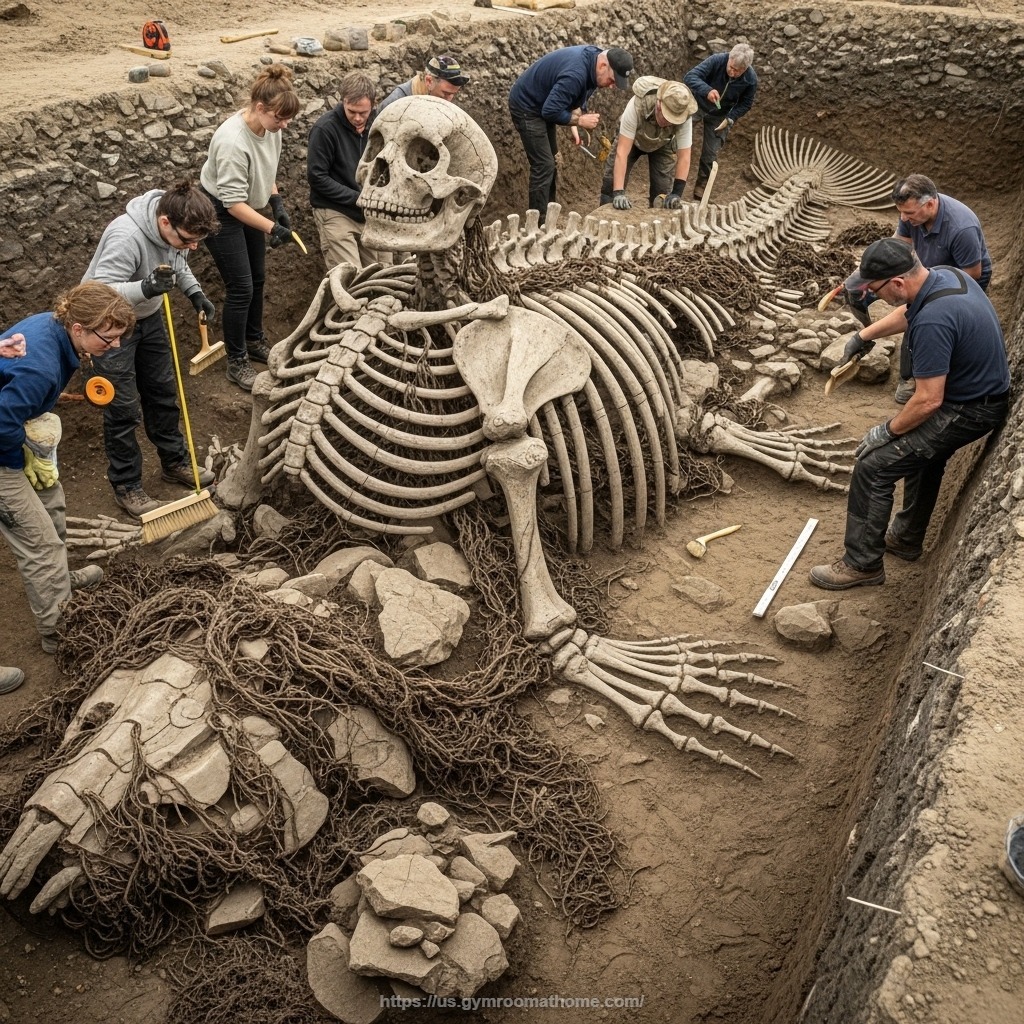
In a discovery that has shaken the world, archaeologists have unearthed something that blurs the line between legend and reality — a massive humanoid-aquatic skeleton buried beneath centuries of soil. The remains, complete with tail fins and human-like ribs, have stunned experts, leaving them to wonder whether this is the greatest archaeological find of our time or simply another elaborate hoax. As scientists carefully excavate the skeleton, they are confronted with a question that’s impossible to ignore: Could this ancient discovery prove that the myths of humanoid sea creatures were more than just stories?
With its incredible scale, intricate details, and preserved posture, the find has sparked fierce debate. Some believe this skeleton is proof of an ancient species once encountered by humanity but somehow forgotten, while others suggest that it’s a long-lost relic of civilizations that once existed alongside mythological creatures. Skeptics, however, argue that the find could be an elaborate hoax — a story fabricated for the sensational nature of its discovery. But as the mystery deepens, one thing is certain: this discovery is far too extraordinary to dismiss.
The Humanoid-Aquatic Skeleton: A Mythological Revelation?
The skeleton’s most astonishing feature is its hybrid nature. Tail fins suggest aquatic adaptations, while the human-like ribs and overall structure hint at a creature that might have lived both in water and on land. Could this be evidence of a species that defies everything we thought we knew about the evolutionary timeline? For centuries, stories of merfolk and sea beings have captivated human imagination, but what if these tales were not just the stuff of myths, but the echoes of a real species that once roamed the Earth?
The fact that such a specimen has remained hidden for centuries — buried in layers of soil — challenges not only our understanding of evolution but also raises questions about the interactions early humans may have had with creatures now relegated to the realm of fantasy. Did ancient civilizations document these beings in their myths because they once coexisted with them, or were these myths mere creations, borne of imagination alone?
Controversial Remains: Evidence of a Struggle or Ritual?
Adding to the intrigue is the discovery of tangled remains beside the humanoid skeleton, which hint at a struggle, collapse, or possibly even a ritual burial. The position of the remains suggests that the creature may have been deliberately placed in a specific posture — a common practice in ancient burial traditions. But what was the relationship between early humans and these beings? Were they feared, revered, or possibly hunted? Did ancient cultures try to honor or worship these creatures, or was this find evidence of a tragic conflict between two worlds?
The very idea that these beings could have coexisted with humans, or had an impact on ancient societies, opens a world of possibilities. If the tangled remains do represent a battle or ritual of some kind, it suggests that these creatures may have played a much larger role in early human history than we ever imagined.
A Discovery That Challenges History
What makes this excavation so significant is not just the bones it has uncovered, but the possibilities it opens up for how we view history, evolution, and the intersection of myth and reality. If this humanoid-aquatic creature is real, it could rewrite our understanding of ancient history, revealing that what we thought were mere myths may have been grounded in truth. The possibility of a forgotten species — once encountered and perhaps even worshiped — would reshape our perceptions of early civilizations and their beliefs.
A New Frontier in Archaeological Discovery
As archaeologists continue to investigate, the questions raised by this discovery will only multiply. Is this the proof of a creature once known in ancient legends, or is it something else entirely? Regardless of the outcome, one thing is certain: this excavation isn’t just uncovering bones — it’s unveiling secrets that could shatter everything we thought we knew about human history.