My Foster Father Impregnated Me At 16 And Kicked Out Of Home But Bikers Took Revenge For Me
My Foster Father Impregnated Me At 16 And Kicked Out Of Home But Bikers Took Revenge For Me
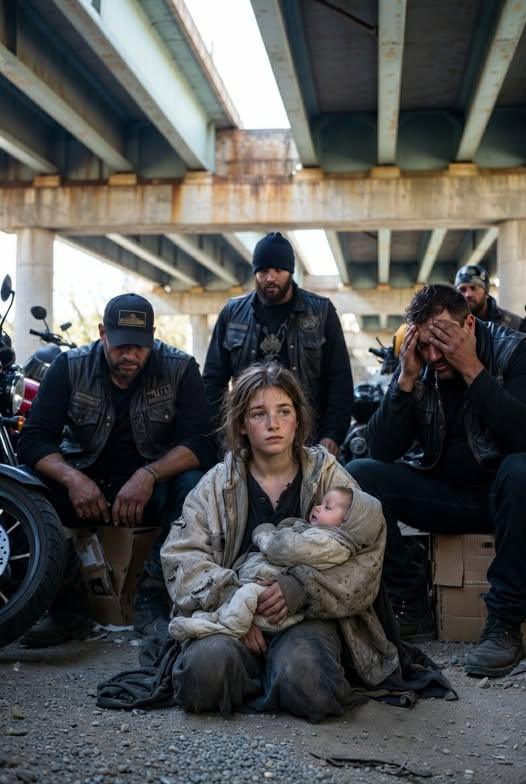
The bikers found me hiding under the bridge with my baby and refused to leave until I told them who did this to me.
Five massive men in leather vests surrounded the cardboard box I’d been living in for three weeks, and when they saw my two-month-old daughter wrapped in my dirty jacket, the biggest one started crying.
My name is Ashley and I’m sixteen years old. Or I was sixteen when this happened. I’m seventeen now. But back then, I was a teenage mother living under a highway overpass in November with a newborn baby and seventeen dollars to my name.
I’d run away from my foster home when I was seven months pregnant. My foster father found out I was pregnant and told me I had two choices: get an abortion or get out.
I refused the abortion. So he threw me out. Literally threw my clothes in a garbage bag and told me to never come back.
Nobody believed me when I tried to tell them why I was really pregnant. That my foster father had been raping me since I was fourteen. That the baby was his. That I had nowhere else to go.
Child Services said I was lying to avoid consequences for “sleeping around.” My caseworker said I was making false accusations because I was angry about being disciplined. The police said there was no evidence and I had a history of “behavioral issues.”
So I lived on the streets. Seven months pregnant, then eight months, then nine months. I slept in parks and bus stations and under bridges. I ate from dumpsters. I stole food when I had to.
I gave birth to my daughter in a gas station bathroom at 3 AM on a Tuesday. Alone. No doctor. No pain medication. Just me and the terror and the pain. I bit down on my jacket to keep from screaming. I delivered her myself. Cut the cord with a knife I’d stolen from a convenience store.
I named her Hope. Because that’s all I had left.
For two months, I kept her alive. I don’t know how. I nursed her even though I was starving. I kept her warm even when I was freezing. I protected her from the men who came around at night looking for vulnerable girls.
But I was dying. I knew I was dying. I was bleeding too much. Hadn’t stopped bleeding since Hope was born. I was getting weaker every day. Could barely stand up. I knew if I didn’t get help soon, Hope would die too. Because I’d die first and she’d starve.
I was trying to figure out how to surrender her. How to leave her somewhere safe where someone would find her and take care of her. A hospital. A fire station. Somewhere she’d have a chance.
That’s what I was planning the morning the bikers found us.
I heard the motorcycles first. The rumble of engines echoing under the bridge. I grabbed Hope and pushed myself further back into my cardboard box shelter, trying to hide. Men on motorcycles meant danger. Meant men who might hurt me. Might take my baby.
But they didn’t leave. The engines shut off. I heard boots on gravel. Deep voices talking.
The boots stopped right in front of my box. I clutched Hope so tight she started to fuss, a tiny whimper that broke the silence.
“Hey, kid,” a gravel-rough voice said, gentle as I’d ever heard a man speak. “We ain’t here to hurt you. Just saw the box move and… hell, we thought it might be a stray dog or somethin’. Didn’t expect… this.”
I peeked out. Five huge men stood in a half-circle, hands open and visible like they already knew I was scared to death. The biggest one (shaved head, beard down to his chest, arms covered in tattoos) was crouched down so he wasn’t towering over me. His eyes were red.
He looked at Hope, then at me, and a tear slid into his beard.
“Jesus Christ,” he whispered. “How old are you, baby girl?”
I tried to answer, but my throat was so dry only a croak came out.
Another biker (long gray ponytail, patch that said “Sergeant at Arms”) pulled a clean bandana from his pocket and held it out. “Here. Wipe your face. We got water. Sandwiches. Whatever you need.”
I still didn’t move. I couldn’t. I was shaking too hard.
The big one sat cross-legged on the freezing ground like it was nothing. “My name’s Tank,” he said. “That’s Preacher, Doc, Bear, and Little Mike even though he’s six-four.” The others gave small waves, trying to smile. “We ride with the Iron Saints. People think we’re scary. Sometimes we are. But never to kids. Never to babies.”
He reached out slow, palm up. “Can I see her? Just for a second. I got a granddaughter about that age.”
Something in his voice cracked the last piece of ice around my heart. I let him take Hope.
Tank cradled her like she was made of glass. Hope blinked up at him, then yawned, tiny fist against his massive thumb. The toughest looking man I’d ever seen started crying harder.
“She’s perfect,” he choked. “What’s her name?”
“Hope,” I whispered.
He nodded, lips trembling. “Good name.”
Preacher knelt beside me. “Sweetheart, you’re bleeding. Bad. We gotta get you to a hospital.”
I started to panic. “They’ll take her from me. They always take kids from girls like me.”
“No,” Doc said firmly. He had kind eyes behind his glasses and a stethoscope patch on his vest like he really was a doctor once. “Not this time. You got five uncles now who ain’t lettin’ that happen.”
They wrapped us both in blankets that smelled like leather and motor oil and safety. Tank carried me like I weighed nothing. Bear took Hope, cooing to her in a voice soft as a lullaby. They put us in a warm pickup (someone’s mom-van disguised as a biker truck) and drove us to a small private hospital two towns over, one that apparently owed the Iron Saints “a favor or twelve.”
The nurses cried when they saw us. Doctors rushed around. They said I had a severe infection, hemorrhaging, malnourished almost to the point of no return. They said Hope was a miracle; she should’ve been much sicker than she was.
I kept waiting for someone to call Child Services. To take her away.
Instead, Tank sat beside my bed holding my hand the entire first night. When the social worker finally came, Preacher met her in the hallway. I don’t know what he said, but she left without ever coming into my room.
Three days later, they discharged us, not to a shelter, not to foster care, but to a big old farmhouse on the edge of town. Mama Bear (Bear’s actual wife, a tiny woman with a huge laugh) had already turned the sunroom into a nursery painted sunshine yellow.
Tank stood in the doorway the first night, rocking Hope while I took the first hot shower I’d had in almost a year.
“You’re home now, Ashley,” he said. “Both of you.”
They found him, of course. My foster father.
The Saints have their ways. I never asked for details, and they never offered them. One morning the news just said a known sex offender had “fallen down the stairs multiple times” before confessing to years of abuse and turning himself in. The DNA test came back the same week. He’ll never see daylight again.
Hope is three now. She calls Tank “Papa” and thinks motorcycles are magical horses that roar. She has five “uncles” who would burn the world down before letting anyone hurt her, and a “nana” who bakes cookies shaped like Harleys.
I finished high school online. I start community college in the spring. I still have nightmares sometimes, but when I wake up screaming, there’s always someone there. Tank sleeps on the couch with the baby monitor turned up loud, just in case.
Last month, on Hope’s third birthday, Tank took me out to the garage. There was a little pink bicycle with training wheels and a leather jacket hanging off the handlebars (child-sized, with a tiny Iron Saints patch on the back that says “Princess.”)
He scratched his beard, embarrassed. “Figured she oughta match the family.”
I cried all over him. He just hugged me and said, “Told you the day we found you, kid. You got uncles now. Family ain’t always the one you’re born to. Sometimes it’s the one that finds you under a bridge and refuses to leave.”
Hope is napping in my lap right now as I write this. She’s got Tank’s blue eyes and my stubborn chin. She’s safe. She’s loved beyond measure.
And for the first time in my entire life, so am I.
We didn’t just survive.
We won.