At 3 AM, a man carried his dying dog into Lake Superior.
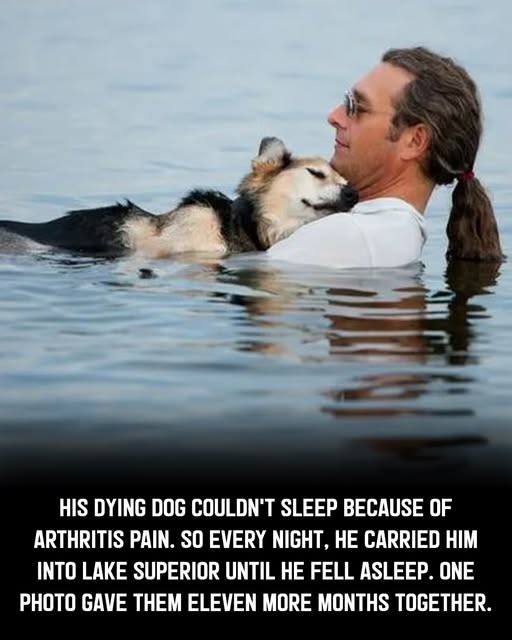
At 3 AM, a man carried his dying dog into Lake Superior.
A photographer captured one moment. And the world’s response gave them eleven more months together.
John Unger was nineteen years old and barely holding on when he found Schoep.
It was 1993 in Bayfield, Wisconsin, a small town on the shore of Lake Superior. John was struggling—directionless, depressed, wrestling with thoughts of ending his life. He’d grown up in a troubled home and felt adrift in a world that didn’t seem to have a place for him.
Then he met a rescued puppy at a shelter. The dog had been mistreated, was scared of people, flinched at sudden movements. Most people would have passed him by for an easier, friendlier dog.
John saw himself in that frightened puppy.
He named him Schoep—pronounced “Shep”—and took him home.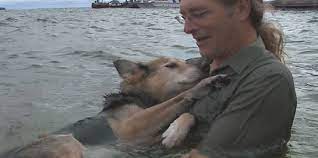
The bond was immediate and profound. Schoep was terrified of the world, but he trusted John. And John, who was terrified of his own thoughts, found something to live for in taking care of this damaged creature who needed him.
They grew up together. John has said publicly that Schoep saved his life during those dark years—that the dog gave him a reason to get out of bed, to keep going, to choose life when he’d been contemplating death.
For nineteen years, they were inseparable. Schoep went everywhere with John—hiking, camping, road trips across the country. They were partners, best friends, the kind of bond that goes beyond pet and owner into something deeper.
Then Schoep got old.
By 2012, Schoep was approaching twenty years old—an extraordinary age for a dog his size. But the years had taken their toll. He developed severe arthritis in his hips and legs. Walking became painful. Standing hurt. He struggled to get comfortable, his aging joints causing constant discomfort.
The veterinarian was honest: Schoep didn’t have much time left. They could manage his pain with medication, but he was dying. John should prepare himself.
John refused to accept that Schoep would spend his final days in pain.
He remembered that water therapy could help arthritis—the buoyancy taking pressure off joints, the cold water reducing inflammation. Lake Superior was right there, massive and cold.
So John started carrying Schoep into the lake.
Not during convenient daylight hours. At 3 AM, when John couldn’t sleep from worrying about his dying friend. At dawn, before work. Whenever Schoep seemed to be suffering.
He’d wade into the cold water of Lake Superior, cradling his 80-pound dog in his arms like a child, and just float there. The water supported Schoep’s weight. The cold numbed his pain. And most importantly, Schoep could finally rest.
In John’s arms, floating in the dark water, Schoep would fall asleep—something he could rarely do on land anymore because of the pain.
This became their routine. Night after night. John carrying his best friend into the lake, holding him while he slept, giving him relief from the constant ache in his bones.
In August 2012, John asked his friend Hannah Stonehouse Hudson, a photographer, if she’d come to the lake and capture one of these moments. Not for publicity—just for himself. A memory of these final peaceful moments with Schoep.
Hannah arrived at the lake and photographed John wading into the water with Schoep. She captured the moment when Schoep, exhausted and in pain on land, finally relaxed in John’s arms and fell asleep.
The photograph is heartbreaking and beautiful. John, fully clothed in the water, cradling his elderly dog. Schoep’s gray muzzle resting against John’s chest, completely vulnerable, completely trusting. Both of them with eyes closed. Both of them, for that moment, at peace.
John is crying in the photo. You can see the love and the grief etched in his face.
Hannah posted the photo on her Facebook page on August 2, 2012.
Within days, it had been shared hundreds of thousands of times. Then millions.
People around the world saw something profound in that image: devotion, love in its purest form, the willingness to do anything—wade into cold water at 3 AM, every day, indefinitely—to ease the suffering of someone you love.
The comments flooded in. Thousands of people shared their own stories of beloved pets, of end-of-life care, of the impossible pain of watching a cherished companion age and suffer.
But people didn’t just share their emotions. They wanted to help.
Donations began arriving. Five dollars here. Twenty dollars there. Hundreds of small donations from strangers moved by the photo. Within weeks, over $25,000 had been sent to help pay for Schoep’s medical care.
The money funded laser therapy treatments, acupuncture, pain medication, and other palliative care that John couldn’t have afforded on his own. Treatments that reduced Schoep’s pain and gave him better quality of life.
The veterinarian had said Schoep didn’t have much time. The viral photo and the treatments it funded gave him eleven more months.
Eleven more months of being carried into Lake Superior. Eleven more months of falling asleep in John’s arms. Eleven more months of being loved.
On July 18, 2013, Schoep passed away peacefully at home, surrounded by John and people who’d come to love him through his story. He was approximately nineteen or twenty years old—the exact age uncertain because he’d been a rescue, but old by any measure.
John was devastated. The companion who’d saved his life, who’d been with him for two decades, was gone.
The outpouring of grief from strangers around the world was overwhelming. Thousands of people who’d never met Schoep mourned him. The photo had connected them to something universal—the love between human and animal, the pain of loss, the beauty of devotion.
For a while, John couldn’t imagine having another dog. How do you replace someone who saved your life?
But eventually, he opened his heart again. He adopted another rescue dog who needed him. Because that’s what Schoep had taught him: love isn’t diminished by being shared. Saving one broken creature doesn’t prevent you from saving another.
John has continued to share Schoep’s story, speaking about depression, mental health, and the healing power of the human-animal bond. He’s been open about how close he came to suicide as a young man, and how Schoep gave him a reason to stay alive.
The photo of them in Lake Superior became iconic—featured in art exhibits, shared in grief support groups, posted by people mourning their own pets. It remains one of the most powerful images of devotion ever captured.