Ukrainian Astronomers Say 20 Giant Objects Moved Across the Moon—Then Offered Their Most Extraordinary Theory

A cluster of faint shapes crossed telescope footage of the moon, some flashing in repeated patterns and others appearing to race above the lunar surface at extraordinary speeds.
Ukrainian astronomers studying the recordings say they counted more than 20 unidentified objects.
Their most dramatic interpretation goes much further: The moon, they suggest, could be serving as a base for technologically advanced craft capable of reaching Earth in approximately 20 minutes.
The claims come from researchers affiliated with Ukraine’s Main Astronomical Observatory, who analyzed high-speed telescope observations recorded during August and September 2025.
The scientists described disc-like and ring-shaped objects that appeared enormous when calculated at the moon’s distance. Some were estimated to span between 15 and 25 miles, while others appeared to produce fast pulses of light or travel several miles per second.
However, the findings remain preliminary.
The study has not undergone peer review, the reported objects have not been independently confirmed and their estimated dimensions depend heavily on the assumption that they were actually near the moon.
The recordings therefore present an unresolved observation—not proof of extraterrestrial spacecraft.
More Than 20 Objects Appeared in Two Observation Periods
The study was conducted by astronomers Boris Zhilyaev, Vladimir Petukhov and Sergey Pokhvala.
Using telescopes equipped with high-speed cameras, the team recorded extremely faint objects during observations of the moon in 2025.
The largest group appeared on Sept. 7 during two separate observation periods beginning around 7:05 p.m. and 7:27 p.m. Eastern Time.
Researchers reported identifying more than 20 objects in the footage.
Because the shapes behaved differently, the team divided them into two broad groups.
They called one group “atmospheric” objects. These appeared to remain stationary relative to the moon rather than rapidly crossing its visible surface.
The second group was labeled “continental.” Those objects appeared to travel over the lunar landscape at high speed.
The terms describe how the shapes looked in the recordings. They do not establish what the objects were made of, where they originated or whether they were controlled by anyone.
Repeating Flashes Raised Questions
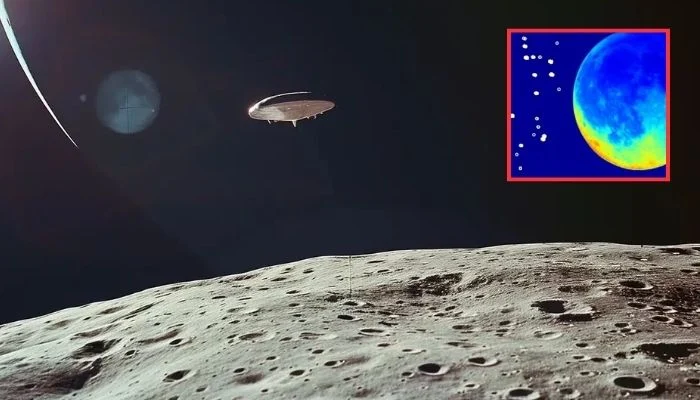
The so-called atmospheric objects appeared to move together with the moon while producing brief flashes.
According to the researchers, individual pulses lasted between approximately 0.1 and 0.5 seconds and sometimes repeated in patterns.
The team examined the brightness of those flashes and estimated how much sunlight the objects might have reflected.
From those calculations, researchers suggested the objects could have measured from roughly 1,400 feet to nearly 6,000 feet across.
Those estimates contain a major uncertainty.
An object’s apparent size depends on its distance from the camera. A small object close to Earth can look similar to an enormous object much farther away.
The scientists’ larger calculations assume the shapes were located close to the moon. If they were instead satellites, debris, atmospheric effects or something nearer the telescope, their actual size would be dramatically different.
Some of the recorded shapes were also extremely faint, appearing in the original footage as marks only a few pixels wide before image processing and false colors made them easier to examine.
One Object Appeared to Cross 14 Miles
The objects classified as continental produced the study’s most dramatic speed estimates.
Researchers described disc-shaped forms that appeared to move across the lunar surface. Based on the assumption that the objects were traveling at the moon’s distance, some were calculated to be between approximately 15.5 and 24.9 miles wide.
One object appeared to cover nearly 14 miles while moving at an estimated 4.1 miles per second.
That would equal nearly 15,000 mph.
A separate observation on Aug. 16 reportedly captured ring-shaped objects during daylight conditions.
Those rings were estimated to measure about 22 miles across. The researchers said they appeared unusually dark, as though absorbing most of the radiation reaching them.
They also seemed to rotate once every three minutes while moving at an estimated 6.8 miles per second.
If those calculations accurately represented physical objects near the moon, the speeds and dimensions would describe machines far beyond familiar aircraft.
But the study does not independently establish that the objects occupied that location.
The extraordinary numbers come from interpreting two-dimensional telescope images through a particular distance assumption.

Researchers Proposed a Lunar Base
After studying the movement and repeated flashes, the Ukrainian team argued that the patterns did not appear random.
They suggested the objects showed signs of organized or intelligent behavior.
The researchers then offered their most controversial conclusion: that the moon may function as a base for unidentified flying objects.
They proposed that craft leaving the lunar region could reach Earth in about 20 minutes and later appear in the atmosphere as unidentified anomalous phenomena, or UAPs.
The paper described the activity as possibly connected to a technologically advanced civilization.
No physical lunar structure was documented, however.
The footage did not reveal a visible base, launch facility, occupants or clear evidence linking the separate objects to one another.
The base theory was an interpretation of their reported movement—not a directly photographed discovery.
“Unidentified” Does Not Mean Alien
The label UFO traditionally means unidentified flying object.
It does not automatically mean an extraterrestrial vehicle.
An unidentified shape may remain unexplained because the image is unclear, its distance is unknown or too little information exists to compare it with ordinary objects.
Possible explanations for unusual telescope footage can include satellites, fragments of space debris, aircraft, meteors, atmospheric distortion, sensor noise or processing artifacts.
The Ukrainian team argued that the speed, scale and coordinated behavior distinguished its observations from those possibilities.
Still, no independent group has reproduced the findings or publicly confirmed the objects’ lunar location.
Without that confirmation, the footage cannot establish whether researchers recorded distant objects near the moon or much smaller phenomena closer to Earth.
The gap between those possibilities is enormous.
A faint mark crossing an image can become a 20-mile craft only if its distance is known.
Similar Work Previously Drew Criticism
Scientists associated with Ukraine’s astronomical observatory have published earlier claims involving unidentified objects seen during telescope observations.
Those studies also attracted attention because they described unusually fast, dark or bright objects in Earth’s atmosphere and near space.
Previous work from the group faced criticism over its methods, particularly the way distance and size were calculated from limited visual data.
Ukraine’s National Academy of Sciences reportedly rejected conclusions from similar research, citing problems that included errors in determining how far away the observed objects were.
That history does not by itself explain the new footage.
It does show why independent analysis and peer review will be especially important before the latest interpretations can be accepted.
Other researchers would need access to the original recordings, camera settings, telescope information, observation conditions and complete calculations.
They would then have to determine whether ordinary objects or imaging effects could reproduce what the Ukrainian team recorded.
Why the Footage Still Attracts Attention
Even without confirmation of alien technology, the observations raise an interesting scientific problem.
Modern skies are crowded.
Thousands of satellites orbit Earth, while spent rocket stages, fragments and other pieces of debris move through space. Cameras aimed at the moon may capture objects between the telescope and the lunar surface, creating the illusion that something is moving directly above the moon.
High-speed equipment can also record brief flashes or small movements that ordinary cameras miss.
That sensitivity creates opportunities for discovery, but it also creates interpretation challenges.
The less visible an object is, the more heavily researchers may depend on image enhancement and mathematical assumptions. Small errors can produce enormous differences in estimated size or velocity.
The study’s striking conclusion therefore rests on its most difficult unanswered question:
Where were the objects?
Until their distance is established, scientists cannot reliably determine how large or fast they were.
A Mystery, Not a Confirmation
The Ukrainian researchers believe they recorded structured activity near the moon and argue that its characteristics point toward advanced technology.
Their calculations describe objects larger than cities moving at several miles per second. Their interpretation imagines a lunar base capable of sending craft toward Earth with extraordinary speed.
But the evidence has not yet reached the level required to confirm that scenario.
The study remains non-peer-reviewed. No independent observatory has verified the objects, and no publicly documented physical base has been found on the lunar surface.
What remains is a collection of faint images, unusual light patterns and a theory far larger than the available proof.
The footage may eventually receive an ordinary explanation. It may expose problems in how the observations were measured. Or further examination may leave some objects genuinely unidentified.
For now, the most accurate conclusion is also the least dramatic.
More than 20 unexplained shapes appeared in telescope recordings aimed toward the moon.
The Ukrainian scientists believe they know what those shapes could represent.
The rest of the scientific world has not yet agreed.