A Young Boy’s Sign Sparks a Powerful Conversation About Beauty
A Young Boy’s Sign Sparks a Powerful Conversation About Beauty
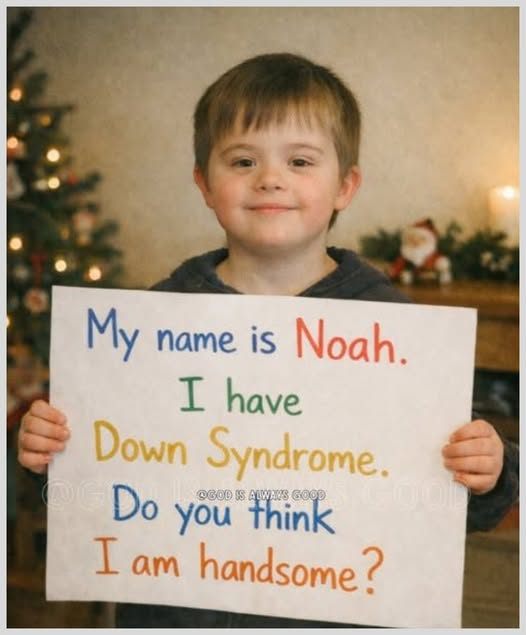
A photograph of a young boy holding a handwritten sign has quietly captured hearts and attention. On the sign, written in simple letters, are the words: “My name is Noah. I have Down syndrome. Do you think I am handsome?”
The image shows Noah standing proudly, his posture confident, his smile gentle and sincere. His bright eyes reflect curiosity rather than doubt, yet the question he poses speaks to a deeper reality faced by many children with disabilities.
The photo is not truly asking for validation. Instead, it serves as a reminder of how society defines beauty, worth, and belonging. Too often, those definitions exclude people who look or move differently.
Noah’s message challenges that narrow view. It invites people to pause and consider what beauty really means, and who gets to claim it.
Advocates for disability inclusion say moments like this reveal the importance of representation and affirmation. Children absorb messages from the world early, learning whether they are seen, valued, and celebrated.
Noah’s confidence reflects something powerful: the impact of love, acceptance, and encouragement. His sign does not ask for pity. It asks for recognition.
True beauty, experts say, is not found in perfection or conformity. It lives in authenticity, kindness, joy, and the courage to stand openly as oneself.
The image has resonated widely because it speaks without accusation. It simply reminds viewers that dignity does not come from meeting a standard, but from being human.
In Noah’s quiet question lies a universal truth: everyone deserves to be seen not through labels or diagnoses, but through the light they bring into the world.
And sometimes, the most powerful statements are written in a child’s handwriting.