THE ORBITAL MINEFIELD: SPACE DEBRIS IN 2026
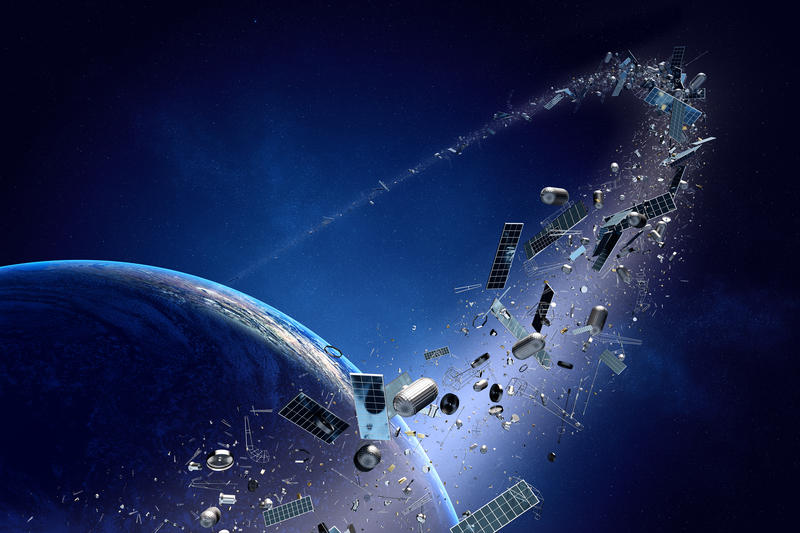
The dream of a limitless frontier in space is colliding with the hard reality of orbital congestion. Since the dawn of the space age in 1957, humanity has launched thousands of missions. While our success in reaching orbit has accelerated, it has left behind a complex and dangerous legacy: an ever-growing cloud of technological debris.
The Numbers Game: Clarifying the Crowd
As of early 2026, the situation in Low Earth Orbit (LEO) is characterized by a massive increase in activity. We currently track over 14,500 active satellites, largely driven by the expansion of commercial mega-constellations.
It is a common misconception that there are more “dead satellites” than “active satellites.” If we look strictly at payloads (satellites), active ones actually outnumber the defunct ones. However, when you look at the total inventory of human-made objects in orbit—including spent rocket stages, mission-related components, and millions of fragmentation pieces—the “dead” material vastly outweighs the functioning hardware.
The U.S. Space Surveillance Network tracks over 32,000 large objects (10 cm or larger) in orbit. Even more daunting is the “invisible” threat: the European Space Agency (ESA) estimates there are over 130 million debris fragments between 1 mm and 1 cm in size. These tiny particles, traveling at hyper-velocities (up to 17,500 mph), carry enough kinetic energy to catastrophically disable critical infrastructure like the International Space Station or communication arrays.
The Kessler Syndrome: The Existential Risk
The primary concern for researchers is the Kessler Syndrome—a scenario where the density of orbital objects becomes so high that a single collision triggers a self-sustaining chain reaction. One collision creates thousands of fragments, which then hit other objects, creating an exponential growth of debris.
While we have not yet triggered a runaway Kessler scenario, we are rapidly approaching critical density in certain orbital bands. Operators are now utilizing “graveyard orbits” for high-altitude assets and active maneuvering to avoid conjunctions. Many companies are moving toward “de-orbit by design,” proactively lowering the altitude of their satellites to ensure they burn up in the atmosphere at the end of their mission, rather than lingering as permanent hazards.
Sustainability as a Necessity
Space is a finite resource. As we push further into the commercialization of LEO, the sustainability of our space environment is becoming as vital as our progress on the ground. We have transitioned from an era of “exploration” to an era of “orbital management.” The challenge for the next decade will be to develop the technology not just to launch, but to clean up the debris we have already created.