China misses growth target for first time since Covid as Iran turmoil roils global trade
Hong Kong —
China is struggling to offset economic challenges both at home and abroad, as its economy grew at a slower-than-expected pace in the second quarter of the year.
On Wednesday, China’s National Bureau of Statistics said the economy grew 4.3% in the quarter ending June 30, compared to the same period a year ago.
The figures, which fell short of expectations for 4.5% growth, are a rare admission of economic weakness for China, which has long worked to prop up industrial activity with infrastructure investment and exports.
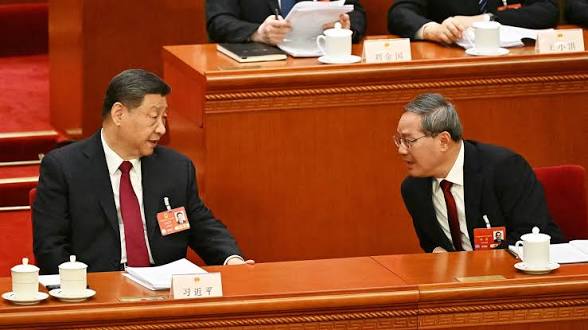
That’s also despite China’s target for 4.5-5% expansion this year, the lowest since Beijing started announcing such figures in the early 1990s. In 2020, officials decided to forgo setting a target during the Covid-19 pandemic.
The weaker economic data is a sign that sluggish consumption at home is outweighing recent strength in Chinese exports, and the nation is not immune from the economic turmoil caused by the war in Iran.
A slowdown in the housing sector and a difficult job market have made Chinese consumers reluctant to spend, even as the economy has expanded at a relatively steady clip. Earlier this week, Beijing released its first five-year policy plan to boost consumption and lift annual retail sales to about $9 trillion by 2030.
Wednesday’s numbers come off the back of a stronger-than-expected start to the year for China, which notched 5% growth in the first quarter. China’s exports in the second quarter surged 27%, exceeding analyst expectations off strong trade in semiconductors and computer parts.
But despite growing international demand for Chinese goods, domestic consumption remains a critical weak spot in the nation’s economic development.
The divergence underscores an increasingly pronounced “two-track economy” in China – advanced technologies are powering its thriving export engine, while demand for everyday goods stagnates at home.
Retail sales, a key gauge of consumption, rose 1% year-over-year in June, according to Wednesday’s data. The monthly figure rebounded from its first decline since December 2022 recorded in May.
Higher energy costs during the war in Iran have helped lift China out of one of its longest periods of deflation, as the nation struggles with industrial overcapacity and sluggish domestic demand. Global crude prices settled as high as $114 a barrel in May, as strikes in the Middle East and the effective closure of the Strait of Hormuz choked off supplies from the Gulf.
However, the continuation of attacks between the US and Iran could pose challenges to China’s economy. While China has buffered itself from the broader supply shocks, more expensive fuel and commodities could weigh on consumer sentiment and disrupt manufacturing.
“The possibility of renewed Middle East conflict looms large and could extend commodity price volatility, further threaten supply chains, raise prices, and weigh on financial conditions,” the International Monetary Fund wrote in its July report.
Earlier this month, the IMF upgraded its growth forecast for China this year from 4.4% to 4.6% off its strength in high-tech manufacturing and exports. Meanwhile, the financial organization revised its global growth outlook down from 3.1% to 3.0%.
This is a developing story and will be updated.
https://www.cnn.com/2026/07/14/business/china-q2-gdp-export-economy-intl-hnk