The Golden Titan of the Dunes: The Sarcophagus That Egyptologists Never Saw Coming
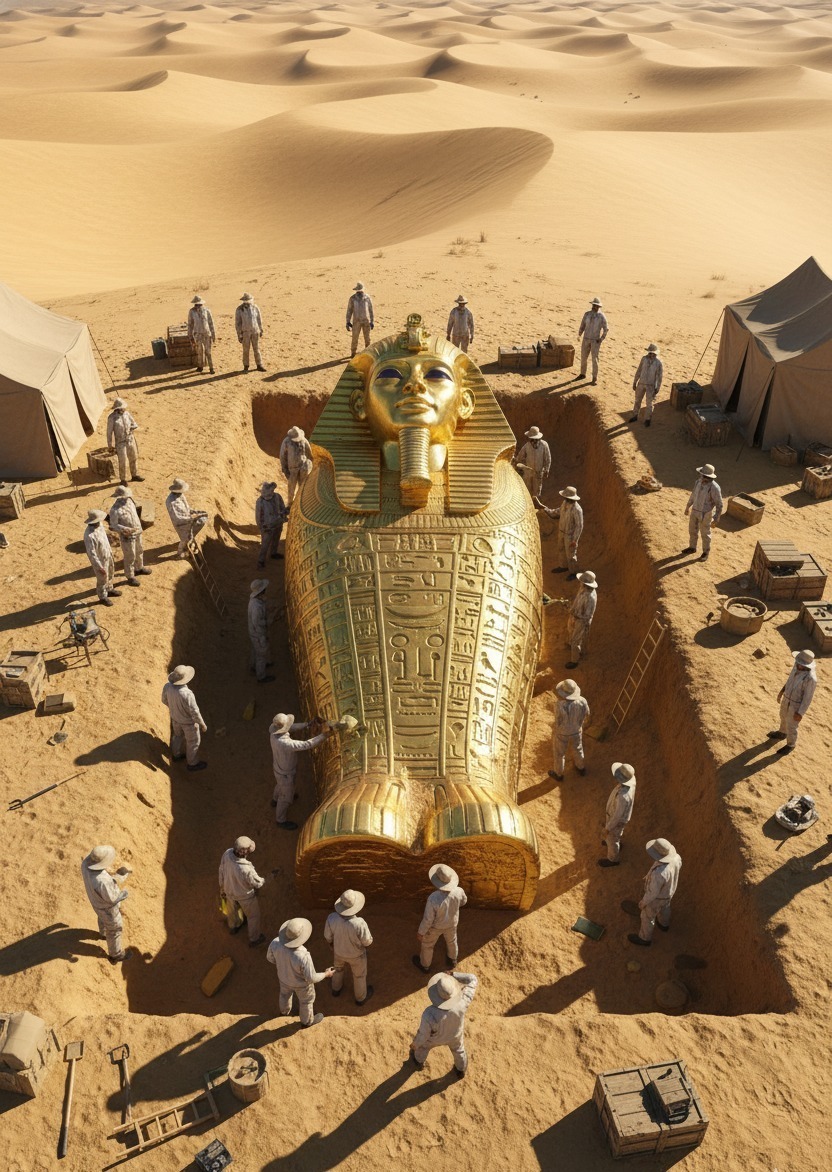
In a breathtaking discovery that has stunned the world, a colossal golden sarcophagus — grander than any known royal tomb — has been unearthed beneath the shifting sands of the Moroccan desert. This remarkable find, with its impossible scale, immaculate carvings, and eerie isolation, has ignited fierce debates among archaeologists, skeptics, and conspiracy theorists alike. Why would such a monumental sarcophagus be buried thousands of miles away from Egypt’s well-known burial sites? And how has it remained untouched and gleaming as though it were sealed only yesterday?
Some experts suggest that this discovery points to a forgotten dynasty or even an ancient civilization that may have defied history itself, while others question whether the discovery is too perfectly staged — from the precision of its lighting to the aerial footage — raising doubts about the authenticity of the find. With officials remaining silent, the world is left wondering: Are we witnessing the greatest archaeological breakthrough of the century, or is this a grand, elaborate mystery that we’ve only just begun to unravel?
The Golden Sarcophagus: A Monumental Find in the Desert
The discovery of the golden sarcophagus is being hailed as one of the most astonishing archaeological finds of our time. Measuring far larger than any royal tomb from ancient Egypt, the sarcophagus boasts exceptionally intricate carvings and gilded surfaces that gleam in the sunlight, leaving experts speechless. Its imposing size and opulent detail suggest that it was intended for someone of extraordinary significance — someone whose legacy was meant to be remembered for millennia.
But here’s the twist: the sarcophagus has been found in the Moroccan desert, thousands of miles from Egypt’s famous burial sites. This raises an immediate question: Why was this grand tomb placed so far from ancient Egypt’s known burial grounds? Could this be evidence of a forgotten dynasty — a royal family that defied the boundaries of known history? Or could it be the remains of a foreign ruler whose significance was lost to time?
The Mystery of Its Immaculate Condition
Even more perplexing than its location is the impeccable condition in which the sarcophagus was found. Unlike many ancient tombs that have been ravaged by time, looters, and the elements, this golden sarcophagus gleams as if it were sealed only yesterday. Its decorative carvings are pristine, and its golden sheen remains untarnished. How could such a monument, buried beneath the desert for centuries, remain so well-preserved?
Some believe the answer lies in the desert’s unique climate — dry and stable, the sands may have acted as a preservative. However, others are more skeptical, pointing to the seemingly perfectly orchestrated elements of the discovery: aerial footage, precision lighting, and the perfect alignment of the sarcophagus. Could this be a carefully staged spectacle, designed to attract global attention and stir the public’s imagination?
A Forgotten Dynasty or a Staged Mystery?
The mystery deepens as archaeologists debate whether this discovery points to a forgotten civilization or a mysterious dynasty that once thrived in North Africa, far from the historical reach of ancient Egypt. Could this be evidence of an undiscovered empire, one whose history has been erased or intentionally hidden from the pages of time?
Alternatively, skeptics argue that the timing and presentation of the find appear far too perfect. Some even suggest that the discovery could be part of a grand mystery, carefully orchestrated to blur the line between reality and legend.
A Legacy Shrouded in Mystery
As the world watches, captivated by the mystery of the golden sarcophagus, questions about its true origins and significance remain unanswered. Is this the long-awaited discovery that could change our understanding of ancient civilizations, or is it a cleverly crafted illusion designed to capture the world’s attention? One thing is certain: the secrets of the sarcophagus are only beginning to unfold, and the answers may be far more extraordinary than anyone expected.