Firefighter Lost His Job After Saving a Bear Cub—But Was His Decision Heroic or Reckless?
One decision in the middle of an inferno
The wildfire had already consumed thousands of acres by the time crews received the order to retreat.
Flames were moving rapidly through the forest, driven by dry vegetation and unpredictable winds. Thick smoke reduced visibility, burning trees threatened to collapse, and every minute spent inside the danger zone increased the possibility that a firefighter could become trapped.
According to a widely shared online story, one of the firefighters on the ground was a man identified only as Espinoza.
He had reportedly served his community for ten years. To the people who knew him, firefighting was more than a uniform or a paycheck. It represented a promise to enter dangerous places when others were trying to escape them.
But on that day, protecting life also meant knowing when to withdraw.
The commander’s instructions were clear: the conditions had become too dangerous, and the crew needed to fall back immediately.
No one was to reenter the burning area.
Then Espinoza heard something through the smoke.
A faint cry from inside the forest
At first, the sound was almost impossible to separate from the noise of the fire.
Branches cracked as they burned. Equipment roared nearby. Firefighters shouted instructions while moving toward safer ground.
But Espinoza reportedly stopped.
Somewhere behind the wall of smoke, he believed he could hear a small, frightened cry.
His fellow firefighters did not know exactly what was making the sound. It might have been an injured wild animal. It might have been coming from farther away than it seemed. In a fire environment, smoke, wind and terrain can distort both sight and sound.
The order to retreat still stood.
Going back would mean deliberately leaving the protection of the team and entering an area that commanders had already judged unsafe.
For several seconds, Espinoza faced a choice that would later divide everyone who heard the story.
He could follow the order and remain with his crew.
Or he could turn toward the cry.
Espinoza reportedly chose the second option.
He disappeared into the smoke
Before his colleagues could stop him, Espinoza ran back toward the burning forest.
The decision shocked the people around him. Firefighters depend on coordination, communication and discipline. When one crew member acts alone, others may be forced to follow if that person becomes injured or trapped.
Espinoza was not only risking his own life.
If the fire shifted or an escape route closed, his team might have to risk additional lives trying to rescue him.
For several tense moments, he disappeared from view.
Then a figure emerged through the smoke.
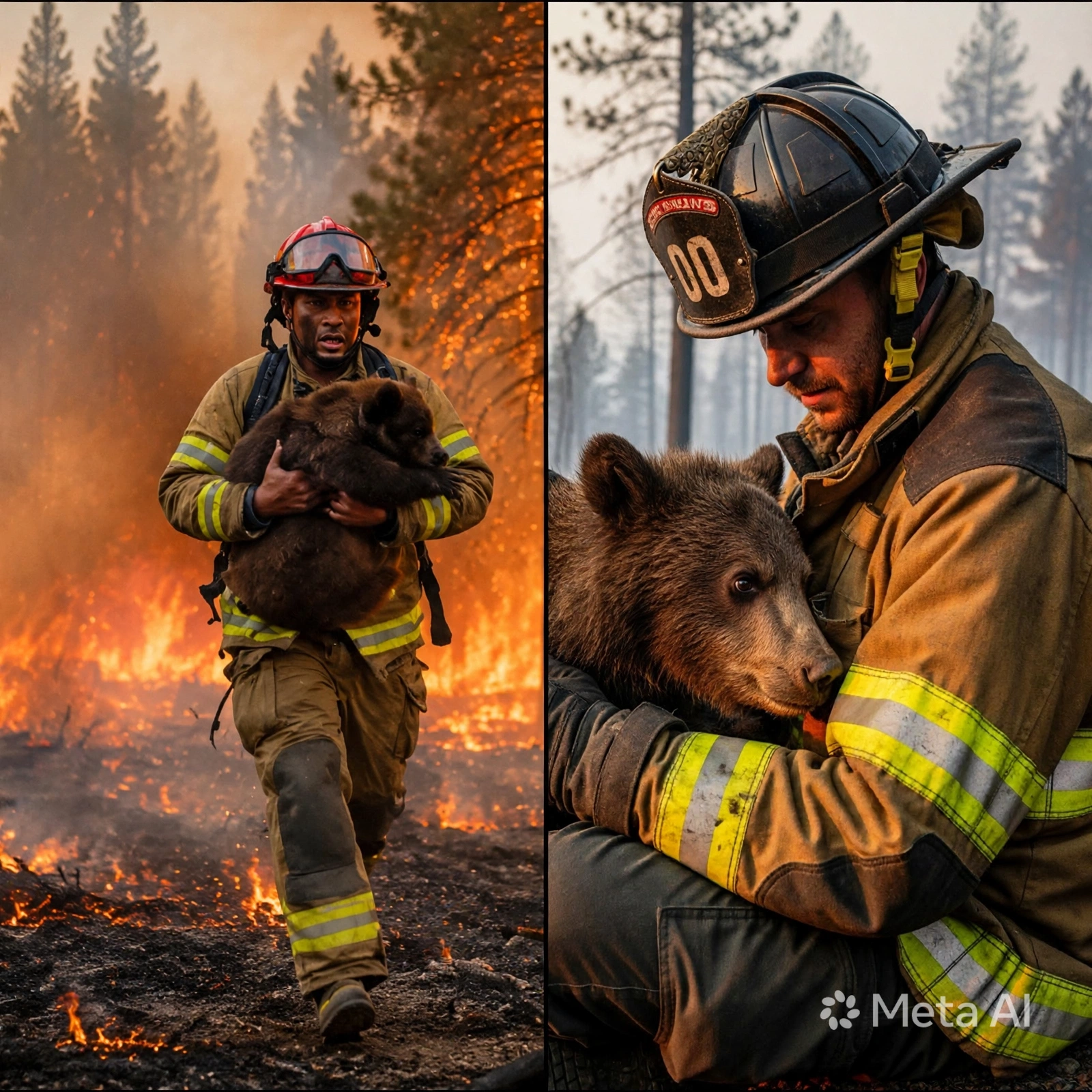
Espinoza’s protective clothing was covered in ash. His face was blackened with soot, and he was reportedly coughing as he moved away from the flames.
But he was not alone.
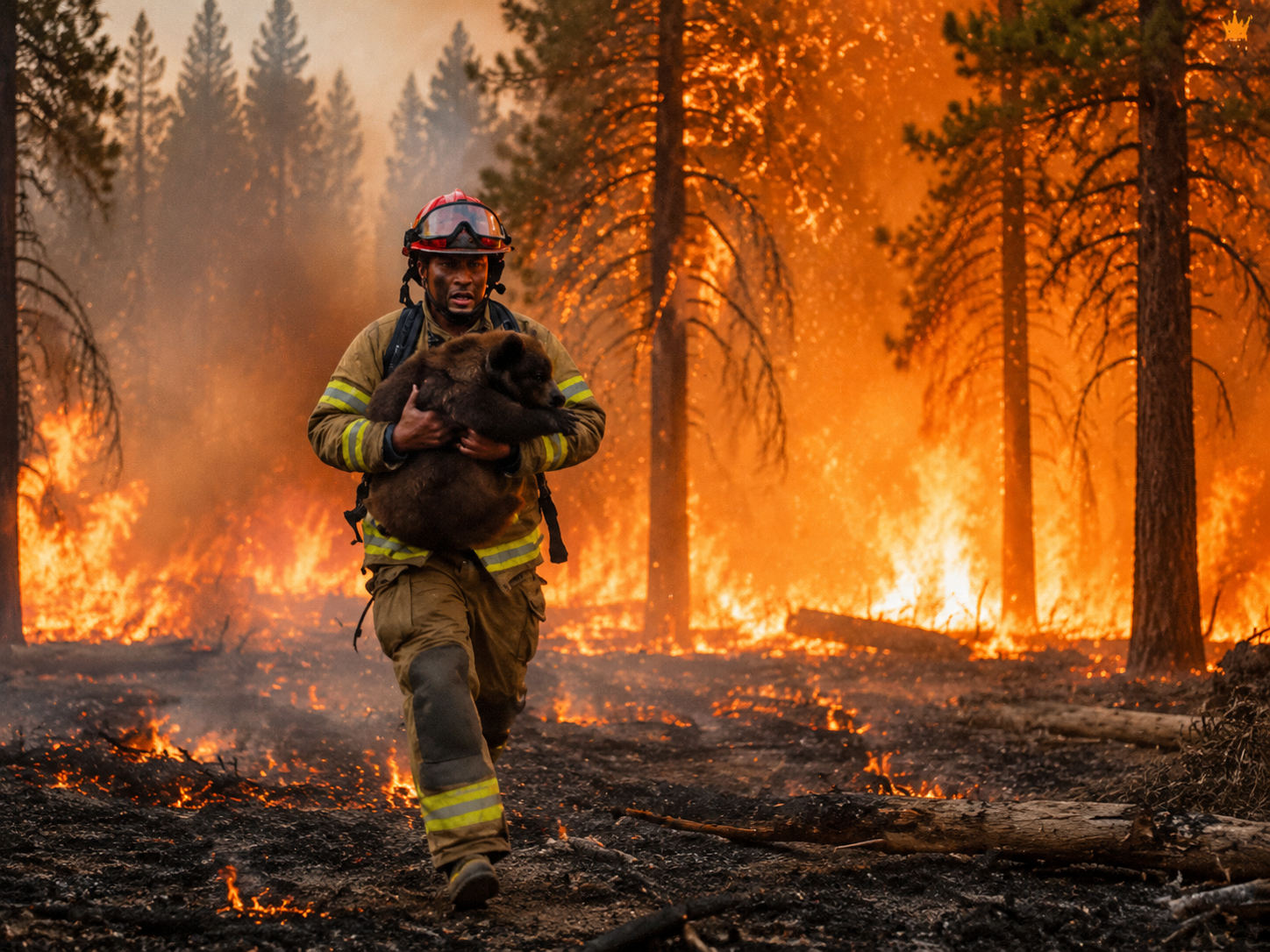
Pressed against his chest was a small bear cub.
The frightened animal was alive.
The image that changed the story
The scene was immediately powerful: a firefighter walking out of smoke with a helpless animal clinging to his uniform.
To many people, it represented the purest form of courage.
Espinoza had heard a vulnerable creature in distress and acted when no one else could reach it. He had entered a place of extraordinary danger without knowing whether the rescue would succeed.
The bear cub was reportedly transferred into the care of people equipped to treat and protect it after the fire.
But attention soon shifted from the animal’s survival to the firefighter’s conduct.
Espinoza had ignored a direct command.
His department now had to decide whether a successful rescue erased the danger created by his actions.
According to the circulating account, it did not.
Espinoza lost his job.
Why emergency orders cannot be treated as optional
The reported punishment angered many people, but the department’s alleged position was not difficult to understand.
Emergency operations cannot function if every responder independently decides which instructions to follow.
A retreat order is usually based on information that an individual firefighter may not possess. Commanders may be monitoring changes in wind, fire behavior, available resources and the condition of escape routes.
A firefighter on the ground may see one immediate opportunity to help. The commander must consider the survival of the entire team.
If Espinoza had been injured, other firefighters might have been required to reenter the area. One attempted animal rescue could then have become a rescue operation involving multiple human lives.
Critics therefore argued that the outcome should not determine whether the decision was acceptable.
The bear cub survived, but success did not make the risk disappear.
Had Espinoza failed to return, the same decision might have been remembered not as heroism, but as a preventable tragedy.
Why others believed he did exactly what a firefighter should do
Supporters saw the situation differently.
They argued that firefighters choose their profession because they are willing to protect those who cannot protect themselves. Espinoza heard a living creature in distress and responded instinctively.
To them, the bear cub’s species did not make its life meaningless.
The animal was young, frightened and apparently unable to escape the approaching danger. Leaving it behind might have been safer, but it would also have meant ignoring a cry for help that Espinoza believed he could answer.
His supporters said rules are designed to preserve life, not eliminate compassion.
They also questioned whether dismissal was an appropriate punishment for a firefighter who had reportedly served for a decade and successfully completed the rescue.
Could he have been suspended instead?
Could the department have required additional training?
Could officials have recognized the compassionate intent behind the decision while still disciplining him for violating procedure?
The reported firing transformed the story into a larger argument about the limits of obedience.
The personal reason behind his decision
When Espinoza was reportedly asked whether he regretted going back, his response was simple:
“I’d want someone to do the same for my children.”
The answer changed the emotional meaning of the rescue for many readers.
Espinoza said he had not heard merely an animal.
He had heard a baby crying in terror.
As a father, he imagined what it would feel like to know that one of his children was trapped while a capable rescuer chose to walk away.
The comparison was emotionally powerful, although critics argued that a firefighter cannot treat every endangered animal exactly as a human child. During a major disaster, responders must make difficult decisions about priorities, resources and acceptable risk.
Still, Espinoza’s words explained why he had been unable to ignore the sound.
His decision was not presented as a calculation.
It was an instinctive reaction from a parent who believed that a vulnerable life was calling for help.
Heroism and recklessness can look surprisingly similar
The debate surrounding the story reveals an uncomfortable truth: courage and recklessness are sometimes separated only by the outcome.
A person runs into danger and returns with a survivor. The public calls that person a hero.
Another person makes the same decision, becomes trapped and forces others to attempt a rescue. The public may call that decision irresponsible.
In both situations, the original choice may have been driven by compassion.
The result changes how people remember it.
That is why emergency organizations cannot base their rules solely on whether a dangerous action happens to succeed. Procedures must account for what could reasonably have gone wrong.
But rules alone cannot answer every moral question.
There are moments when a person must make a decision before all the facts are available. Sometimes following procedure prevents a larger tragedy. At other times, an unexpected act of courage saves a life that would otherwise have been lost.
The difficulty is that no one knows which outcome will occur when the decision is being made.
What happened to the cub?
The online account says the bear cub survived and received care after being removed from the fire zone.
It does not provide the name of a wildlife rehabilitation center, a veterinary report or details about whether the cub was eventually released.
Those missing details matter.
A young bear rescued from a wildfire may be injured, dehydrated or separated from its mother. Wildlife professionals would need to evaluate its condition and determine whether reunion, rehabilitation or long-term care was appropriate.
Removing a wild animal from danger is only the beginning of a rescue. Its welfare afterward depends on trained professionals who can minimize human contact and determine the safest possible future.
Without official records, the cub’s final outcome remains unclear.
A story that spread because there was no easy answer
The account of Espinoza and the bear cub attracted attention because it did not offer a simple hero or villain.
The firefighter’s compassion is easy to admire.
The danger of disobeying an emergency order is equally difficult to dismiss.
His commander had a responsibility to protect the entire crew. Espinoza felt a responsibility toward the helpless animal he believed was trapped inside the fire.
Both responsibilities were connected to saving life.
They simply pointed in opposite directions.
People who supported Espinoza focused on the cub he carried out.
People who criticized him focused on the firefighters who might have been required to go in after him.
That difference explains why the debate became so intense.
Was firing him the right decision?
Even readers who believe Espinoza broke an essential safety rule may question whether termination was justified.
Discipline can serve several purposes. It can punish misconduct, protect an organization, reinforce safety standards and warn others against repeating a dangerous action.
But discipline can also consider intent, experience and previous conduct.
If the circulating account is accurate, Espinoza had served for ten years before the incident. The available story does not say whether he had previously violated orders, whether he received a formal hearing or whether the department considered a lesser penalty.
Without that information, it is impossible to fairly evaluate the alleged decision to fire him.
The story presents the punishment as immediate and absolute, but real employment cases often involve policies, investigations, union rules and appeal procedures.
None of those details are provided.
That absence is another reason the story should be treated as an inspirational narrative rather than confirmed reporting.
The question at the heart of every rescue
Whether Espinoza was a real firefighter or a character in a modern morality story, the situation reflects a dilemma emergency workers regularly confront:
How much personal risk is acceptable when another life is in danger?
There is no answer that applies perfectly to every situation.
A responder who ignores every risk will eventually become another victim.
A responder who refuses every uncertain rescue may leave preventable losses behind.
Professional training exists to help people make those decisions without relying only on emotion. But training does not remove empathy, and it cannot predict every circumstance.
The image of a firefighter carrying a bear cub from the smoke remains powerful because it captures both sides of the conflict.
It shows compassion at its most courageous.
It also shows how one individual decision can challenge the safety structure protecting an entire team.
Courage does not always produce agreement
Espinoza reportedly accepted the consequences of his decision.
He did not claim that the order had never been given. He did not argue that the fire was harmless. He simply believed that the cry he heard mattered.
Some will view that belief as the defining quality of a hero.
Others will see it as evidence that personal emotion was allowed to override professional judgment.
Perhaps both interpretations contain part of the truth.
The bear cub needed help.
The firefighters needed discipline.
Espinoza chose the cub—and, according to the story, paid for that choice with his career.
The debate is unlikely to end because it asks readers to choose between two values most people consider important: compassion and responsibility.
When those values support each other, the right decision seems obvious.
When they collide in the middle of a wildfire, there may be no choice that leaves everyone satisfied.
The question remains:
Was Espinoza a hero who refused to abandon a helpless life—or a firefighter whose disobedience could have placed an entire crew in danger?