The Chimpanzee Everyone Feared Risked Everything to Save His Only Friend
The solitary animal at the edge of the village
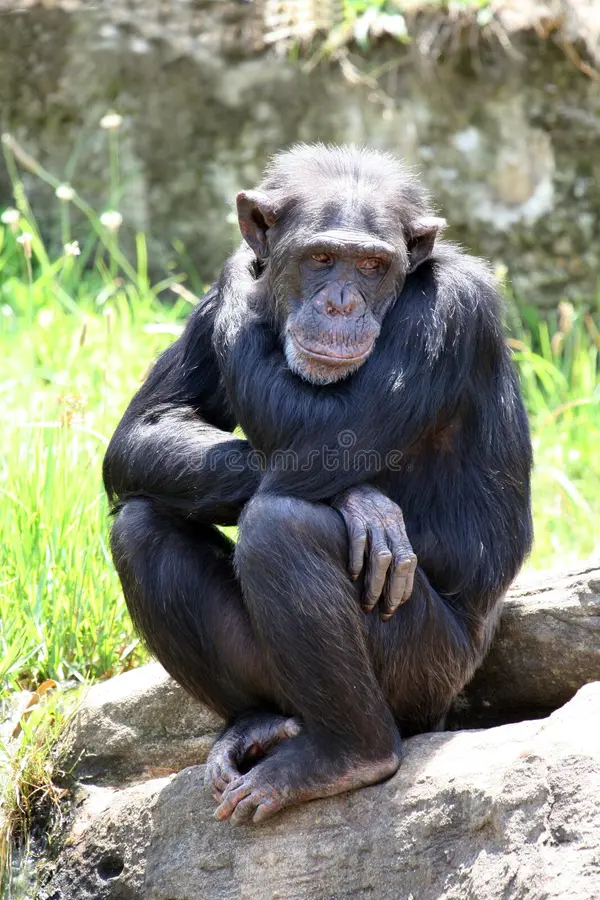
For years, residents of a small, unidentified village had reportedly become accustomed to an unusual presence near the edge of their community: a lone chimpanzee wandering between abandoned buildings, trees and quiet roads.
He did not belong to a visible group. He searched for food alone, slept wherever he could find shelter and rarely allowed anyone to approach him.
Villagers kept their distance.
Some believed he had been separated from his original chimpanzee community. Others knew only that he was physically powerful, unpredictable and sometimes aggressive when people moved too close.
To them, he was not an animal seeking companionship.
He was a danger that had to be watched from afar.
But behind the behavior that frightened residents may have been something they had never considered: isolation.
Chimpanzees are deeply social animals capable of forming enduring relationships, communicating through gestures and vocalizations, and responding differently to familiar individuals. Research has also documented consolation, cooperation and behavior suggestive of empathy among chimpanzees, although scientists warn against assuming that their emotional experiences are identical to those of humans.
According to the online story, the chimpanzee had spent years trusting no one.
Then a stray dog entered his life.
The dog that refused to leave
At first, the dog appeared to be just another stray wandering through the village.
He had no collar, no visible owner and no permanent place to sleep. Like the chimpanzee, he survived by searching for food and avoiding danger.
Residents began noticing that the dog repeatedly followed the chimpanzee.
The chimpanzee initially ignored him. He continued walking, searching for food and resting beneath trees as though the dog were not there.
But the dog kept returning.
Day after day, he followed at a cautious distance. He did not challenge the larger animal or attempt to take his food. He simply remained nearby.
Eventually, the chimpanzee stopped driving him away.
The distance between them gradually became smaller. Villagers reportedly saw them resting under the same trees, walking along the same roads and sharing pieces of food.
The animal that had rejected every attempt at human contact had accepted a companion from another species.
No one knew why the bond formed.
Perhaps the dog’s calm persistence made him appear harmless. Perhaps both animals recognized something familiar in the other’s isolation. Or perhaps their repeated encounters simply developed into trust.
Whatever the explanation, the relationship changed the chimpanzee’s behavior.
He was no longer always alone.
An unlikely friendship becomes a daily sight
The pair soon became a familiar sight around the village.
The dog walked beside the chimpanzee rather than behind him. When the chimpanzee stopped, the dog stopped. When one rested, the other remained nearby.
They did not communicate through a shared spoken language, but they appeared to develop a routine.
The dog reportedly showed no fear of the chimpanzee’s size. The chimpanzee, meanwhile, appeared increasingly protective of the smaller animal.
Residents who had once watched the chimpanzee only with suspicion began observing the friendship with curiosity.
The relationship challenged the story they had created about him.
They had assumed he was incapable of trusting anyone because he avoided people. But perhaps he had not rejected companionship itself. Perhaps he had simply never found a companion he considered safe.
Scientific experiments have found that chimpanzees can respond empathetically not only to members of their own species but, under some circumstances, to humans as well. That does not verify this particular story, but it shows that social responses crossing species boundaries are biologically possible.
For several months, the two animals reportedly remained inseparable.
Then one morning, the village awoke to screams.
The cries that terrified the neighborhood
The sound was loud, urgent and unmistakably distressed.
Residents recognized the chimpanzee’s calls, but they had never heard him vocalize in that way.
Some were afraid to leave their homes. They assumed that he had attacked a person or another animal.
Others cautiously looked outside, expecting to find destruction.
Instead, they saw the chimpanzee kneeling beside the road.
The dog was lying motionless near him.
The chimpanzee repeatedly looked toward the surrounding houses and cried out. He moved around his injured companion but refused to leave.
The animal people had feared was not threatening the village.
He was apparently asking it for help.
What the security footage allegedly revealed
According to the circulating account, nearby surveillance footage later showed what had happened before residents emerged.
The dog had suffered an unspecified injury and could no longer walk.
The source does not explain whether he had been struck by a vehicle, attacked by another animal or injured in some other way. It also does not provide the alleged recording for independent review.
The story claims that the chimpanzee discovered his friend on the ground and remained beside him.
When the dog failed to rise, the chimpanzee reportedly attempted to carry or drag him toward nearby homes. Once he reached an area where people might hear, he began calling repeatedly.
He could not explain the injury.
He could not ask for a veterinarian.
But his actions appeared purposeful: remain with the dog, move him closer to people and continue making noise until someone responded.
For residents, the scene transformed their understanding of the animal.
The chimpanzee they had considered dangerous was refusing to abandon a vulnerable companion.
The villagers finally approached
People were understandably cautious.
An adult chimpanzee can be extremely powerful, particularly when frightened or distressed. Approaching one beside an injured companion could carry serious risk.
But according to the story, the chimpanzee did not charge or threaten the residents who came forward.
Instead, he moved aside enough for them to reach the dog while remaining close.
The dog was transported to a veterinary clinic, where he reportedly received emergency treatment.
The source does not identify the clinic, attending veterinarian, diagnosis or treatment provided. It states only that the dog survived.
The chimpanzee could not accompany him.
For the first time since their friendship began, the two animals were separated.
Waiting for his friend to return
The online account gives few details about the period following the rescue, but its emotional focus is clear.
The chimpanzee reportedly remained near the places where he and the dog had spent time together. He searched familiar roads and appeared to wait for his companion.
The villagers now watched him differently.
Before the rescue, his movements had made them nervous. Afterward, the same behavior looked less like aggression and more like concern.
They had witnessed an animal remain beside an injured friend when leaving would have been easier.
He had not benefited from carrying the dog toward the houses. He had not received food or protection in exchange.
According to the story, he acted because his companion needed help.
Researchers remain careful when interpreting animal behavior as altruistic or compassionate. Chimpanzee prosocial behavior can depend on context, relationships and whether assistance has been requested. Still, controlled studies have shown that chimpanzees can help others and engage in cooperative or consoling behavior under certain conditions.
The reunion the village had hoped to see
Weeks later, the dog reportedly returned.
He was still recovering, but he could walk again.
The chimpanzee recognized him immediately.
The story describes the reunion without providing video or an identifiable witness, but claims that the two animals quickly resumed their familiar routine.
They walked together.
They rested near one another.
The dog had survived, and the friendship continued.
For the villagers, the reunion completed a transformation that had begun on the morning of the rescue.
The chimpanzee had not suddenly become a domesticated animal. He remained powerful, wild and deserving of distance and professional management.
But he was no longer viewed only through fear.
Residents had seen loyalty, social attachment and an apparent willingness to protect another living creature.
The danger of judging behavior without understanding its history
The emotional lesson of the story rests partly on the villagers’ original misunderstanding.
They interpreted the chimpanzee’s avoidance as hostility.
They saw his strength but not his isolation.
They noticed defensive behavior without knowing what experiences may have produced it.
Wild animals should always be treated cautiously, and dangerous behavior should never be romanticized. A chimpanzee’s apparent affection for a dog does not make it safe for humans to approach, keep or interact with freely.
At the same time, fear can prevent people from recognizing the complexity behind animal behavior.
Trauma, separation, confinement and unstable environments can influence how an animal responds to people and other animals. Chimpanzees also develop individual behavioral patterns; research has found relatively stable differences in consoling behavior among individuals over time.
The chimpanzee in the story may have been feared because residents knew only what he did—not what he had experienced.
The stray dog asked no questions about his past.
He simply stayed.
Two abandoned animals found what they were missing
The chimpanzee had reportedly lost his social group.
The dog had apparently lost or never known a human home.
Both survived alone before finding each other.
Their friendship was not based on being alike. They belonged to different species, communicated differently and had vastly different physical abilities.
Yet each provided something the other lacked.
The dog gave the chimpanzee steady companionship.
The chimpanzee gave the dog protection—and, at the moment of greatest danger, access to human help.
That is why the story has resonated so strongly online.
It transforms two animals commonly viewed through different stereotypes—a potentially dangerous ape and an unwanted stray—into companions defined by trust rather than fear.
What the story does—and does not—prove
The narrative does not prove that chimpanzees think about friendship exactly as humans do.
It does not demonstrate that wild chimpanzees and dogs should be encouraged to live together.
Most importantly, it does not provide enough identifiable evidence to establish that this specific rescue occurred as described.
There is no named village.
There are no names for either animal.
There is no date, wildlife authority, veterinary clinic, original CCTV recording or official statement.
Independent searches mainly reveal social-media posts repeating similar claims, including variants that place a chimpanzee carrying a dog to a veterinary clinic in Thailand. None of those reposts supplies verifiable documentation of the event.
There are genuine, documented examples of rescued chimpanzees forming close relationships with dogs at sanctuaries. Liberia Chimpanzee Rescue & Protection, for example, has published information and photographs showing its rescued dog Princess interacting with orphaned chimpanzees. That documented relationship is separate from the unnamed village story.
Why the message still matters
Even when treated as an unverified animal narrative, the story carries a meaningful theme.
Trust is often built slowly.
The dog did not immediately change the chimpanzee’s life through one dramatic gesture. He returned each day. He remained calm. He stayed close without forcing contact.
Eventually, the chimpanzee responded.
And when the dog was injured, that trust was tested.
The chimpanzee reportedly could have walked away. Instead, he stayed beside his friend, brought him toward people and continued calling until help arrived.
The rescue changed how the village saw him—but the dog had already seen something they had missed.
He had found a companion where everyone else saw only danger.
The friend who never left
The chimpanzee’s most important act was not his strength.
It was his refusal to use that strength only for himself.
He stayed beside an injured animal.
He carried him toward help.
He called until people listened.
And when the dog returned, their friendship continued as though the separation had never changed what they meant to one another.
Perhaps that is why the story is so powerful.
It suggests that the beings most misunderstood by the world may still possess an extraordinary ability to care.
The chimpanzee had spent years with no one to trust.
Then a stray dog chose him.
When that dog needed help, the chimpanzee made his own choice.
He did not run.
He did not leave.
He stayed with his only friend.