The Secret Hidden in a 1900 Family Photograph: Did a Little Girl’s Hand Gesture Carry a Message of Survival?
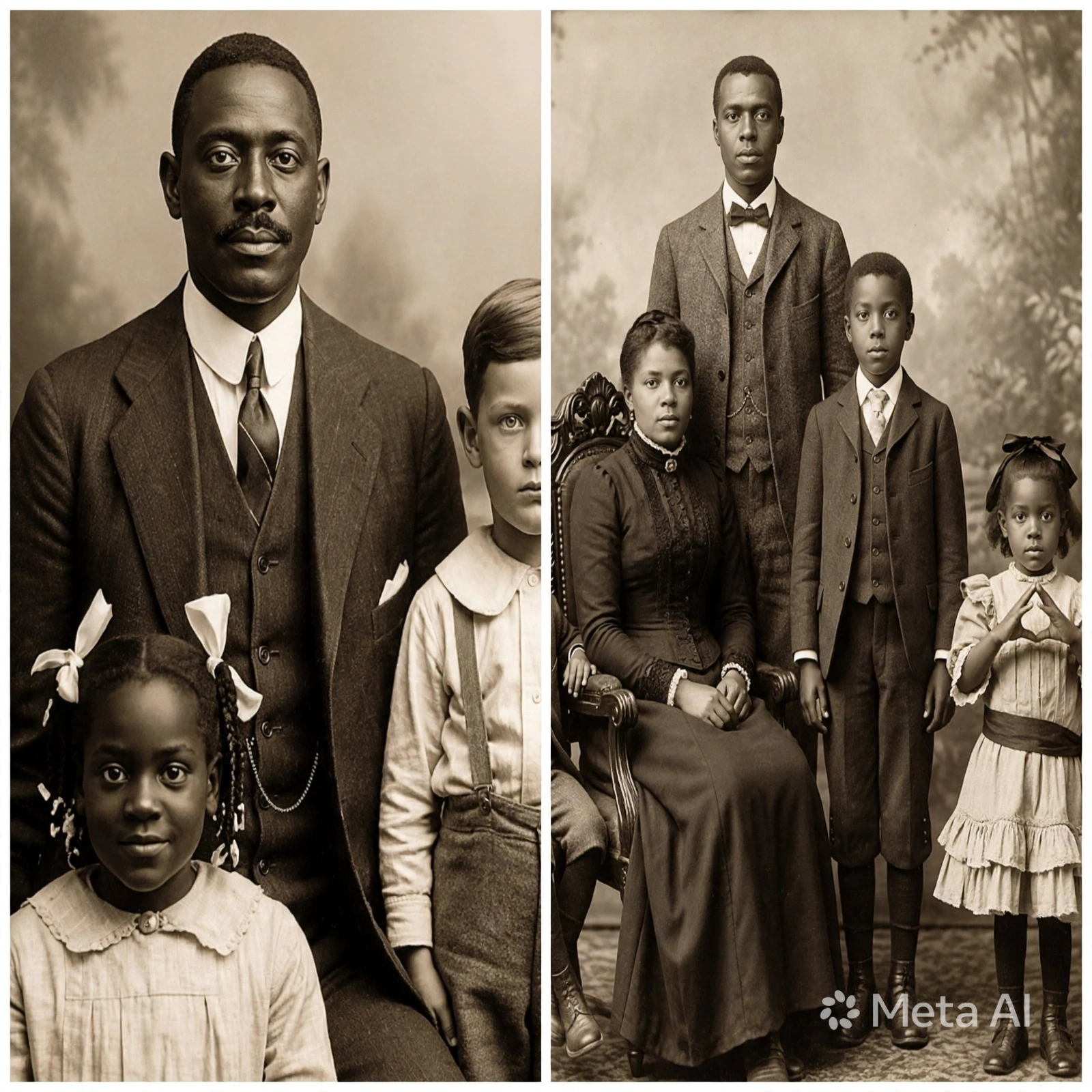
An ordinary portrait with one unsettling detail
For more than a century, the photograph appeared to be an ordinary family portrait from the beginning of the twentieth century.
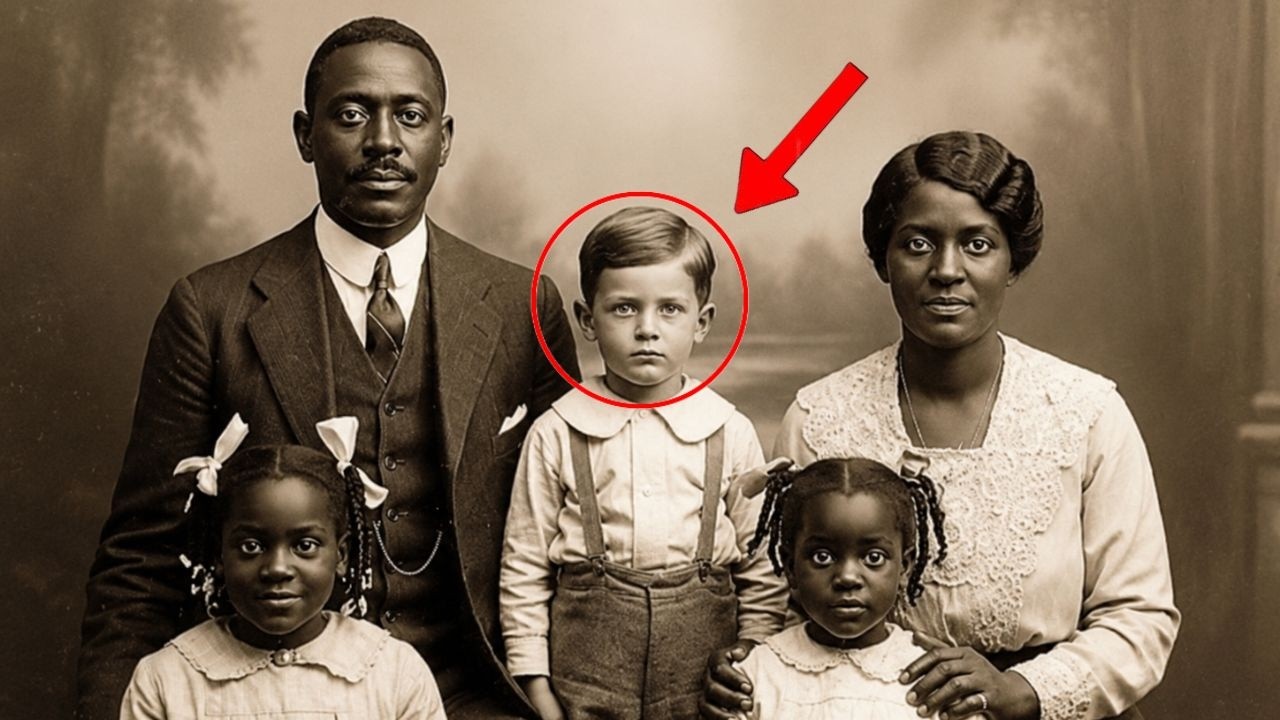
A Black father stood proudly in his finest suit. His wife sat beside him wearing a carefully arranged dress. Their four children had been positioned around them according to the formal traditions of early studio photography.
No one smiled—a common feature of portraits from the period.
Nothing about the image initially seemed unusual.
Then attention turned to the youngest child.
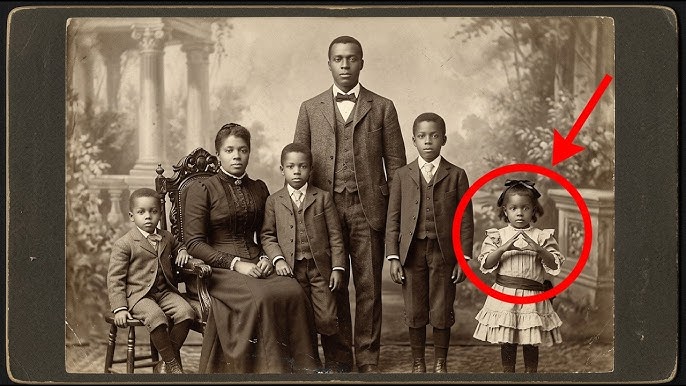
Standing beside her family in a white dress, the four-year-old girl held one hand against her chest. Her fingers appeared crossed and arranged in a position that some observers believed was too deliberate to be accidental.
Was she simply moving while the photograph was taken?
Had a parent instructed her to pose that way?
Or was the child displaying a message meant to be understood by someone outside the frame?
According to the online account surrounding the image, that small gesture may have been connected to a hidden network of communication used by Black families facing racial intimidation in the American South.
The interpretation remains unverified—but the history behind the theory reveals why even a seemingly peaceful family photograph could contain fear, secrecy and a plan for survival.
The family identified in the story
The people in the photograph are described in the circulating account as Isaac and Esther Coleman and their four children.
The portrait was reportedly taken around 1900 in Natchez, Mississippi, a city located along the Mississippi River with a long and complex racial history.
Isaac Coleman was said to be a landowner who had worked for years to establish economic independence for his family. The photograph presented the Colemans as respectable, successful and determined to preserve a record of what they had achieved.
Their clothing mattered.
For Black families living only a generation after emancipation, arranging a formal portrait could represent far more than personal pride. It documented family unity, dignity and progress in a society that often attempted to deny all three.
The image declared that the family existed.
They owned their identities.
They intended to be remembered.
But prosperity did not necessarily bring safety.
The source suggests that the Coleman family’s land and growing independence may also have placed them in danger. It portrays the portrait as having been taken during a period when Black families throughout the South faced segregation, voter suppression, intimidation and racial violence.
Freedom had not ended the danger
Slavery had formally ended decades before the photograph was reportedly taken, but freedom did not immediately produce equality or security.
The period following the Civil War brought major political and social changes. During Reconstruction, African Americans established schools, entered politics, created businesses and acquired property.
That progress was followed by a powerful backlash.
Across the South, discriminatory laws and violent intimidation were used to restrict Black political participation, enforce segregation and weaken the economic independence of African American communities.
A successful Black farmer or business owner could become a target precisely because that success challenged the racial hierarchy of the period.
Families might face threats, property destruction, manipulated debts or pressure to abandon land they had worked years to obtain.
Under those conditions, deciding whether to remain or relocate was rarely simple.
Leaving could provide safety, but it could also mean surrendering a home, farm, church community and network of relatives.
Staying could preserve everything a family had built—but expose its members to escalating danger.
The story surrounding the Coleman portrait places the family directly inside that dilemma.
The mystery of the little girl’s hand
The youngest child’s hand became the center of the mystery because everyone else in the photograph maintained a conventional pose.
Her fingers appeared to be positioned carefully across her chest.
Some observers interpreted the gesture as a coded warning or signal. According to that theory, it might have indicated that the family was preparing to leave, that danger was approaching or that assistance was needed.
However, the original article does not identify a historian, photographic archive or documented codebook connecting that precise hand position to a known survival network.
That distinction is essential.
Communities facing persecution have frequently used indirect communication, trusted messengers and shared symbols. But the existence of secret communication in history does not automatically prove that every unusual gesture in an old photograph was a code.
Children also moved during early photographic sessions. They touched their clothing, shifted their hands or struggled to maintain the stiff poses expected by adults.
The girl may have been following a parent’s instruction.
She may have been making a personal or religious gesture.
The position may have had no hidden meaning at all.
Yet the possibility of a message has continued to attract attention because it fits the larger reality of an era in which openly discussing threats or escape plans could make a family more vulnerable.
Survival depended on trusted networks
Before the Civil War, the Underground Railroad operated as a decentralized network of people who helped enslaved individuals seek freedom.
It was not a single organization with official offices or complete written records. Secrecy was necessary, and many acts of assistance were never documented.
After emancipation, the original mission of helping people escape slavery changed. However, Black churches, relatives, community leaders and neighborhood organizations continued helping families facing violence, displacement and injustice.
Information often traveled through personal relationships.
A minister could provide the name of a trusted person in another city.
A railway worker could explain a safer route.
A relative who had already moved north might send money or instructions.
A family might leave quietly to avoid alerting anyone who wanted to prevent the move.
The Smithsonian has cautioned that some popular stories about formal Underground Railroad symbol systems—particularly widely repeated quilt-code legends—lack strong historical documentation. That caution applies equally to interpreting an unexplained hand gesture: an emotionally compelling theory should not be treated as proven evidence without a reliable record.
Still, the absence of a universal code does not mean secretive communication never occurred. It means such communication was often local, informal and difficult for later historians to reconstruct.
Did children carry hidden messages?
The account surrounding the photograph suggests that children sometimes played a role in community communication because adults often underestimated them.
A child could move between houses without attracting the same suspicion as an unfamiliar adult.
Children could memorize names, repeat short instructions or carry an object whose meaning was known only to the recipient.
Whether the four-year-old Coleman girl understood her alleged gesture is another unanswered question.
A parent could have positioned her hand without explaining why.
She might have been told simply to hold her fingers in a certain way while the camera captured the image.
Under that interpretation, the child was not necessarily an active messenger. She was the safest place to hide the message.
But no surviving testimony has been provided to confirm that this happened.
The gesture remains an interpretation—not a historical conclusion.
The family reportedly left Mississippi
According to the story, researchers later found indications that the Coleman family appeared in records outside Mississippi.
The account suggests they relocated north, leaving behind the land and community they had spent years building.
Their departure is presented as evidence that the concerns reflected in the photograph may have been real.
Yet the article does not reproduce census records, property documents, railway records or family letters connecting the people in the photograph to a verified migration route.
The specific journey therefore remains uncertain.
The broader pattern, however, is historically well established.
African Americans began moving out of the South in significant numbers before the period generally associated with the Great Migration. The Library of Congress notes that migration increased during the late nineteenth and early twentieth centuries as Black families searched for economic opportunity, political rights and relief from oppressive conditions.
Beginning around 1915, the movement expanded dramatically. Millions eventually relocated from primarily rural Southern communities to cities in the North and West.
For many families, migration was not simply a search for better employment.
It was a survival decision.
What leaving would have cost
A family such as the Colemans could not simply pack a few bags and begin again without consequences.
Land represented security, inheritance and independence.
A farm could provide food, income and a place for future generations. Giving it up meant losing something that may have taken decades of sacrifice to obtain.
Leaving also meant separating from relatives, churches and neighbors who formed the family’s support system.
The destination offered no guarantee of equality. Northern cities also contained housing discrimination, racial hostility and unequal employment conditions.
But migration could provide distance from immediate threats and access to new possibilities.
Families sometimes left gradually. One member traveled first, found work and sent money back. Others followed when a home or job became available.
Some changed addresses without publicly announcing their plans.
Others avoided recording details that could expose relatives who remained behind.
A sudden disappearance from local records was not necessarily evidence of mystery.
Sometimes it was evidence of caution.
Why the photograph matters even without a proven code
The historical value of the portrait does not depend entirely on whether the girl’s fingers formed a secret signal.
The image already preserves something meaningful.
It shows a Black family standing together at the start of a century that would bring profound change.
The father’s suit, the mother’s dress and the children’s careful arrangement reflect the family’s desire to present themselves with dignity.
The photograph may have been intended for relatives, displayed inside the home or carried during a future move.
For families whose histories were frequently excluded from official records, a portrait could become evidence of identity and continuity.
It could preserve faces that otherwise might disappear from written history.
The picture says that this family was here.
They had relationships, aspirations and a future they were trying to protect.
The mystery of the hand gesture adds another possibility: perhaps the photograph was intended not only to preserve memory, but also to communicate.
The danger of creating certainty from an image
Old photographs invite interpretation because the people inside them can no longer explain what they were thinking.
Viewers study clothing, posture, facial expressions and background objects in search of clues.
Sometimes those clues lead to genuine discoveries. A photographer’s studio mark can identify a location. A military badge can establish a period. A handwritten name can reconnect a portrait with descendants.
But images can also encourage modern observers to create narratives unsupported by evidence.
A solemn expression may reflect the photographic conventions of the time rather than sadness.
A damaged section of an image may appear to contain an object that was never there.
An unusual hand position may look intentional simply because viewers have already been told that a secret exists.
Responsible historical interpretation requires more than a compelling visual detail.
Researchers would need the original photograph, its ownership history, the photographer’s records, reliable identification of the family and documents tracing what happened afterward.
None of those materials is presented in the source article.
A story that reflects a genuine history
Although the specific Coleman narrative is unverified, it resonates because it is built around historical experiences that were real for countless families.
Black Americans acquired property and built businesses after emancipation.
Many faced systematic efforts to restrict their progress.
Families relied on churches, relatives and trusted community networks when formal institutions failed to protect them.
Large numbers left the South in search of greater safety and opportunity.
Some family histories became fragmented during those moves.
Names changed.
Documents disappeared.
Stories were passed orally until later generations no longer knew which details were literal and which had become family legend.
The Coleman photograph, whether authentic as described or shaped into a modern historical narrative, reflects that larger struggle between preservation and erasure.
The girl whose gesture survived
The youngest child could not have known that people more than a century later might study the position of her fingers.
She may have been nervous, tired or impatient.
She may have been following an instruction.
She may have carried a message that was perfectly clear to someone living in 1900 but impossible for modern viewers to recover.
That uncertainty is what gives the image its power.
The photograph offers no final answer.
It leaves viewers suspended between an ordinary family moment and the possibility of a carefully concealed warning.
Behind the child stand her parents and siblings, dressed for the future they hoped to build.
Around them was a society in which dignity, land and success did not guarantee protection.
The family’s formal clothing showed achievement.
Their serious expressions showed determination.
And the smallest hand in the photograph may—or may not—have revealed the danger they were preparing to survive.
What should readers believe?
The most responsible conclusion is not that researchers definitively discovered a forgotten survival code.
There is not enough evidence for that claim.
The better conclusion is that the photograph encourages us to look more carefully at the lives preserved inside historical images.
Even when a mysterious gesture cannot be decoded, the people in the photograph should not be reduced to a puzzle.
They were part of a generation living through the unfinished consequences of slavery.
They built homes, raised children, acquired property and made difficult decisions about when to remain and when to leave.
Their survival depended not on a single dramatic symbol, but on family, memory, courage and community.
Perhaps the little girl’s hand contained a secret.
Perhaps it did not.
But the world surrounding her family was filled with dangers that often required discretion, cooperation and extraordinary resilience.
That history is not a theory hidden inside the photograph.
It is the reality standing directly in front of the camera.