When Her Son’s Communication Tablet Died, This Mom Turned Her Own Arm Into a Voice He Could Always Reach
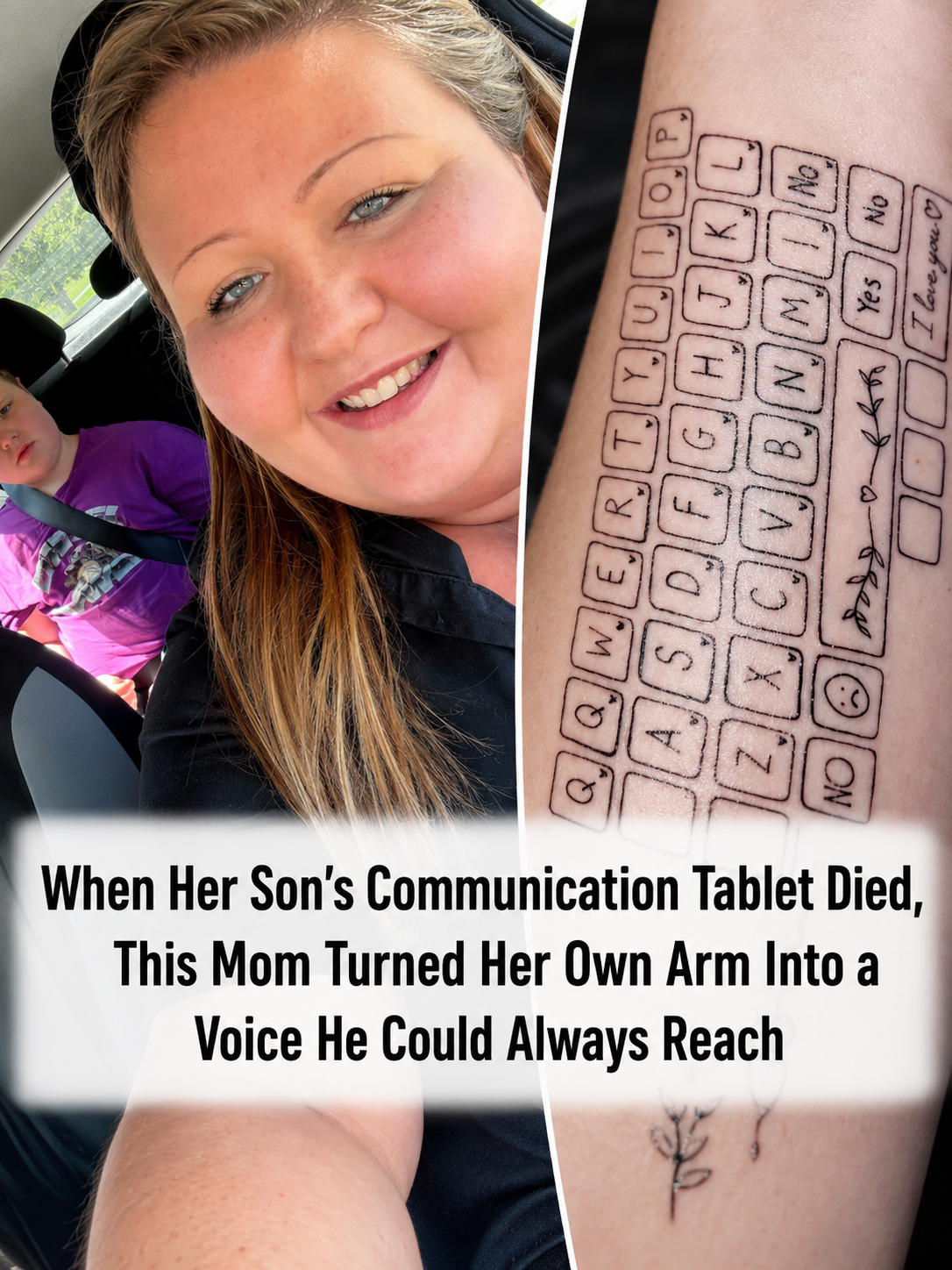
At a restaurant, Jessica Fletcher suddenly faced a problem that many families who rely on technology understand all too well: the device her son used to communicate had stopped working.
For Jessica’s 11-year-old son, Hunter, however, a dead battery meant far more than an inconvenience.
Hunter is autistic and nonverbal. He typically communicates through an Augmentative and Alternative Communication, or AAC, device—a tablet that lets him choose words and symbols to express what he wants to say. When its battery died during their restaurant visit, his usual method of communicating disappeared with it.
Jessica improvised.
She wrote the alphabet on a piece of paper, expecting Hunter to point to letters and spell out what he wanted to eat.
But Hunter had another idea.
He turned the paper over and drew something that surprised his mother: a keyboard, recreated from memory. Then, using his finger as though he were typing on an actual device, he tapped out his order.
For Jessica, that small restaurant moment revealed a much larger possibility.
She realized that while technology had opened important communication doors for her son, Hunter needed an option that could never run out of battery power.
So she decided to put one permanently within his reach.
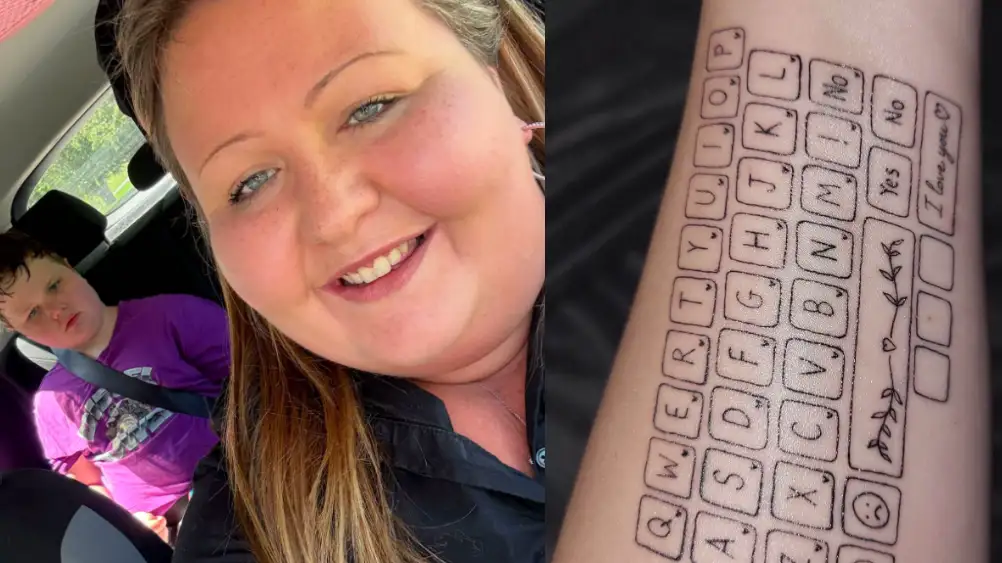
Jessica worked with a tattoo artist to create a keyboard across her forearm. The design contains letters along with simple emotional options, including happy and sad faces and a button Hunter can use to communicate affection. Whenever he is beside his mother, her arm can now become a communication board.
The tattoo offers another benefit Jessica had not overlooked.
AAC devices can speak selected words aloud, which is useful in many situations but can also make communication public. By tapping letters directly on Jessica’s arm, Hunter can communicate more quietly when he chooses.
For his mother, the tattoo therefore represents more than a backup plan. It is another way of giving Hunter control over how he expresses himself.
The idea quickly reached far beyond their family.
A video showing Hunter using the tattoo attracted millions of views and more than 1.5 million likes. Parents of autistic and nonspeaking children began contacting Jessica, along with nurses, physicians and first responders interested in having similar communication tools available. Tattoo artists also reached out offering to create the design for parents of nonspeaking children.
Jessica later partnered with a clothing company to put keyboards along shirt sleeves, allowing people to use the same concept without getting a permanent tattoo.
Autism advocate Maddy Dever, who chairs the National Autism Network and is a parent to four autistic young adults, emphasized the broader importance of finding communication methods that work for each individual. When nonspeaking children are given the right avenue to express themselves, she explained, families can discover abilities and intelligence that others may never have recognized.
That idea is ultimately what transformed Jessica’s tattoo from an unusual piece of body art into something much more meaningful.
It began because a tablet battery died.
Hunter responded by drawing his own solution.
His mother then turned that solution into something he could carry with him whenever he held her arm.
Technology may fail, batteries may run out and devices may sometimes be unavailable. But for Hunter, one communication tool is now permanently close by—and it happens to belong to the person determined to make sure he always has a way to be heard.