🔥 “If We Had Waited Any Longer, We Would Have Died” — Canadian First Nation Escapes Wildfire Just Moments Before Flames Engulf Their Community
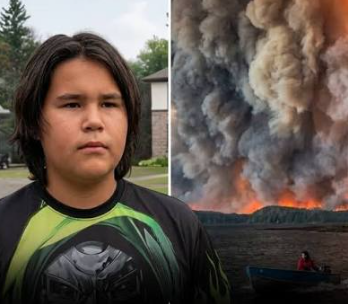
What began as an ordinary summer day quickly became a desperate race for survival for the residents of Namaygoosisagagun First Nation, also known as Collins First Nation, in northwestern Ontario.
Just hours after being told there was no immediate danger from a nearby wildfire, the small Indigenous community found itself fleeing as towering flames and thick smoke rapidly closed in.
For many, the escape came only moments before their homes disappeared beneath the fire.
A Wall of Smoke Appears
On July 13, Miiyah Paavola looked outside her home and noticed an enormous wall of smoke approaching.
Although the smoke seemed alarmingly close, community leaders say they had earlier been informed by Ontario’s Ministry of Natural Resources that the wildfire did not pose an immediate threat.
That reassurance would soon be overtaken by events.
Within hours, evacuation became the only option.
“There wasn’t really time to think,” Paavola recalled. “Everything happened so quickly.”
Escaping Across the Lake
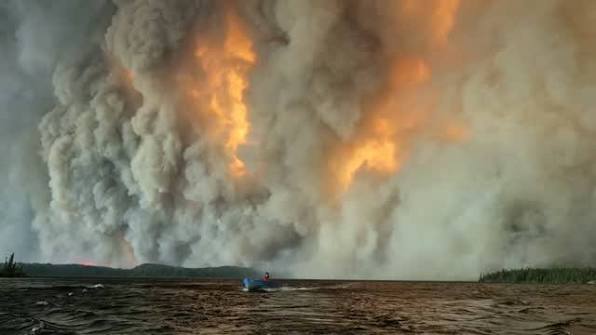
With almost no time to prepare, Paavola grabbed a wet towel before climbing into a small aluminum boat.
She shared the cramped vessel with five other people, three dogs, and a cat.
For Collins First Nation, evacuation options are limited. The remote community has no road access, relying instead on a railway line and Collins Lake for transportation.
Only after their boat pulled away from shore did Paavola fully understand how close disaster had come.
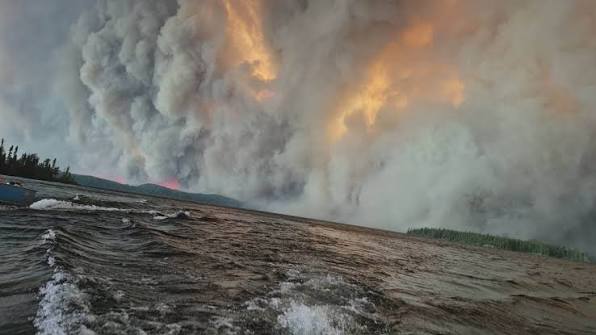
“The sky was orange and gray, and everything became so dark,” she said.
As the boat moved farther across the lake, she watched flames reach the shoreline while an enormous wall of smoke followed behind.
“If we had waited any longer,” she said, “we would have been dead.”
A Dangerous Journey to Safety
The evacuation itself proved almost as frightening as the wildfire.
Residents crowded into aging 12- and 14-foot aluminum boats powered by decades-old motors.
The crossing of Collins Lake took roughly forty minutes under difficult conditions.
Strong waves repeatedly rocked the small boats, and shortly after departing, the vessel carrying Paavola struck a submerged rock and nearly overturned.
Despite the terrifying journey, everyone aboard managed to reach safety.
Only about 25 of the community’s approximately 60 residents happened to be in Collins when the wildfire arrived.
Community members believe that circumstance likely prevented an even greater tragedy.
Many families, however, were forced to leave beloved pets behind during the rushed evacuation.
A Mother’s Worst Fear
Miiyah’s mother, Chief Helen Paavola, was away from the community when the fire erupted.
Earlier that day, she had also been told that there was no immediate threat and that the visible smoke was coming from a fire located farther away.
Then communication with her community suddenly stopped.
Unable to reach her daughter or her two sons, she feared the worst.
“All I could think was that my children were gone,” she recalled.
“I thought my community was gone.”
Only after learning that everyone had successfully escaped did relief replace fear.
But there was little left to return to.
Like every other home in Collins First Nation, her own house was completely destroyed.
An Entire Community Lost
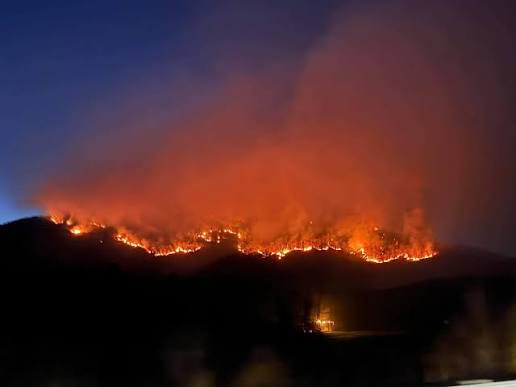
The wildfire reduced nearly the entire community to ashes.
According to Linda Debassige, Grand Council Chief of the Anishinabek Nation, the destruction included more than 30 homes, along with the community’s administration office, school, community center, storage buildings, vehicles, and other essential equipment.
She believes the residents’ decision to evacuate immediately saved countless lives.
“If they had waited for an emergency response,” she said, “we would now be searching for the bodies of children, elders, women, and men.”
Questions About Emergency Preparedness
Following the disaster, Ontario officials acknowledged that the wildfire ignited unusually close to Collins First Nation, leaving responders with very little time to react.
The provincial government has said it will review its response to the emergency.
Community leaders argue that stronger preventative measures could have reduced the damage.
They note that Collins had already faced wildfire threats only weeks earlier and say additional fire breaks and fuel reduction efforts might have provided greater protection.
Meanwhile, the Anishinabek Nation says it has been covering hotel accommodations, meals, and emergency supplies for evacuated residents staying in Thunder Bay while awaiting broader government assistance.
Wildfires Continue Across Canada
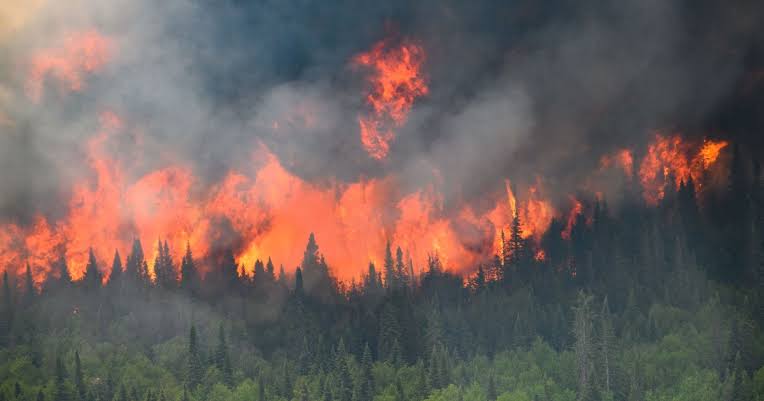
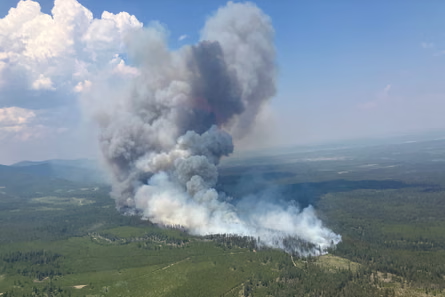
The destruction in Collins comes amid one of Canada’s most active wildfire seasons.
Hundreds of wildfires remain burning across the country, including more than 160 active fires in Ontario alone.
Several communities throughout northwestern Ontario remain under evacuation orders or emergency alerts as firefighters continue battling rapidly changing conditions.
The fires are also affecting communities hundreds of miles away.
Smoke has spread across much of Ontario, reducing visibility and triggering air quality warnings, including in Toronto, where hazy orange skies and the smell of smoke have blanketed the city.
Smoke Creates Health Risks Far Beyond the Fire
The impacts extend well beyond communities directly threatened by flames.
For residents with chronic respiratory illnesses, deteriorating air quality has made everyday activities increasingly difficult.
Scott Bailey, who lives in Belleville and has chronic obstructive pulmonary disease (COPD), says breathing has become significantly more challenging as wildfire smoke fills the atmosphere.
“It’s like breathing through a straw,” he explained.
Simple tasks such as grocery shopping now require careful planning, while windows remain closed and air purifiers run continuously inside his home.
Hope Beyond the Ashes
Although Collins First Nation has lost nearly everything, community leaders remain determined to rebuild.
Chief Helen Paavola acknowledges the deep grief shared by residents as they mourn their homes, belongings, and the life they once knew.
“There is despair. There is confusion. There is hurt. There is mourning,” she said.
“But there’s hope.”
Despite the devastation, she says the future has never been in doubt.
“We are going home,” she said.
“We’re going to rebuild, and we are going home.”
Source: edition.cnn