Sweden Reconsiders Digital-First Education and Returns to Books and Handwriting
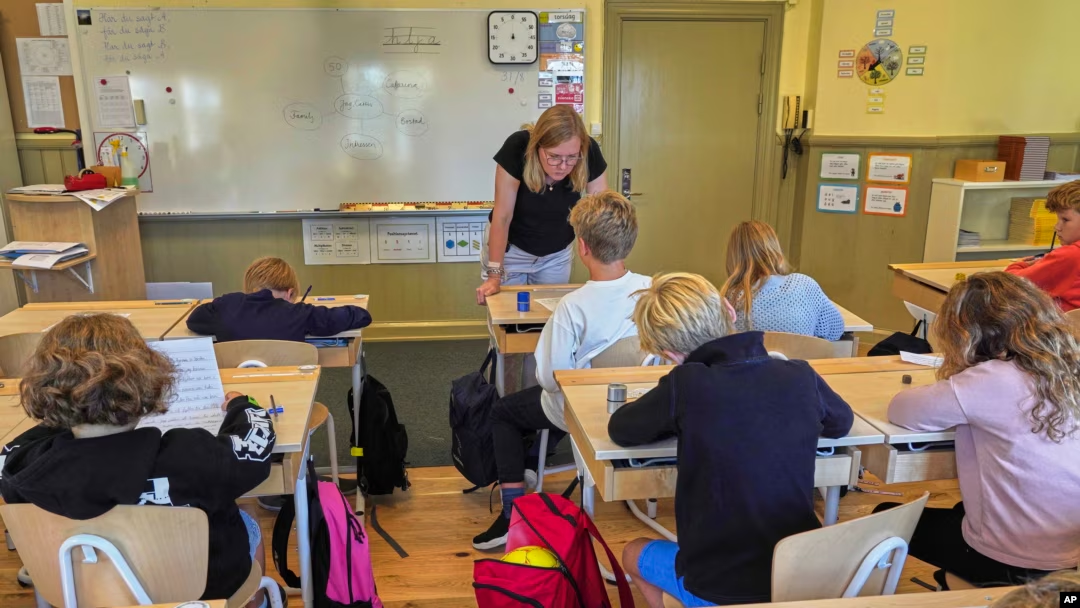
In a notable reversal of education policy, Sweden is scaling back its highly digitized approach to learning and reintroducing traditional tools such as printed textbooks, handwriting practice, and structured reading time. After nearly fifteen years at the forefront of classroom digitalization, the Swedish government is now investing more than €100 million to ensure that every student has access to physical books.
The shift reflects growing concerns that the country’s early and enthusiastic embrace of tablets and laptops may have come at a cost. Sweden was once viewed as a global model for technology-driven education, replacing textbooks with screens and encouraging digital learning from an early age. However, policymakers and researchers now argue that foundational skills may have been weakened in the process.
The policy change has been strongly championed by Lotta Edholm, Sweden’s Minister for Schools, who has criticized what she describes as an “all-out embrace” of digital tools in classrooms. While Swedish students continue to perform above the European average overall, international assessments have raised warning signs. Data from the Progress in International Reading Literacy Study (PIRLS) showed a decline in reading comprehension among Swedish fourth-grade students between 2016 and 2021.
Cognitive scientists have also weighed in on the issue. Experts from the Karolinska Institute and other research bodies have warned that excessive screen use can negatively affect concentration, attention span, and deep information processing. Studies suggest that reading on paper and writing by hand activate cognitive pathways that are less effectively engaged when using digital devices, particularly for young learners.
As a result, Sweden’s new education strategy places special emphasis on the early formative years. The government plans to completely phase out digital learning for children under the age of six, arguing that young minds benefit most from tactile experiences such as holding books, writing with pens, and turning physical pages. These activities are seen as essential for developing memory, fine motor skills, and sustained focus.
Schools across the country are now reintroducing quiet reading hours, manual writing exercises, and structured literacy programs. While digital tools are not being banned outright, their role is being redefined. Technology is expected to support learning rather than replace traditional teaching methods, especially in core subjects like reading and writing.
Sweden’s recalibration has drawn international attention, as many countries continue to expand digital learning in classrooms. By acknowledging the limits of hyper-digitalization, Sweden offers a case study in balance—suggesting that innovation in education does not necessarily mean abandoning proven methods.
As debates over screen time and childhood development intensify worldwide, Sweden’s return to basics highlights a growing recognition that progress in education may lie not in more technology, but in knowing when—and how—to use it.