Phil Collins’ Five Children Were Called to Say Goodbye—Then He Was Given One More Chance to Be Their Father

In early 2024, Phil Collins was lying unconscious in a Swiss hospital while his five children gathered around him.
His kidneys were failing. Other organs were beginning to shut down. Doctors could not promise that the singer whose voice had filled stadiums and American radio for decades would wake again.
Collins later said his family faced discussions about whether he should remain on life support. Friends and relatives came believing they might be saying goodbye, though he remembers little of those visits.
Among them was his daughter Lily Collins, sitting beside the father whose long absences had once caused deep pain between them.
The reversal was painful and complete.
For much of his adult life, Collins had been the one leaving—departing for tours, recording sessions and another performance before thousands of strangers. Now his children had crossed distances to reach him, not to watch him sing, but to prepare for the possibility that he was dying.
He survived.
The recovery did not restore his ability to drum or return him to the physical strength of his peak years. What it offered was quieter and perhaps more important: another chance to remain present for the family that fame had repeatedly pulled him away from.
The Voice That Seemed to Be Everywhere
For listeners who came of age in the 1980s and 1990s, Phil Collins was nearly impossible to avoid.
He had joined Genesis as its drummer in 1970, then became the band’s lead singer after Peter Gabriel’s departure. Under Collins’ voice, Genesis evolved from progressive rock into one of the world’s biggest stadium acts.
At the same time, he built an enormous solo career.
His 1981 debut album, Face Value, introduced “In the Air Tonight,” a song whose restrained tension and explosive drum entrance became one of the most recognizable moments in popular music. More hits followed: “Against All Odds,” “One More Night,” “Sussudio,” “Take Me Home,” “Another Day in Paradise” and “You Can’t Hurry Love.”
Collins was singing with Genesis, releasing solo albums, producing other artists, writing for films and appearing at major global events. He won Grammys, an Academy Award and a place among the era’s most commercially successful musicians.
His music could sound wounded, joyful, bitter or reassuring. The vulnerable voice encouraged listeners to feel that they knew the person behind it.
His children experienced a different version of the same success.
To the public, Collins seemed permanently present.
At home, he was often gone.
Fame Built a Career—and Distance
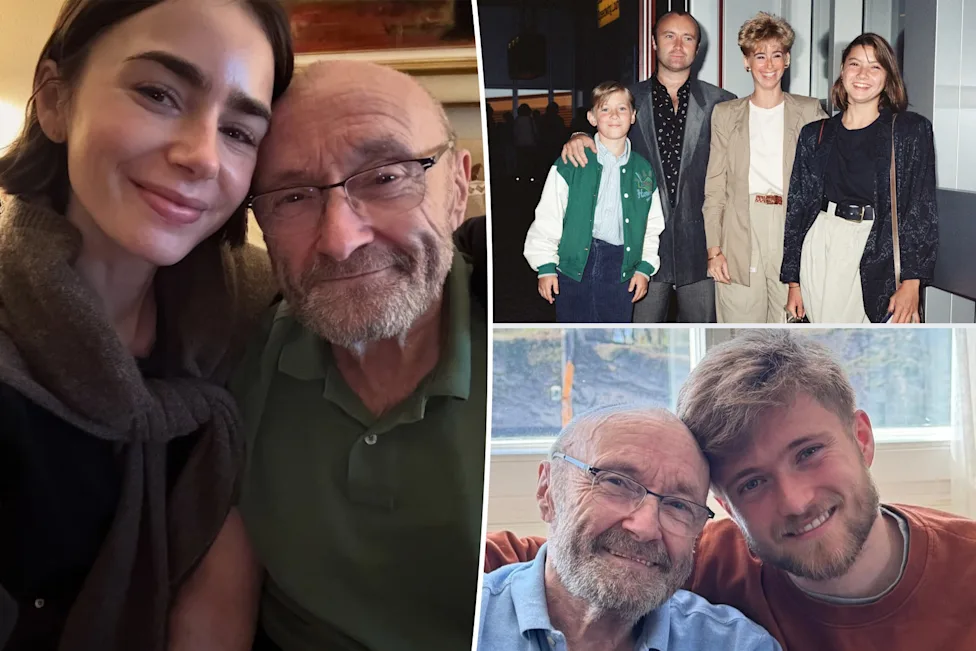
Collins has five children from three marriages.
He adopted Joely, the daughter of his first wife, Andrea Bertorelli, and the couple also had a son, Simon. His second marriage, to Jill Tavelman, produced daughter Lily. With his third wife, Orianne Cevey, he had two sons, Nicholas and Mathew.
The marriages ended, while touring and work repeatedly carried Collins between countries.
His personal failures frequently entered his songwriting, which helped create some of his most successful music. But transforming pain into hits did not repair the damage within the relationships themselves.
Lily later wrote openly about growing up with anger and insecurity connected to her father’s absence. She forgave him in her 2017 memoir, but forgiveness did not change the years when she had wanted more of him than occasional visits between professional commitments.
Collins has acknowledged his shortcomings as a husband and father. In later life, he appeared increasingly aware that musical success had required choices other people were forced to absorb.
There is no simple equation between fame and neglect. Touring was his work, and several of his children later built careers connected to entertainment. Nicholas even became his father’s drummer when Collins could no longer play.
But the family history remained complicated.
The man who sang about heartbreak to millions had created some of it inside his own home.
When the Drummer’s Body Began to Fail
Collins’ physical decline developed over years.
A spinal injury and subsequent surgeries caused nerve damage that affected his hands and feet. He gradually lost the ability to play drums, the instrument that had shaped his identity since childhood.
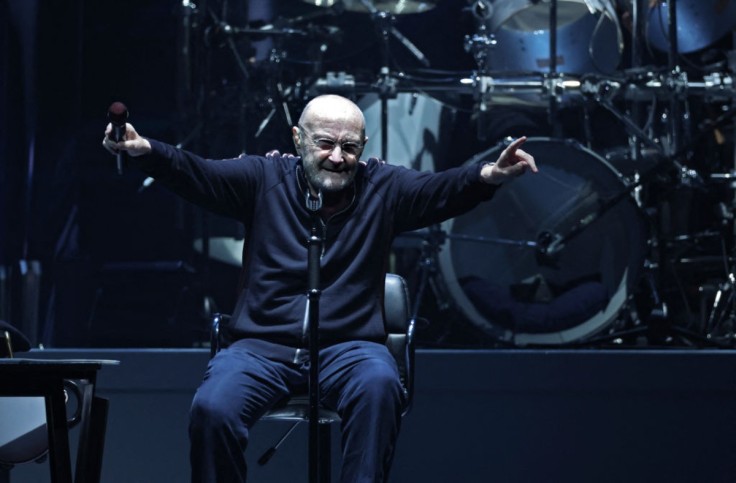
He also developed mobility problems and began using a cane. During Genesis’ final tour, he performed while seated, with Nicholas behind the drum kit.
The image was difficult for longtime fans to process.
Collins had once attacked the drums with compact power, singing while playing patterns that demanded extraordinary coordination. By the end of Genesis’ touring life, he could no longer stand through a full show.
The band played its final concert in London in March 2022.
Retirement did not bring immediate peace.
Collins had already described periods of depression and alcohol misuse after his major touring years slowed. Without the schedule that had structured his life, drinking became a way to fill loneliness and emotional emptiness.
In a recent interview, he described a severe relapse that included drinking wine in the morning. What may have begun as an attempt to escape isolation became another threat to a body already weakened by years of illness and surgery.
By November 2023, his condition required hospitalization.
He was discharged shortly before Christmas, only to be rushed back into intensive care weeks later.
This time, the crisis deepened.
The Call No Family Wants to Receive
Collins spent roughly seven months in the hospital.
By the spring of 2024, he was largely unconscious as his kidneys and other organs failed. His longtime manager contacted his five children and told them to come.
They arrived understanding that they might not see him alive again.
Collins later said he had no idea what was happening around him. Other people carried the fear while he remained unaware of how close his life had come to ending.
His children were forced to confront questions about life support—decisions that reverse the natural order of a family.
A parent normally makes medical choices for a child.
Now the children of Phil Collins had to consider whether the machines beside their father were preserving a future or merely delaying his death.
The moment carried the full weight of their shared history.
There were strained relationships, missed years and memories of a father who had often belonged to the world. Yet when the call came, all five children gathered.
They did not arrive as members of a famous musical family.
They arrived as children who still wanted more time.

Surviving Did Not Mean Returning to the Stage
Collins eventually recovered enough to leave the hospital.
He has described himself as extraordinarily fortunate to have survived. He also said he has not consumed alcohol since the crisis.
That sobriety is not being presented as the beginning of a dramatic concert comeback.
Collins still lives with serious physical limitations. He requires extensive assistance, cannot play drums as he once did and has spoken realistically about the barriers to performing again.
For a man whose life was built around movement, rhythm and work, that reality carries its own grief.
He received his first drum kit as a small child. The instrument became his path into Genesis, his signature as a musician and eventually one of the most famous sounds in popular music.
Losing that ability meant losing more than a job.
It meant watching his body refuse the language through which he had always expressed himself.
But survival gave him something the stage could not.
It gave him time.
The Children Who Had Learned to Live Without Him
The relationships between Collins and his children are not identical.
Joely became an actress and producer. Simon followed his father into music. Lily built an international acting career. Nicholas became a drummer and performed beside Collins during his final tours, while Mathew pursued professional soccer.
Each had to form an identity beneath one of the most famous surnames in music.
For years, the public largely understood them through their connection to him. At the hospital, the relationship moved in the opposite direction.
Collins depended on them.
Lily reportedly sat beside him in tears, grateful for moments she had once feared would never come. Her words captured how a near-death experience can compress decades of conflict into one urgent desire: Do not let this be the last conversation.
Their reconciliation should not be turned into a perfect ending. Family wounds are not automatically erased by illness, and physical survival does not guarantee emotional repair.
What the crisis created was an opening.
Collins could no longer return to the past and become the father he might have been when the children were young. He could only decide what kind of father remained possible now.

The Hardest Applause to Earn
Phil Collins spent decades receiving proof that the world wanted him.
Albums sold by the millions. Stadium crowds sang his lyrics back to him. His drum sound became instantly recognizable, and his voice followed listeners through weddings, divorces, long drives and lonely nights.
None of that could answer the question waiting in the hospital.
Had he been present enough for the people who knew him without the songs?
The health crisis forced Collins to confront a life in which professional achievement and personal regret existed side by side. The same work ethic that created an extraordinary career also helped keep him away from home. When the work ended, alcohol filled part of the space it left behind.
His children could not rescue the drummer he had been.
They could help preserve the father he still had time to become.
That is the deeper meaning of Collins’ survival. It is not a story about a star defeating age and returning triumphantly beneath concert lights.
It is about a man waking after his family had prepared to lose him.
The voice that once seemed to belong to everyone was given another chance to speak privately—to apologize, listen and remain.
For Phil Collins, the most important encore may not happen onstage.
It may be the time he now spends with the five people who came to his bedside believing there would be no more.