New York Chose a Very Specific Day to Honor Dolly Parton — Fans Will Understand the Date Immediately
New York could have chosen Dolly Parton’s birthday.
It could have chosen the anniversary of one of her biggest songs, the opening of one of her movies or another date associated with her extraordinary career.
Instead, Manhattan chose Sept. 25, 2026.
At first glance, the date does not seem particularly important.
Then write it the American way:
9/25.
Or, with a little Dolly Parton imagination: “9 to 5.”
That is exactly the joke.
Manhattan Borough President Brad Hoylman-Sigal officially proclaimed Sept. 25, 2026, Dolly Parton Appreciation Day in the Borough of Manhattan, deliberately choosing the date as a playful reference to Parton’s beloved 1980 workplace anthem and movie, 9 to 5.
But the proclamation is not merely celebrating one famous song.
It also recognizes the much larger legacy Dolly left behind — including a children’s literacy program that has now put more than 300 million free books into young readers’ hands around the world.
The Date Was Absolutely Intentional
Hoylman-Sigal made the connection explicit when announcing the proclamation on Sept. 2.
“I am officially declaring 9/25 (‘9 to 5’) as Dolly Parton Appreciation Day in the Borough of Manhattan,” he wrote.
For longtime fans, it is difficult to imagine a more fitting calendar joke.
“9 to 5,” written and performed by Dolly for the 1980 movie of the same name, became one of the defining songs of her career.
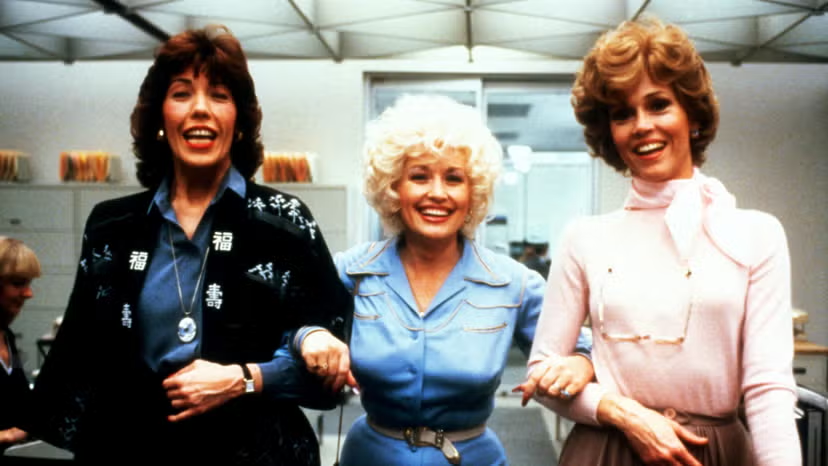
The movie starred Dolly alongside Jane Fonda and Lily Tomlin as three women navigating a deeply unequal workplace and fantasizing about turning the tables on their sexist boss.
For Dolly, it was also her feature-film acting debut.
Then the title song became a phenomenon of its own.
The combination turned the phrase “9 to 5” into something inseparable from Dolly Parton.
Forty-six years later, Manhattan found a way to turn it into a date.
But This Isn’t a New York City-Wide Holiday
There is one important distinction.
The official proclamation came from the Manhattan Borough President.
So Dolly Parton Appreciation Day on Sept. 25 is specifically an official recognition in the Borough of Manhattan, not a newly created federal holiday or a statewide New York holiday.
That has not stopped the tribute from becoming part of a much larger wave of Dolly-related recognition across New York.
Following her death on Aug. 25 at age 80, the Empire State Building and other landmarks were illuminated in pink.
The IFC Center temporarily used “IFC Will Always Love You” on its marquee.
Someone even transformed signage at the Fulton Street subway station into a temporary “Dolly Parton Street” tribute.
In other words, Manhattan’s proclamation formalized something New Yorkers had already begun doing themselves.
Remembering Dolly loudly.
And, appropriately, with a little humor.
The Proclamation Goes Far Beyond Her Music
Hoylman-Sigal’s official statement praised Dolly as one of the “defining American icons of our lifetime.”
But he also emphasized that her cultural legacy cannot be measured only through record sales, movies or awards.
He specifically highlighted Dolly’s devotion to literacy and public health.
The centerpiece of that philanthropic legacy is the Imagination Library.
According to the proclamation, the program has distributed more than 300 million free books and reached approximately 3 million children around the world.
That is an extraordinary second career for someone who already had one of the most successful music careers in American history.
Dolly founded the Imagination Library in 1995 through the Dollywood Foundation.
The original idea was simple: mail books directly to young children so families could build home libraries regardless of income.
It was inspired in part by Dolly’s father, Robert Lee Parton, who struggled with literacy.
What began in Dolly’s home county in Tennessee eventually expanded internationally.
Children enrolled in the program receive age-appropriate books from birth until age five.
By the time Dolly died, the initiative had distributed hundreds of millions of books.
The Number May Be One of Dolly’s Most Important Achievements
Dolly accumulated the kind of accomplishments that could easily overshadow almost anyone else’s philanthropic work.
She wrote “Jolene.”
She wrote “I Will Always Love You.”
She starred in 9 to 5.
She built Dollywood into one of America’s best-known theme parks.
She crossed from country music into pop, film, television, business and eventually even rock.
Yet Dolly repeatedly treated the Imagination Library as one of the achievements closest to her heart.
That is why the Manhattan proclamation placing the program alongside her music is significant.
It suggests that by the end of her life, Dolly was being honored not merely as an entertainer who happened to give money away.
Her charitable work had become fundamental to what people believed her name represented.
Hoylman-Sigal described the hundreds of millions of books as evidence that one person’s generosity could change how an entire generation grows up reading.
“9 to 5” Was Always Bigger Than a Catchy Title
There is also something appropriate about using 9 to 5 for an official civic tribute.
The song was enormously catchy.
But it was also about work.
Dolly sang about getting out of bed, pouring coffee and spending the day working for someone who seemed to take more than he gave.
The lyrics captured frustration familiar to ordinary employees: being underpaid, underestimated and watching someone above you take credit.
That message helped the song survive long after the typewriters and office fashions in the movie became nostalgic.
It also meant that one of Dolly’s most famous hits was fundamentally about everyday people.
So Manhattan’s choice of 9/25 is not simply a cute numerical joke.
It invokes one of Dolly’s clearest working-class anthems.
New York’s Connection to Dolly Was Different From Tennessee’s
Tennessee could claim Dolly as one of its own.
She was born in East Tennessee.
Her childhood in the Smoky Mountains became part of her songwriting.
Dollywood sits in Pigeon Forge.
Her family history is deeply tied to the region.
New York does not have that same geographical claim.
Yet Dolly’s reach had long since escaped state lines.
Her music crossed genres.
Her movies became national favorites.
Her literacy work reached children across the country.
And her image became one of the rare pieces of American popular culture recognizable across generations.
That helps explain why Manhattan’s borough president described the proclamation as being made on behalf of 1.6 million Manhattanites.
The tribute was not about pretending Dolly belonged to New York.
It was acknowledging that Dolly eventually belonged almost everywhere.
Sept. 25 Could Become an Especially Dolly-Like Kind of Tribute
There is also an appealing possibility built into the date.
Fans can celebrate the music.
They can watch 9 to 5.
They can play “Jolene” and “I Will Always Love You.”
They can wear rhinestones.
But coverage surrounding the proclamation has also encouraged New Yorkers to honor Dolly through the kind of generosity she practiced, particularly by supporting children’s literacy and donating books.
That feels closer to Dolly’s legacy than simply placing her name on a calendar.
A Dolly Parton Appreciation Day centered only on celebrity would tell half the story.
A day that combines music, humor and helping children sounds much more like her.
So Why September 25?
Because sometimes the best tribute is hiding in plain sight.
Sept. 25 becomes 9/25.
And 9/25 becomes Dolly’s “9 to 5.”
Manhattan could have selected a solemn anniversary.
Instead, it chose a date with a joke built into it — the kind fans immediately understand once they see the numbers.
But beneath the clever date is a serious recognition.
Dolly Parton left behind songs heard around the world.
She also left behind more than 300 million books placed into children’s hands.
On Sept. 25, Manhattan plans to celebrate both.
And if Dolly Parton Appreciation Day needed a date, there was probably never going to be a better one than 9/25.