Police Find a Second Gun and About $28,000 in Cash — Then the Woman’s Anger Turns Into Regret

By the time police began a deeper search of the truck, the woman had already admitted firing the newly purchased 9mm and told officers that marijuana was inside the vehicle.
But investigators were about to discover something else.
First came another firearm.
Then came a metal box filled with cash.
As officers counted the money, the total climbed rapidly — $10,000, $20,000, $24,000 and eventually approximately $28,000.
For the woman, however, the cash was not mysterious.
She had already told officers where she said it came from.
“A Parent Passed Away”
At approximately 14:02, while officers continue managing the truck and preparing to search its contents, the woman becomes increasingly anxious about what will happen to the vehicle.
She asks police to allow someone to come pick it up.
Then she explains why she is so concerned.
A parent, she says, recently passed away and left her a substantial amount of money.
“I have money in my truck,” she tells the officer.
She repeatedly asks police to let her call someone who lives nearby and insists that person could arrive almost immediately.
Officers try to calm her.
They tell her they first need to finish searching both her and the truck, then they can determine what happens next.
“Let’s breathe,” one officer says.
“Let’s calm down.”
For a brief period, the interaction becomes less confrontational.
Police even agree to allow her a cigarette while they continue processing the scene.
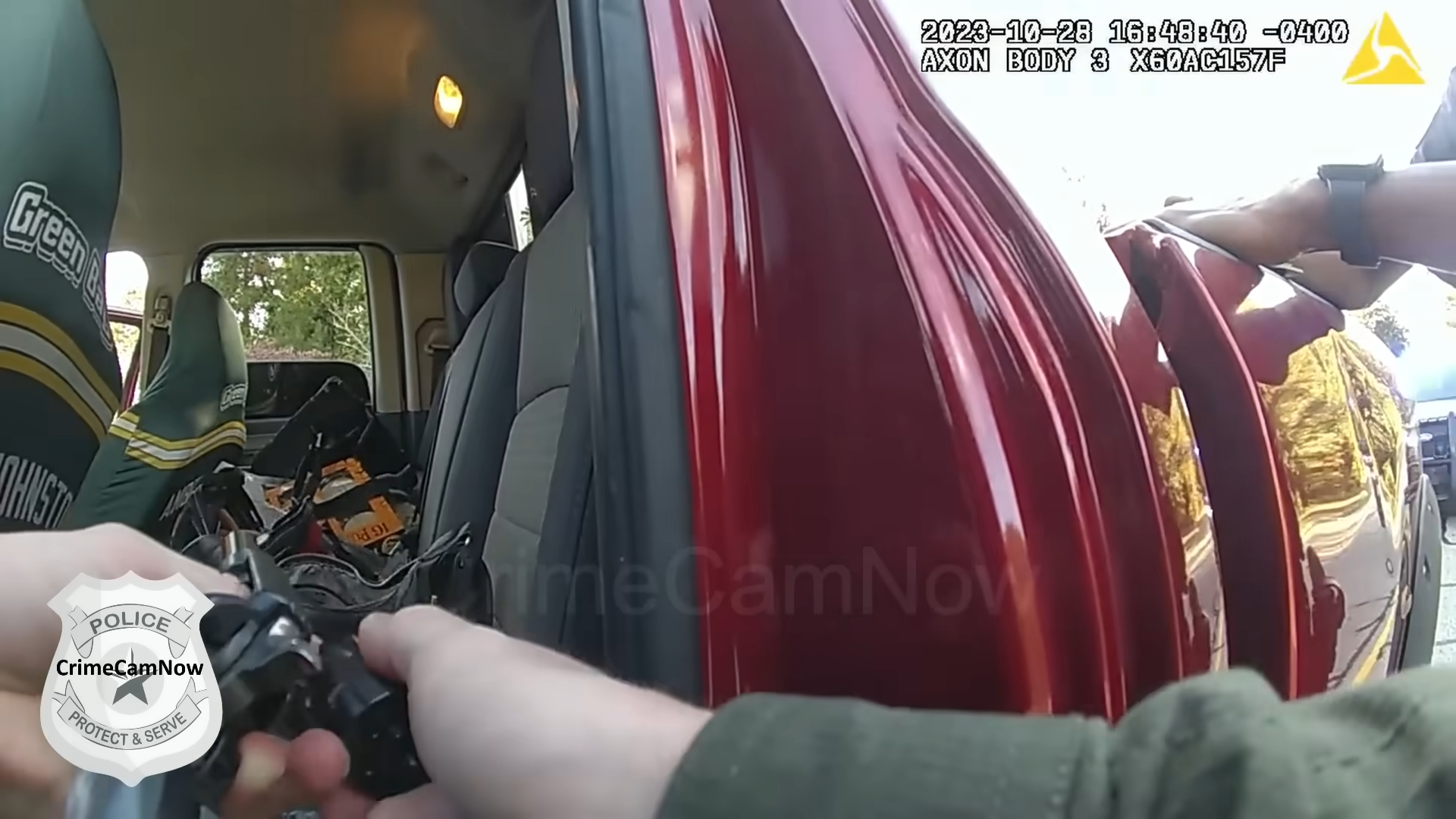
Then the search produces another firearm.
Another Gun Inside the Truck
At approximately 15:17, the narration explains that officers searching the vehicle found a second gun belonging to the male suspect.
An officer reacts immediately after seeing it.
“That’s a big boy.”
Police decide they will take possession of that weapon as well.
The gun is described as fully loaded.
That finding is significant because the male occupant has legal issues of his own.
Police had already learned that he was driving on a suspended license and had an outstanding warrant.
The presence of a firearm would later contribute to the charges filed against him.
But the search was not finished.
Officers soon open a metal box.
Inside is a large amount of cash.
One officer starts counting.
“That’s $10,000 right here.”
Then:
“This is $20,000.”
The total continues upward.
$22,000.
$24,000.
Then approximately $28,000.
An officer remembers what the woman had said earlier.
Her parent had died.
The money, according to her explanation, had been left to her.
Police Decide the Cash Is Hers
Despite the unusual sight of tens of thousands of dollars inside a truck already connected to firearms and marijuana, officers do not automatically treat the money as criminal proceeds.
Instead, they discuss what they are legally justified in doing with it.
Several officers agree that they do not have grounds to simply seize the cash.
They talk through whether it should be taken for safekeeping, left with someone else or transported with the woman.
“This is her cash,” one officer says.
The officers ultimately decide that she can take the money with her and that it can be processed at the jail.
They specifically note that she may need it to post bond.
According to the closing narration, she ultimately brought $5,000 with her to jail for bond purposes, while the remaining money was secured in a police evidence locker.
The handling of the money also marks a noticeable change in the mood.
The initial high-risk stop had been tense and heavily armed.
Now officers are trying to reassure the woman.
“Nobody’s Judging You”
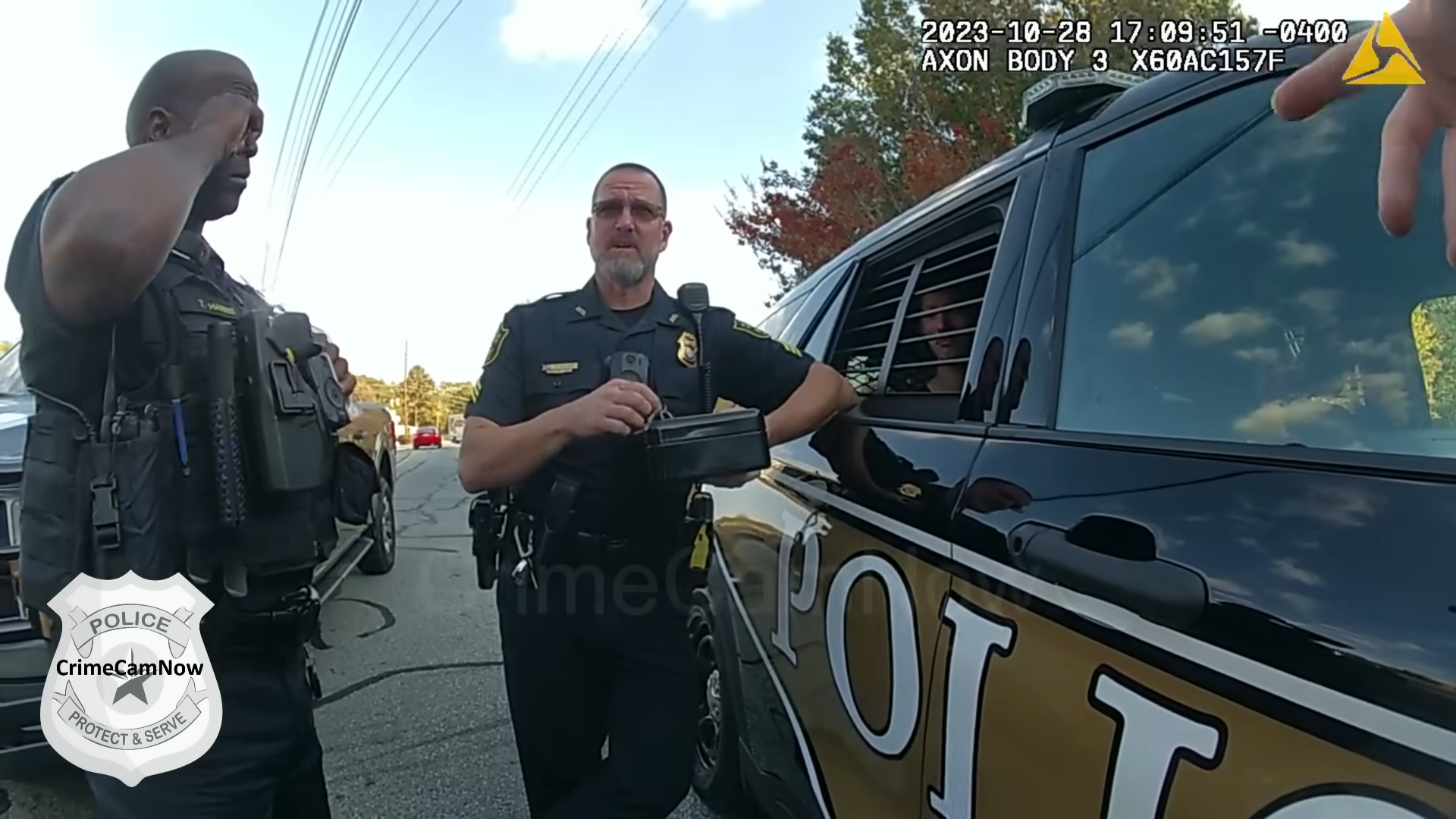
At approximately 18:11, an officer helps the woman toward a patrol vehicle.
Her emotions appear to be catching up with her.
“It’s okay, sweetheart,” the officer tells her.
Then he adds:
“Ain’t nobody judging.”
Another officer echoes the same message.
“No one’s judging.”
Police explain that they are dealing with reckless conduct and continue speaking to her in a noticeably calmer tone than during the earlier stop.
The mood even becomes briefly humorous.
While discussing who should be contacted about the truck, the woman reveals that her phone password is “1-2-3-4.”
An officer immediately jokes that she needs to change it.
The woman replies that she “used to be a blonde,” drawing laughter.
It is a strange moment of normality after an incident involving gunshots, a high-risk stop, two weapons and a K9 search.
But the legal consequences remain.
Both Occupants Face Charges
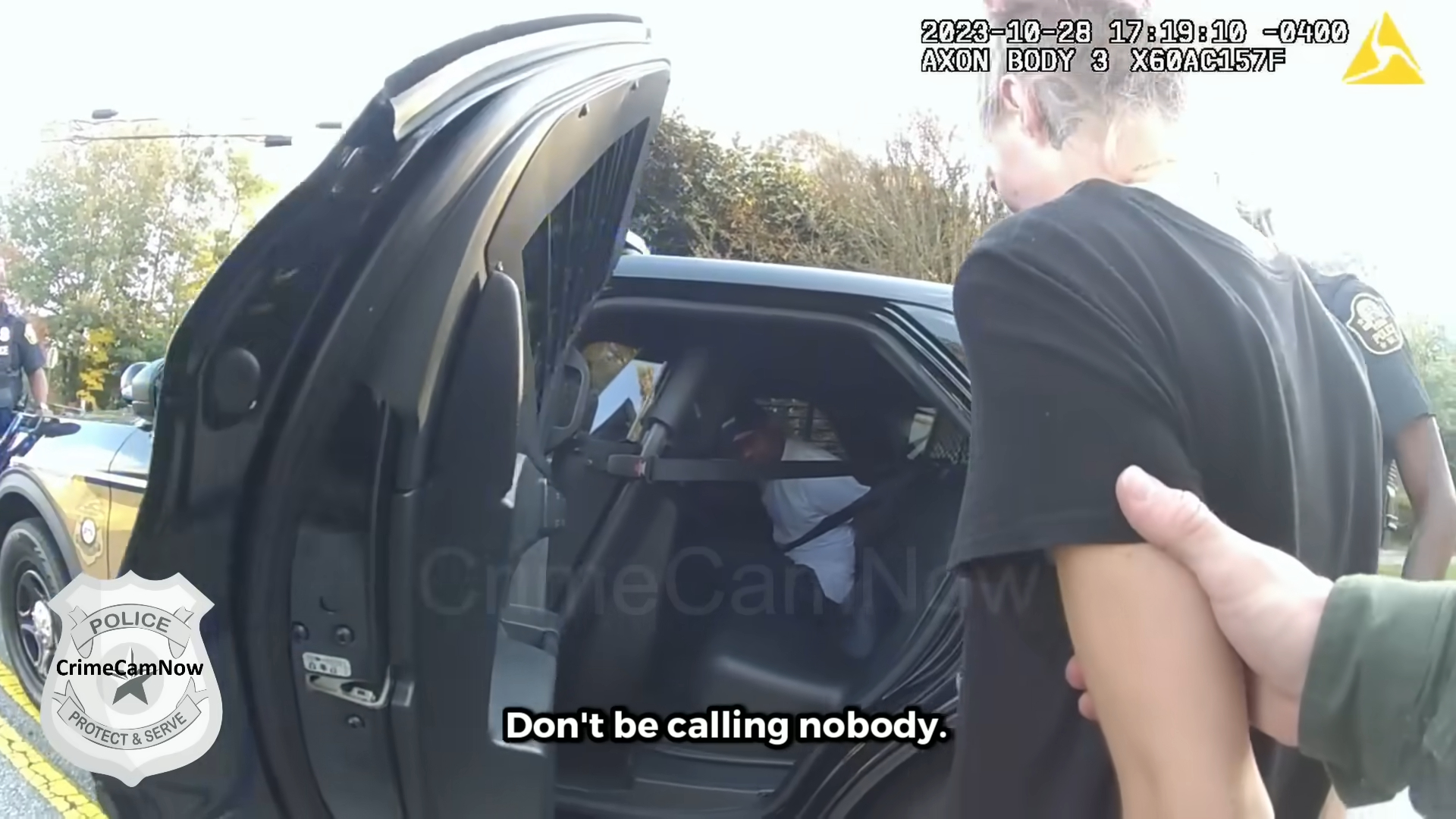
The footage’s closing narration explains that the male suspect was charged with driving while his license was suspended, DUI, possession of a firearm by a convicted felon and a probation-violation warrant.
For the woman, the clearly stated charges include reckless conduct and discharging a firearm while under the influence of alcohol. The closing narration also appears to begin naming an additional possession-related charge, although that phrase is incomplete in the transcript.
Both were transported to the Cobb County Jail.
Only then does the woman’s demeanor change completely.
The urgency about her truck is gone.
The arguments are gone.
The explanations are gone.
What remains is regret.
“This is so stupid,” she says.
“I’m pissed at myself.”
A few moments later, she says it again.
“This is stupid.”
Then comes the line that perhaps best summarizes the entire encounter:
“I know better.”
She repeats the thought.
“I do better.”
Finally:
“I’m stupid.”
The contrast is striking.
Hours earlier, she had apparently purchased a new handgun.
Shortly afterward, neighbors heard gunfire.
Police found her truck, recovered two weapons, received her admission that she had fired more than five rounds and discovered marijuana and roughly $28,000 in cash.
Yet by the end of the footage, the most memorable moment is quieter.
Sitting in police custody, the woman no longer tries to explain what happened.
She simply appears to recognize how quickly one decision had changed the course of her day.