Janusz Korczak: The Man Who Walked Into the Gas Chamber So 200 Children Would Not Be Alone
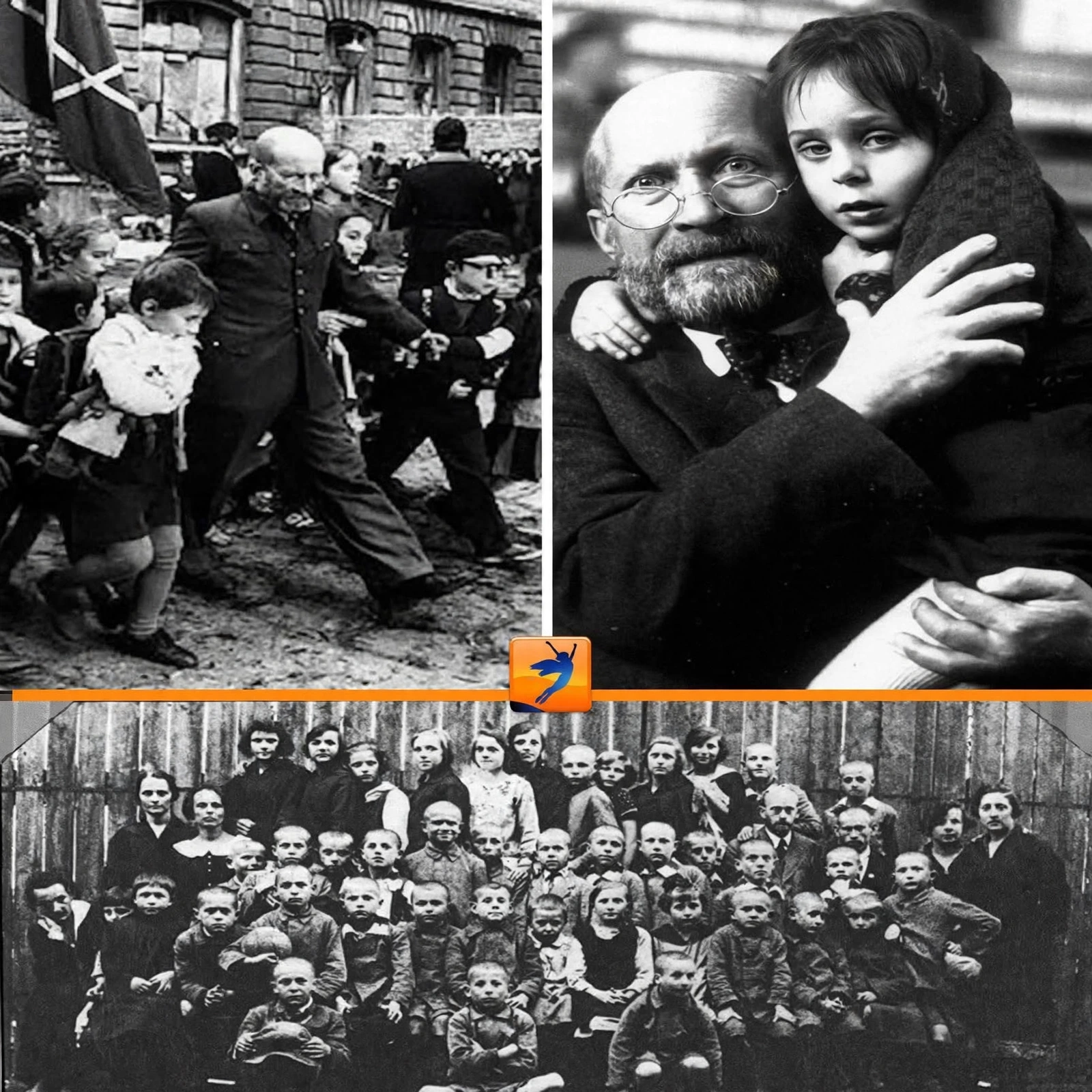
The Doctor Who Believed Every Child Was a Treasure
In the darkest years of human history, when cruelty and hatred threatened to destroy every trace of compassion, one man made a choice that showed the true strength of the human spirit.
His name was Janusz Korczak.
He was a doctor, an educator, a writer, and a Polish military officer. But above all else, he was a protector of children.
For decades, Korczak dedicated his entire life to one simple but revolutionary belief: that children were not property, not unfinished versions of adults, and not people whose voices mattered less.
They were human beings.
They had thoughts.
They had emotions.
They had dreams.
And they deserved dignity.
Long before the world even had a concept of children’s rights, Korczak was already fighting for them. He believed that adults were not meant to control children’s lives, but to guide and protect them.
His entire life was built around one promise: A child’s life is precious.
And when history placed him in the most unimaginable situation, he proved that his beliefs were not just words.
They were how he lived — and how he died.
The Orphanage That Became a Kingdom of Respect
In 1912, Janusz Korczak founded the Dom Sierot — the Orphans’ Home — in Warsaw, Poland.
At a time when most orphaned children were treated as a burden on society, Korczak created something completely different.
His orphanage was not just a place where children got food and a roof over their heads.
It was a community.
A home.
A place where children were treated with respect.
Korczak understood that children who had lost their parents had already experienced enormous pain. They didn’t need more adults telling them they were powerless.
They needed love.
They needed stability.
They needed someone who truly believed in them.
Inside the orphanage, Korczak created what he called a “Children’s Republic.” The children had real responsibilities, clear rules, and even their own court system where every dispute could be discussed fairly — where even the staff could be put on trial by the children.
It was a revolutionary idea for its time.
Instead of punishment based on fear, Korczak taught understanding.
Instead of demanding blind obedience, he taught responsibility.
He wanted children to learn what fairness was by actually experiencing fairness.
To him, every single child was extraordinary.
He described children as precious gifts and creative flames that adults had a sacred duty to protect.
Korczak believed adults constantly underestimated children.
They saw small bodies and assumed small minds.
But he saw something entirely different.
He saw individuals with their own personalities, feelings, and ideas.
His philosophy could be summed up in one powerful sentence:
You have not done enough for a child until you have done everything you possibly can.
And one day, that belief would demand the ultimate sacrifice.
The Darkness Arrives in Warsaw
When World War II began, Korczak’s world changed forever.
The Nazi occupation of Poland brought unimaginable suffering, especially for Jewish families.
In Warsaw, Jewish residents were forced into the Warsaw Ghetto — a walled-off, sealed area where hundreds of thousands of people were imprisoned under horrific conditions.
There was starvation.
Disease.
Fear.
Constant uncertainty and terror.
The children Korczak had protected for years were now trapped in a world where just surviving until tomorrow became a daily battle.
When the Nazis ordered all Jews into the ghetto, Korczak was faced with a decision.
He would not abandon his children.
He moved with his nearly 200 children from the Orphans’ Home into the ghetto.
He knew exactly how dangerous it was.
He understood what was happening.
But he stayed.
Inside the ghetto, Korczak became more than their caretaker.
He became their father figure.
Their doctor.
Their protector.
Their only source of hope.
Every single day, he fought to find food and medicine.
He scoured the ghetto for supplies.
He begged for help.
He used every connection and every bit of fame he had.
Not for himself.
For them.
The children needed him.
And he refused to leave them.
The Chances to Escape That He Rejected
Because Janusz Korczak was already a famous and deeply respected figure in Poland, he was offered multiple opportunities to save himself.
People knew who he was.
They knew his reputation as a writer and educator.
They knew his importance.
Many people tried to convince him to leave the ghetto.
Many offered him forged papers, hiding places, a way to survive on the Aryan side of Warsaw.
He could have escaped.
He could have lived.
He had every reason to choose himself.
After all, he was not responsible for the actions of the Nazis.
He was one man.
One life.
One person against an entire machine of destruction.
But Korczak saw it differently.
If he left those children behind, he would be betraying everything he had spent his entire life teaching them.
He had always told them that love means responsibility.
That loyalty matters more than safety.
That no one should ever be abandoned when they need you the most.
How could he tell children that they mattered and then walk away the moment their lives were in danger?
He couldn’t.
So he stayed.
Not because he wanted to die.
But because he refused to let children face death alone.
The Final March Through the Warsaw Ghetto
In the summer of 1942, the Nazis began the Grossaktion Warschau — the mass deportation of Jews from the Warsaw Ghetto to extermination camps.
The children from Korczak’s orphanage were among those selected to be sent away.
What happened next became one of the most heartbreaking and courageous images of the entire Holocaust.
The children were being taken to Treblinka, a Nazi death camp.
They were terrified.
They were being led toward something they could not fully understand.
Korczak knew the truth about where they were going.
But he wanted to protect them from fear for as long as humanly possible.
So he gave them the one thing every child deserves: comfort and dignity.
He told them they were going on a journey.
He told them to prepare themselves.
He asked them to wash their faces and put on their best, cleanest clothes.
And so the children walked through the streets of the ghetto with incredible dignity.
They sang songs.
They marched in neat rows.
They carried a green flag with a gold four-leaf clover — the symbol of their orphanage.
Korczak walked at the very front of the group.
He wore his old Polish military doctor’s uniform.
He carried two of the smallest children in his arms.
The other children held onto him — holding his hands, clutching his coat — refusing to let go of the man who had protected them for so long.
To anyone watching from the windows, it didn’t look like a march toward death.
It looked almost like a school outing.
That was Korczak’s final gift to them.
He could not save them from the horror.
But he could save them from facing it alone and afraid.
The Final Choice at the Train Station
At the Umschlagplatz — the train loading station — something extraordinary happened.
According to eyewitness accounts, a German officer recognized Korczak.
He knew his name.
He knew he was famous.
And he offered him a way out.
A chance to live.
A chance to step away from the children and save himself at the last minute.
But Korczak refused.
There was no hesitation.
No debate.
He stayed with the children.
Because they were his family.
His decision was not made at the train station.
It had been made years earlier, the day he first opened the doors of his orphanage.
It was made every single day he cared for those children.
It was made every time he told them that they mattered.
The Last Moments of a True Protector
Janusz Korczak and the nearly 200 children of his orphanage were transported to Treblinka.
There, they were murdered in the gas chambers.
The exact details of their final moments are difficult to document completely, but the story that has survived through history is one of profound, unforgettable humanity.
Korczak stayed right beside the children until the very end.
He held their hands.
He comforted them.
He told them stories.
He refused to let them face the darkness alone.
Even at the end, he remained exactly who he had always been.
A protector.
A teacher.
A father.
A man who believed that every child deserved to be loved.
The Nazis could take his life.
They could take the children’s lives.
But they could never take away the dignity with which they faced their final moments.
A Legacy That Evil Could Not Destroy
Janusz Korczak had countless reasons to escape.
He had the opportunities.
He had full knowledge of the danger.
He had every justification in the world to save himself.
But he chose something far greater.
He chose love.
His story remains so powerful because it shows us that courage is not only found on battlefields.
Sometimes courage is found in a classroom.
Sometimes it is found in one person refusing to abandon those who depend on them.
Sometimes the greatest act of bravery is simply staying.
Korczak did not defeat the Nazis.
He did not stop the Holocaust.
He could not change the terrible fate that awaited those children.
But he did something that will matter forever.
He gave them dignity in a world that tried to strip it all away.
He gave them kindness in a world filled with cruelty.
He gave them love until his very last breath.
The Man Who Proved Love Is Stronger Than Fear
History remembers many powerful people.
Kings.
Generals.
Leaders and conquerors.
But sometimes the greatest heroes are those who never held any political power or commanded any armies.
They are the people who quietly choose compassion when cruelty is all around them.
Janusz Korczak was one of those people.
He walked into darkness because children needed someone to walk beside them.
He walked the final road with them because he believed no child should ever feel abandoned.
His life teaches a lesson that is just as important today as it was then:
The measure of a person is not what they do when life is easy.
It is what they choose to do when everything becomes difficult.
And when Janusz Korczak faced the darkest moment imaginable, he chose love.
He chose loyalty.
He chose humanity.
And that is why, more than 80 years later, his name still lives on.
Because evil can destroy bodies.
But it can never destroy the memory of someone who refused to stop caring.