Jimmy Hoffa Rose to the Top of American Labor—Then Vanished Without a Trace in One of History’s Greatest Mysteries

One day, he was one of the most recognizable labor leaders in America.
The next, he was simply gone.
The disappearance of James Riddle Hoffa, better known as Jimmy Hoffa, has remained one of the country’s most enduring mysteries. His sudden vanishing in 1975 transformed an already controversial public figure into the center of decades of speculation, ensuring that his name would be remembered not only for his influence over organized labor but also for the unanswered questions surrounding his final days.
Long before his disappearance captured national attention, Hoffa had built an extraordinary career in the American labor movement.
He served as the General President of the International Brotherhood of Teamsters (IBT) from 1957 until 1971, leading one of the nation’s most influential labor unions during a period when organized labor played a major role in shaping working conditions and employment across the United States.
His leadership placed him at the forefront of labor negotiations and made him one of the most recognizable figures connected to American unions.
At the same time, Hoffa’s public image was marked by controversy.
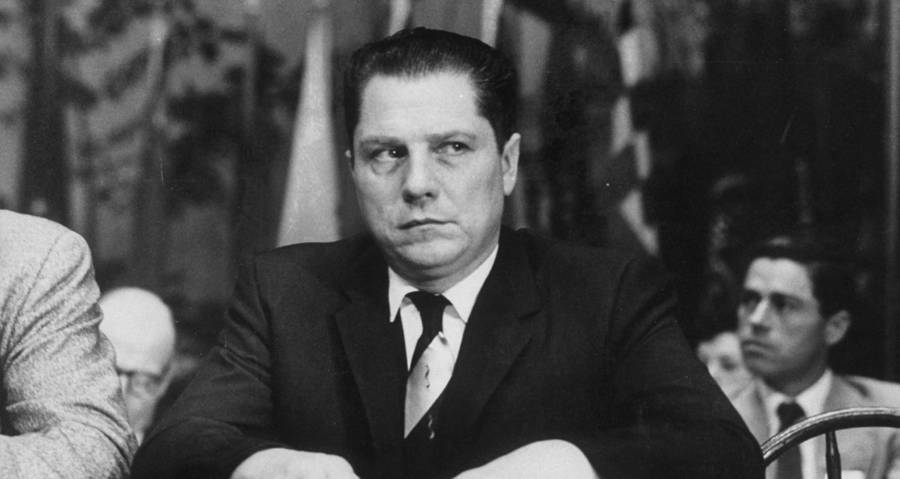
Throughout his career, he was alleged to have ties to organized crime, accusations that followed him as his influence grew. Those claims became part of the public narrative surrounding his life, adding another layer of intrigue to a man who was already one of the country’s most talked-about labor leaders.
By the mid-1970s, Hoffa’s story took a dramatic turn.
In 1975, he disappeared under circumstances that have never been fully explained. His sudden absence immediately sparked widespread attention, leaving behind a mystery that has fascinated the public for generations.
Without clear answers, his disappearance quickly became larger than the man himself.
Instead of being remembered solely for his years leading the Teamsters, Hoffa’s name became permanently connected to one of America’s most famous unsolved disappearances. The unanswered questions surrounding what happened in 1975 have continued to overshadow even his lengthy career in organized labor.
The mystery has often been associated with the greater Detroit, Michigan, area, a region where Hoffa’s story has long been part of local and national history.
Among the nearby communities is Bloomfield Hills, a city in Oakland County, Michigan. Located roughly 20 miles (32 kilometers) northwest of downtown Detroit, the city sits along the Woodward Corridor and is surrounded on most sides by Bloomfield Township.
Although relatively small, Bloomfield Hills forms part of the broader metropolitan region connected to Detroit. According to the 2020 United States Census, the city had a population of 4,470, making it one of the many suburban communities that contribute to the area’s diverse landscape.
Detroit itself provides the larger backdrop to Hoffa’s story.

As Michigan’s most populous city, Detroit stands on the banks of the Detroit River, directly across from Windsor, Ontario, Canada. It is recognized as the largest U.S. city on the Canada–United States border and ranked as the nation’s 26th-most populous city.
The city’s population was recorded at 639,111 in the 2020 Census, with an estimated 649,095 residents in 2025. Beyond the city limits, the Metro Detroit region is home to more than 4.4 million people, making it the 14th-largest metropolitan area in the United States and the second largest in the Midwest.
Detroit has long been known for far more than its size.
As the county seat of Wayne County, it has earned an international reputation through its contributions to music, art, architecture, and design, while also playing a defining role in America’s automotive and industrial history. The city’s economic and cultural influence helped shape the region where Hoffa rose to prominence.
Against that backdrop, Hoffa emerged as one of the most influential labor figures of his era.
Leading the International Brotherhood of Teamsters from 1957 to 1971, he occupied a position that gave him national visibility and lasting significance in the history of organized labor. His leadership years were closely intertwined with the development of one of America’s most powerful unions.

Yet history remembers him for two very different reasons.
One legacy centers on his role as a labor leader who guided the Teamsters for more than a decade. The other is defined by the mystery that began in 1975, when he disappeared without explanation.
That unresolved event has ensured that Hoffa’s story continues to attract attention decades later.
His life reflects both remarkable influence and enduring uncertainty. He reached the highest office within one of America’s largest labor organizations, faced allegations of organized crime connections, and then vanished under mysterious circumstances, leaving behind a case that remains one of the country’s most enduring historical puzzles.
For many, Jimmy Hoffa represents more than a single individual. He stands at the intersection of labor history, public controversy, and one of America’s most compelling unsolved mysteries. While his achievements as president of the Teamsters secured his place in the nation’s labor movement, it was his unexplained disappearance that ultimately transformed him into a lasting historical enigma.