Michael J. Fox Stopped Hiding Parkinson’s—But the Decision Became “Hell” for His Wife

When Michael J. Fox publicly disclosed that he had Parkinson’s disease, the announcement freed him from years of secrecy.
For his wife, Tracy Pollan, it created a different burden.
Fox now says the decision to become completely open about his condition was extraordinarily difficult for Pollan because Parkinson’s never remains fixed. Its symptoms, demands and effects on family life continue to change.
“It was hell on Tracy,” the 65-year-old actor said while reflecting on that period.
Still, Fox believed partial openness would not be enough. If he was going to reveal the diagnosis, he wanted to stop concealing what the disease looked like and use his visibility to help people who did not possess his resources, connections or public platform.
He told Pollan that he had to go “all the way.”
That choice transformed Fox from an actor privately managing a progressive neurological disorder into one of the world’s most recognizable advocates for Parkinson’s research.
It also meant that the illness would become part of his family’s public life.
A Diagnosis at 29
Fox was diagnosed with early-onset Parkinson’s disease in 1991, when he was only 29.
The condition is a progressive disorder of the nervous system that affects movement. For Fox, the news arrived during a career that had already made him one of Hollywood’s most familiar stars.
He had become closely associated with the Back to the Future films and was still working at an age when few people expect to confront a lifelong degenerative disease.
Fox did not immediately tell the public.
For several years, he lived with the diagnosis privately while continuing his career. That secrecy allowed him to preserve some control over how others saw him, but it also separated his public identity from the reality developing at home.
Pollan shared that reality.
While audiences continued to see the successful actor, she witnessed the uncertainty and physical changes behind the image. The diagnosis did not affect Fox alone. It entered their marriage and required both of them to adapt.
By 1998, Fox decided that hiding was no longer sustainable.

The Public Response Initially Felt Wrong
When Fox disclosed his diagnosis, he was surprised by the reaction from people living with Parkinson’s.
Many appeared to celebrate his decision.
At first, Fox found that response difficult to understand. He had announced that he was living with a serious disease, yet people were responding with relief and enthusiasm.
His first reaction was anger.
Then he recognized what the response meant.
At the time, many people with Parkinson’s did not feel comfortable discussing their diagnosis openly. The illness could carry shame, misunderstanding and fear about how others would react.
Fox’s disclosure gave them a highly visible person who was willing to say publicly what they had kept private.
They were not celebrating his illness.
They were responding to the end of silence.
That realization changed how Fox understood his role.
He began thinking about people who lacked the choices available to him. He had access to doctors, professional support and an established career. Many other patients faced the same disease with fewer resources and less reason to feel hopeful.
Fox decided that visibility itself could become a form of advocacy.
“No Half Measures”
Fox concluded that he could not reveal the diagnosis and then continue protecting his appearance at all costs.
He had to let people see the condition as it changed.
That meant abandoning vanity and accepting that Parkinson’s would sometimes become visible in his movements, speech and work.
For Pollan, that level of openness was painful.
The public would not merely know that her husband had Parkinson’s. They would watch its progression, discuss his health and repeatedly ask the family to revisit a difficult reality.
Fox acknowledged that the strain continues because the disease is always evolving.
There is no single adjustment followed by stability.
A family may adapt to one stage only to encounter a new limitation, symptom or decision later. What worked before may stop working. Plans must be reconsidered, and the roles people play inside a marriage can shift.
By becoming a public face of Parkinson’s, Fox allowed millions of strangers into that ongoing process.
He believed the sacrifice was necessary.
Pollan had to live with its consequences.

Building a Mission From the Diagnosis
Fox founded the Michael J. Fox Foundation for Parkinson’s Research after going public.
The organization has since directed more than $3 billion toward research, turning his personal diagnosis into a large-scale effort to accelerate scientific progress.
Deborah W. Brooks, Fox’s longtime business partner and the foundation’s chief executive, said his continued openness represents an active act of generosity.
According to Brooks, no other Parkinson’s patient with Fox’s visibility has allowed the public to observe life with the disease more than three decades after diagnosis in the same way.
She emphasized that this is not simply a matter of ego or celebrity exposure.
Fox is choosing to remain visible.
That choice gives patients and researchers a long-term public example of Parkinson’s progression. It also keeps the disease in conversations that might otherwise move away from it.
The foundation’s work has helped change the research landscape.
Brooks said that when the organization began, very little Parkinson’s research had advanced into human testing. Today, roughly 180 active drug programs are being tested in people.
The disease remains difficult, and access to care is still challenging.
But the scientific environment is no longer where it was when Fox first disclosed his diagnosis.

Acting Became Another Form of Survival
Fox announced his retirement from acting during the COVID-19 pandemic.
Parkinson’s had increasingly influenced what he could do professionally, and he was willing to let the disease guide those decisions.
Later, however, he returned to the screen in Shrinking.
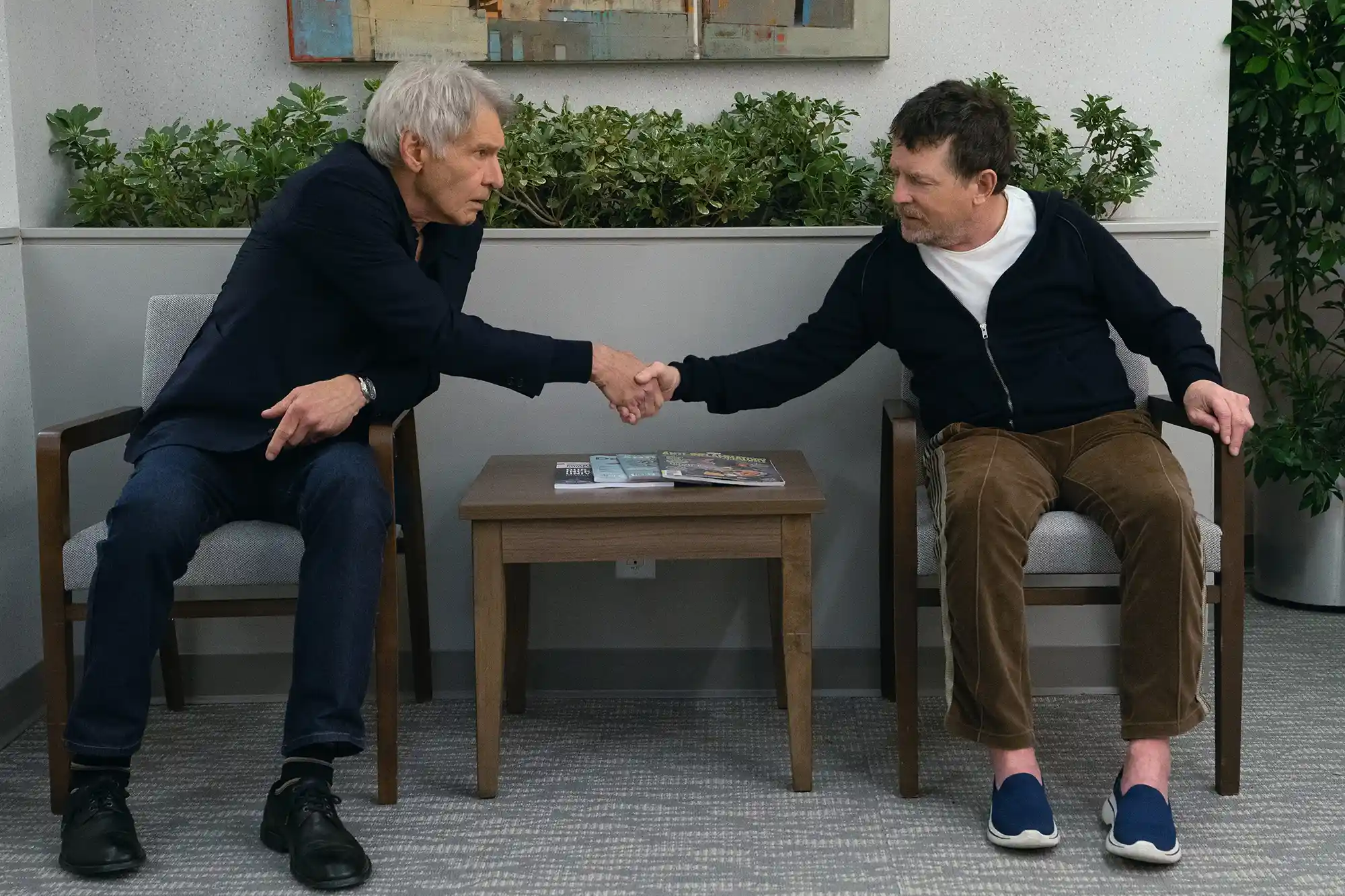
The role placed him opposite Harrison Ford, whose character, Paul, also lives with Parkinson’s. Fox played another patient with the condition, creating an onscreen relationship he had never previously explored.
He described it as the first time he had portrayed someone interacting with another person who also had Parkinson’s.
Fox shared his lived experience with Ford and helped him understand what the role required.
The collaboration became emotionally meaningful.
Fox said Ford responded with warmth and affection, despite his reputation for being reserved or difficult to read.
The performance earned Fox an Emmy nomination, but its value extended beyond recognition.
He said returning to acting prolonged his life and made it more interesting than he had expected it could be at this stage.
The work gave him a reason to remain engaged with creativity rather than allowing the illness to define every decision as a loss.
Letting Parkinson’s Set the Terms
Fox no longer speaks about acting in absolute terms.
He does not consider himself permanently retired. At the same time, he accepts that Parkinson’s may determine whether another role is possible.
That position reflects the balance he has spent decades learning.
He cannot control the progression of the disease.
He can decide how honestly he responds to it.
If he never acts again, Fox said there would be a legitimate reason. If the right opportunity remains possible, he is willing to take it.
That flexibility differs from surrender.
It allows him to stop measuring his life only by what he can no longer do.
The return to acting showed that a changed body could still produce meaningful work. The foundation demonstrated that a diagnosis could become the beginning of a mission rather than only the end of a former life.
Neither achievement removes the daily cost.
The Marriage Behind the Public Mission
Fox’s advocacy is often described through research dollars, public appearances and the hope he has given other patients.
His latest comments draw attention to the person who has carried the private side of that mission.
Pollan did not make the diagnosis public, yet she had to absorb what followed.
She watched her husband reject secrecy and become associated with Parkinson’s wherever he went. She lived through the disease’s changing demands while public audiences celebrated his courage.
Those audiences could admire Fox and then return to their own lives.
Pollan remained beside the condition after the interviews ended.
Fox’s description of the experience as “hell” does not diminish the importance of going public. It reveals the price of doing so.
A decision can help millions and still hurt the people closest to it.
Visibility Was Never Free
Michael J. Fox could have attempted to protect the image audiences remembered from his younger years.
Instead, he decided that hiding Parkinson’s would preserve vanity while doing little for people facing the disease without his advantages.
He chose to be seen.
That visibility helped normalize the diagnosis, gave patients a public advocate and supported a foundation that has reshaped Parkinson’s research.
But courage did not make the process easy for his family.
For Tracy Pollan, there was no clean separation between the public cause and the private illness. Every new stage entered both their home and the story the world believed it knew.
Fox’s openness became a gift to strangers.
Pollan helped carry the cost.
More than 35 years after his diagnosis, Fox is still acting when his body allows it, still funding research and still permitting people to witness what Parkinson’s changes over time.
The decision was never simply to announce that he had the disease.
It was to stop hiding for the rest of his life.