The ‘Transplant Games’ Are About More Than Medals
The ‘Transplant Games’ Are About More Than Medals
From beginners to serious athletes, competitors come to the Olympic-style games to regain their sense of identity and celebrate life.
Robert Lindemann is a 32-year-old accountant from Germany who has undergone a heart transplant — a life-changing experience shared by only a few hundred people in the country each year.
Yet at the Transplant Games, Lindemann does not feel like he stands out. In fact, he finds that reassuring. “It sounds a bit weird when I say you don’t feel special here, because everybody has a special story,” he says.
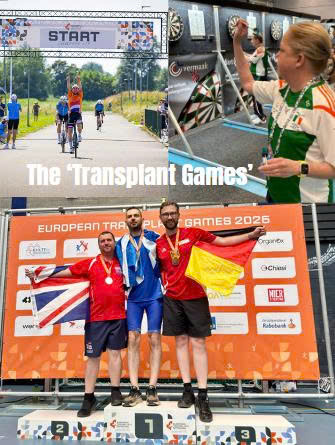
Lindemann was among 600 athletes who traveled to Arnhem in the Netherlands in June for the European Transplant Games. The week-long, Olympics-style event is open to organ and stem cell transplant recipients, people undergoing dialysis, living donors, and family members of both living and deceased donors.
The participants range from highly competitive athletes who train throughout the year to beginners who are gradually rebuilding their strength by trying new sports. Lindemann, for example, chose bowling, pétanque and shot put.
He first took part in last year’s World Transplant Games, about eight months after his operation. Speaking with other participants helped him adjust to a post-transplant life in which “everything was new.” That same network of support encouraged him to return to compete in Arnhem this year.
“This friendship, this sportsmanship, whatever you want to name it, is so unique and so special because nation, gender, age is irrelevant,” he says.
There is also little pressure to explain yourself if you do not want to push your limits or have another drink. Everyone understands that even someone in their early 30s can have a bad day and “feel 80-plus.”
Above all, the community provides hope.
Life after a transplant can be emotionally difficult. Patients may experience a rollercoaster of feelings, including guilt and depression, while thinking about the future can also be challenging. For people who receive a new heart, median post-transplant survival is around 14 to 15 years.
Seeing transplant recipients who have lived beyond that average and remain active can offer another perspective
“Seeing people beating that average — that’s very inspiring and motivating,” Lindemann says.
A sporting tradition built around life after transplantation
The first World Transplant Games were held in 1978 in Portsmouth, England. The event has since become a biannual competition with both winter and summer editions. The European Transplant Games have been running since 2000, alongside numerous national competitions. There is also a Transplant Football World Cup.
Such events “are evidence that patients undergoing transplantation are no longer just fighting for survival,” says Dr. Mariam Zakhary of the Ikon Recovery Center in New Jersey.
Advances in surgery, immunosuppression medications and long-term medical follow-up have allowed transplant recipients to remain physically active in ways that would have been considered impossible in previous decades.
That brings significant benefits.
“There is an abundance of research” in sports medicine and rehabilitation showing that regular physical activity improves cardiovascular endurance and muscle strength, while also benefiting mental health and quality of life, Zakhary says.
One study describes the Transplant Games as a form of “therapeutic landscape.” The events can foster a sense of belonging, hope and motivation, with positive effects potentially lasting well beyond the Games themselves.
“The waiting game is so horrendously difficult,” says Lynne Holt, who has overseen perhaps 1,500 transplants during her career as the U.K.’s first heart and lung transplant coordinator.
For those fortunate enough to receive a transplant, exercise is an important part of rehabilitation.
“This is such a great way to encourage it,” Holt says.
Holt has been a familiar presence at the Transplant Games since becoming involved in 1979. Now retired, she works as Team GB manager, looking after dozens of athletes. She often hides her consistently “leaky eyes” behind sunglasses as emotions run high.
“So many people lose confidence in illness, and transplant is an illness that is pretty scary. … Now, they’re their own person again,” she says.
Finding confidence again
Edelle Collins of Ireland was a sporty teenager. She had been diagnosed with cystic fibrosis as a baby, but the condition did not begin affecting her until she was around 18.
She disliked the idea of being viewed as sick or weak and initially resisted treatment. Over the years, however, her hospital admissions became increasingly frequent.
In 2019, she became seriously ill. Following extended hospital stays and a near-fatal Covid infection, she eventually underwent a double lung transplant in 2021.
The surgery was “very, very difficult” and resulted in kidney problems that required dialysis three times a week. Adjusting to dialysis and new medications, while also trying to avoid infection, left her with virtually no room for enjoyment.
“It was hard to see that things were going to improve,” she says.
Now 50, Collins says she is “very slowly improving.”
She was apprehensive about attending this year’s European Transplant Games, which was her first time at such an event. But her team manager encouraged her, and the knowledge that dialysis could be arranged nearby gave her the confidence to attend.
“My first aim was just to get to Arnhem. Secondly, to try and do my first event. It’ll literally be: take it day by day,” she recalls.
She eventually won a bronze medal in darts and handled an intense heatwave better than she had expected. The extreme heat ultimately forced organizers to cancel the second half of the week’s events.
The experience left Collins feeling encouraged.
“I feel definitely more motivated now, and of more belief that maybe I could do other sports as well,” she says.
Collins also valued being in a place where she was not defined by her health or expected to explain her medical history.
“For the first time, [with] this group of people, I feel that no explanation is needed,” she says. “Nobody’s really interested in your big, long sob story — because we all have sob stories, every single one, and it’s really just about the friendship.”
Collins does not particularly like being described as “inspiring.” Instead, she suggests the phrase “good bounce-backability.”
Whatever the term, it appears to be common among the athletes.
“You’re surrounded by people [who] all have this wonderful, positive attitude about life,” Lindemann says. “Nobody is like: ‘Yeah, my life sucks.’”
The challenges that remain
There are still precautions transplant recipients must consider.
Immunosuppressants, which almost all transplant recipients need to take, can increase the risk of dehydration. They also raise the risk of skin cancer, meaning exposure to the sun must be carefully monitored. Potential infections can also be a concern when traveling and interacting with other people.
Medical professionals stress that individuals should seek personalized advice from their own doctors.
Money presents another challenge. Holt works entirely on a voluntary basis, while participants generally have to cover their own travel and other expenses. Some raise funds to help pay for the costs.
And the emotional experience is not always positive.
Participants who return to the Games year after year often form close friendships with the people they compete against. As a result, they notice when a familiar face is missing, says Lisa Laing, a kidney transplant recipient from the U.K. who attended her first Games in 1992.
Sometimes, the reason for someone’s absence is a sad one.
Living donors take part, too
Living donors also demonstrate that physical fitness does not have to end after donation.
Brendan Coleman from the U.K. donated a kidney to his son two and a half years ago. Now 70, he had planned to compete in the 100 meters, long jump and ball throw events this year. All three events, however, were canceled because of the heatwave.
Coleman is a former semi-professional footballer. For him, competitions such as the Transplant Games provide an opportunity to represent his country while pursuing a medal — or at least achieving a personal best.
“It gives you focus,” he says.
The Games also give him a chance to feel part of something larger, “something bigger than yourself.”
Raising awareness about organ donation
One of the primary goals of the Transplant Games is to increase public awareness of organ donation and ultimately encourage more people to consider becoming donors.
The World Transplant Games Federation says host countries subsequently experience an increase in donation rates, as happened in Germany following last year’s world contest in Dresden. However, it is not clear how much of that increase can be directly attributed to the event.
Campaigners nevertheless want more people to consider living donation and to make sure their wishes regarding organ donation after death have been recorded.
“I tell my team: I’m doing this because I love to see the way you improve your mental and physical health, and you work hard on it – but mainly I’m doing it for the 8,500 people in our country waiting [for an organ],” Holt says. “So I need you to tell your stories.”
For Lindemann, the week of sporting events carries different messages for different groups.
To the general public, the Games are a reminder to remain physically active for long-term health. For families of deceased donors, they offer a poignant reminder that something positive came from their loss.
And for people waiting for a transplant, they acknowledge what those individuals are going through.
“It’s a tough time, especially when it gets longer, and you pass the average waiting time,” Lindemann says. “Keep going, keep fighting, see what’s possible. It’s worth it.”
source: https://reasonstobecheerful.world/the-transplant-games-are-about-more-than-medals/