Two gunmen took her friend. She won’t let them take something else

Rabbi Eli Schlanger leaned back in his chair, sighed and grinned like a kid.
“What are you thinking?” Nikki Goldstein asked him.
“I am completely happy,” Schlanger said. “I love my wife and my children, and I am doing exactly what I am meant to be doing. I am completely on my path.”
It was a summer morning, and light rain was falling outside Goldstein’s home. Schlanger was running late for their Zoom call, but they soon fell into the rhythm of their usual winding, philosophical conversations.
She was a self-described “blonde, blue-eyed, White-passing woman” who felt ashamed at times of being Jewish. He was a bespectacled, bearded man who never went anywhere without wearing the black hat and jacket of an orthodox rabbi. Goldstein joked to him she was the only secular Jew he knew.
“There’s no such thing as a secular Jew,” Schlanger gently corrected her. “We’re just Jews.”
Two weeks after that conversation, Schlanger was leading a Hanukkah celebration when it happened. The mood that Sunday evening on the beach was festive: kids were eating jelly-filled doughnuts and getting their faces painted, and families watched the lighting of a menorah to symbolize the triumph of light over darkness.
At 7 p.m., Goldstein’s phone lit up with texts from friends: Gunshots at Bondi Beach. Lots of sirens and choppers en route…
Her stomach sank. Schlanger was supposed to be at the event.
“Oh God, could be MY rabbi,” she texted a friend.
As more details trickled in via texts, Goldstein screamed. She collapsed into her husband’s arms. And then she wailed like a wounded animal.
The ‘oldest virus of hate’ is spreading across America
Antisemitism has been called “the world’s oldest virus of hate.” It struck that day seven months ago at Bondi Beach in Sydney, Australia, where two supporters of ISIS gunned down Schlanger and 14 other people. But what happened there, and how Goldstein responded, matters just as much in the US for a simple reason: the same hatred is spreading once again here.
Many American Jews no longer feel safe in public. The Anti-Defamation League (ADL) reports that assaults against Jews in the US last year reached a 46-year-old high. Armed guards routinely patrol outside synagogues, Jewish community centers and schools. More Jews report hiding their Star of David necklaces along with other Jewish emblems; 73% report experiencing antisemitism online.
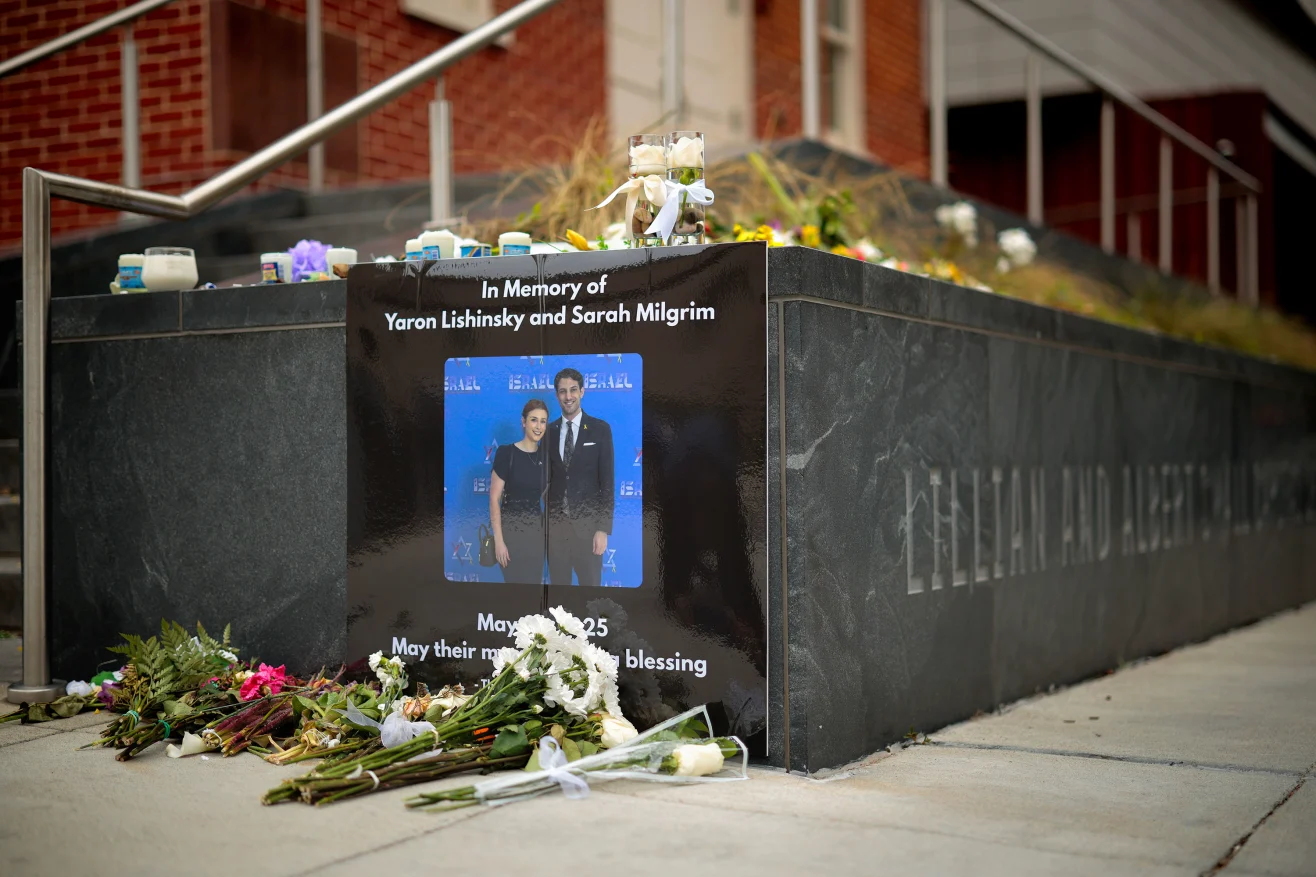
Their fears are well- founded. Just last year, a gunman shot and killed two young Israeli Embassy staffers in Washington. Another man murdered an elderly Jewish woman at a political demonstration in Colorado.
America has “totally passed the Rubicon” on antisemitism, Florida Rep. Jared Moskowitz said last month. He is one of several Jewish lawmakers from both major political parties reporting a rise in personal threats.
“This is the new normal for Jews in America right now,” he said during a television appearance. “Jews are starting to hide in this country, and that is the telltale sign that we are on a very scary trajectory.”
Some of this recent antisemitism is driven by war in the Middle East. After Hamas terrorists attacked Israel on Oct. 7, murdering 1,200 people, Israel invaded Gaza. That war has resulted in the deaths of at least 72,000 Palestinians. It’s also led to an increase in antisemitism not only in the US and Australia, but across Europe as well.
But antisemitism predates the war in Gaza by centuries. In the Middle Ages, Jews were called “Christ killers” and expelled from several European countries. Anti-Jewish riots, or pogroms, swept Russia in the late 19th century. One of the most notorious lynchings during the Jim Crow period in America was of Leo Frank, a Jewish man. And, of course, Nazi Germany also murdered an estimated six million Jews during the Holocaust.
Why do Jewish people evoke so much hatred? Is there a way for a non-Jew to see past the swirling, anti-Jewish conspiracy theories and debates about Israel and actually learn something from Judaism that could improve their lives?
Goldstein and Schlanger offer answers to these questions in a new book, “Conversations with my Rabbi: Timeless Teachings for a Fractured World.” The book retraces the conversations Goldstein and Schlanger shared after their dramatic first encounter in a hospital ICU.

Goldstein was comatose and had been placed on a ventilator after pneumonia overwhelmed her lungs. Doctors told her husband, Rowan, and her daughter, Liberty, to prepare for the worst. She calls her survival a miracle — unlocked by Schlanger when he blew a shofar, or ram’s horn used during the Jewish High Holy Holidays, over her comatose body.
Their book is also an examination of the Noahide Laws, a series of Jewish ethical teachings designed for everyone, regardless of their beliefs. Both authors wanted to show people of all faiths a way of living that helped sustain Jews through exile and trauma. The book offers a Jewish perspective on everything from the dangers of gossip and craving physical pleasure more than spiritual joy to whether animals have souls and the benefits of taking a “soul inventory” at the end of each day.
“We wanted to offer something radically hopeful: a window into Jewish thought that is compassionate, relevant, and powerful,” Goldstein writes in the book.
‘When they hate us, we don’t hide’
Schlanger is the book’s emotional anchor. He illuminates a side of Jewish culture that’s often obscured by media coverage of conflict in the Middle East.
His ebullience, keen intellect and warmth jump off the pages. He was an assistant rabbi at Chabad of Bondi in Sydney and served as a chaplain at a prison and hospital. He was dubbed the “random rabbi” because he had a habit of stopping by people’s houses unannounced with one question: “How can I help?”
As antisemitic events rose in Australia in recent years, Schlanger took on a new role. He spoke out against Jewish hatred at public events, but his natural warmth came out even when ruminating on grim subjects. On one occasion, he released a video titled, “Here’s the best response to combat antisemitism.”
In the video, Schlanger dances in the street with a loopy grin to a bouncy folk song as a vocalist sings, “Just a little light takes away the darkness.” He also fastens an illuminated menorah to the roof of a car as a caption appears: “Want a menorah for your car or home window? DM me?”
“He was very open and almost childlike in his kind of naiveté about the world,” Goldstein tells CNN in an unhurried, lilting Australian accent. “He just believed that if he exerted his goodness on the world, it would be reflected back to him.”
The book makes clear Schlanger did not believe one had to be Jewish to be the recipient of God’s goodness. Once he spotted a Muslim man in a supermarket parking lot, approached him and asked whether they could join forces “to bring light and healing to the world.” When another man’s son was killed in a highly publicized event in Australia, Schlanger found the father’s number, texted him condolences, and said he was available to talk.
“But I’m not Jewish,” the man replied.
“Yes, but you’re human,” Schlanger replied.

Schlanger’s pride in his Jewishness forced Goldstein to reflect on her upbringing. She was raised in a family that thought of themselves as Australian first and Jewish “not even a close second.” She knew more about yoga and meditation than the Torah or Talmud. She didn’t display Jewish symbols of identity, such as the Star of David.
Even when she faced death years later, just before being medically induced into a coma, she didn’t know how to recite any formal Jewish prayers.
When she became a journalist and an author, while working for fashion magazines such as Vogue and Elle, she said she never thought much about her ethnicity.
“If I’m being really honest, there was a part of me that was ashamed of being Jewish,” Goldstein says.
That sentiment seemed alien to Schlanger. He knew the risks of being an out- and-proud Jew, but when Goldstein voiced her concerns, he cited his faith.
“When they hate us, we don’t hide, we don’t cower,” he told her. “We become even more Jewish.”
‘There has to be another way’
Schlanger was a key organizer of the “Hanukkah by the Sea” celebration on December 14, 2025. Goldstein considered stopping by the event but changed her mind after a luncheon she attended earlier ran late.
At 6:41 p.m., a father and son carrying rifles and other weapons took position on a pedestrian bridge overlooking the beach and opened fire on the celebration. There’s video of Schlanger greeting people before the shooting with a wide smile.
As people hit the ground, eyewitnesses said Schlanger remained standing. He faced the gunmen. Accounts differ, but Goldstein said some people heard him say to them: “There has to be another way.”
The gunmen shot and killed Schlanger. They eventually murdered 15 people, including a 10-year-old girl and an 87-year-old Holocaust survivor. One gunman was wounded and arrested, while the other was shot to death by police. The shooting may have been worse if not for the actions of a Muslim immigrant from Syria who wrestled a gun from one of the alleged attackers.

Schlanger died just as he was about to finish the final chapter of his book with Goldstein. He was 41. He and his wife, Chaya, had a son — their fifth child — who was born just two months before the shooting .
For Goldstein, Schlanger’s death was catastrophic. It was a loss to the “whole moral ecosystem” because the world needs more people like him, she says.
“I will never stop missing him,” Goldstein writes in the book. “I’m twenty years older than Eli. I had planned that he’d be at my bedside, reciting the Shema as my soul departed this world for the next. God had other plans.”
What the gunmen couldn’t take
The Bondi Beach massacre challenged the core of Schlanger and Goldstein’s belief: There is a benevolent God that intervenes in history. So how can Goldstein still believe in God after such a devastating loss?
“I do, maybe more than ever,” Goldstein tells CNN.
Goldstein says she takes her cues from Schlanger. He believed that there was life beyond bodily death; and that God had a plan for everything.
“Faith has nothing to do with logic,” she says. “It’s just a feeling… As time has gone on, my faith has deepened, not lessened — despite the tragedy.”
That feeling includes a hunch. Goldstein says she believes Schlanger had a “knowing” that something might happen to him. It’s one of the reasons he pushed so hard for her to write their book when she was skeptical about embarking on their project. He saw the book as part of his legacy.
In one prescient passage, Schlanger pinpoints a challenge Jews face when they confront staggering brutality from strangers.
“The challenge is not to become what we fight,” Schlanger said. “The challenge is to stay human, stay holy, even when others aren’t. Our ancestor knew pogroms, the Shoah, Crusades. And yet we kept lighting candles. We kept teaching our children. We didn’t curse the world. We blessed it.”
Goldstein is trying to follow that advice. She has become a vocal opponent of antisemitism, speaking out against it in synagogues, on TV and in essays. She’s participated in a public memorial organized for the Bondi Beach shooting survivors — and has received a barrage of antisemitic comments on her social media accounts due to her activism. She says she now has a new mission: to carry on Schlanger’s fight against antisemitism by “building bridges between people.”
And she says her book with Schlanger has a new purpose: One day she’s going to present it to the son Schlanger will never know in this world — and to his siblings — to show them what kind of man their father was.

“I have more stories to tell about my journey with him and my burgeoning faith, which is blooming even in his absence,” she says.
Goldstein says she is still having conversations with her rabbi. She can’t hear Schlanger’s voice in a literal sense, but she can hear his words in her head. As she speaks about Schlanger via Zoom, light glints from an object around her neck. It’s a gold Star of David necklace. Her parents gave it to her as a child, but she never wore it — until recently.
“I feel like he’s with me all the time — I mean, a really tangible, palpable presence,” she says of Schlanger.
As she takes on her new mission, Schlanger is still her guide. His message to her, and to others facing the same virus of hate, is the same:
“We don’t run . We don’t cower. We become more Jewish.”
Source: https://edition.cnn.com/2026/07/05/us/nikki-goldstein-rabbi-shooting-bondi-beach