Who Gets the Final Say Over a Critically Ill Baby — the Woman Who Carried Him or His Biological Parents?

A newborn boy with a life-threatening heart defect has become the center of an extraordinary legal battle stretching from California to Alaska, Texas and now the U.S. Supreme Court.
McKenna West carried the baby as a gestational surrogate for California couple Omar Ahmed and Nausheen Gilkar. During the pregnancy, doctors diagnosed the fetus with hypoplastic left heart syndrome, or HLHS, a severe congenital condition in which the left side of the heart is critically underdeveloped.
That diagnosis led to a profound disagreement.
Ahmed and Gilkar considered terminating the pregnancy after consulting doctors about the child’s prognosis, medical suffering and the series of major surgeries he could require. West refused to proceed with an abortion and ultimately traveled from Alaska to Texas, where she gave birth on Aug. 12.
The baby survived birth and underwent the first major operation commonly used to treat HLHS.
But the dispute over who should control his future did not end.
It intensified.
And after a Texas judge ruled that West had no custody rights, she took the fight to the nation’s highest court.
The Baby Was Diagnosed With a Serious Heart Condition Before Birth
HLHS prevents normal blood flow because structures on the left side of the heart are severely underdeveloped.
Children born with the condition generally require urgent treatment beginning shortly after birth. A common approach involves a series of staged heart surgeries — beginning with the Norwood procedure, followed later by additional operations. Even with treatment, HLHS remains a serious lifelong condition.
West and the intended parents learned of the diagnosis during the pregnancy.
What happened next is described very differently by the two sides.
West says Ahmed and Gilkar pressured her to terminate after receiving the diagnosis. She has argued in court filings that she believed the baby had a meaningful chance of survival with treatment and that she could not go through with the abortion.
Ahmed and Gilkar acknowledge that they considered termination, but they have portrayed the decision as one made after receiving devastating medical information about their son’s future.
They later told a Texas court that they wanted the pregnancy to continue and tried to persuade West to come to California so specialists could plan the baby’s medical care.
That distinction has become critical because West now cites the couple’s earlier consideration of abortion as one reason she does not trust them to make the baby’s medical decisions.

West Went to Texas and Asked for Control Over Medical Decisions
Before giving birth, West sought legal custody — technically, sole conservatorship — in Texas.
Her argument was not simply that she had carried the child.
She said she wanted the authority to ensure that the baby received what she considered necessary life-saving treatment.
Texas Attorney General Ken Paxton intervened in the litigation, and a Texas judge temporarily ordered hospitals to provide care while the custody dispute was being considered. The baby was also ordered to remain in Texas during that stage of the case.
After West delivered the child on Aug. 12, however, Ahmed and Gilkar obtained a restraining order preventing her from seeing or holding him.
The two sides even call the baby by different names: the couple calls him Rumi, while West has referred to him as Gabriel.
That seemingly small detail reflects how deep the dispute has become.
Each side sees itself as protecting the same child.
The Baby Underwent His First Major Surgery
Whatever the legal fight, the newborn’s medical crisis was immediate.
He underwent the Norwood procedure soon after birth.
Gilkar later described her son’s condition in emotional testimony, telling the Texas court that he had suffered complications, required a blood transfusion and was struggling while attached to medical equipment.
“He’s our child,” she told the court while defending her and her husband’s right to make decisions for him.
West, meanwhile, has argued that the first surgery is only the beginning.
Her Supreme Court filing says the child is in the middle of a treatment course involving multiple major procedures and claims his future care could be endangered if she is excluded from the case.
That claim is strongly disputed in substance by the parents.
Ahmed and Gilkar have said their goal is to act in their son’s best interests while minimizing unnecessary suffering. Their earlier court filings said that some treatment decisions could not responsibly be made before birth because doctors first needed to evaluate the child after delivery.
West Says the Parents Could Choose Hospice — but That Is Her Allegation
One of the most explosive claims in West’s latest filing is that the baby could be transferred to California and placed in hospice rather than continue through additional surgeries.
Her attorneys have portrayed that possibility as an imminent danger.
But it is important to separate that claim from what courts have actually established.
There has been no court finding that Ahmed and Gilkar intend to cause their child’s death or improperly deny necessary care.
The hospice scenario comes from West’s filing and her interpretation of the parents’ position.
The parents have offered a very different picture.
They have described themselves as devastated parents watching a critically ill newborn suffer through invasive treatment, and they have insisted they are trying to make medically appropriate decisions with specialists.
They have also declined to continue providing West with updates about the baby’s condition.

Then a Texas Court Ruled West Had No Custody Rights
The legal balance shifted sharply on Sept. 2.
According to West’s Supreme Court filings, the Texas court gave full faith and credit to an earlier California judgment recognizing Ahmed and Gilkar as the child’s legal parents.
The Texas judge then dismissed West from the custody proceedings.
In practical terms, the ruling rejected West’s attempt to obtain conservatorship in Texas.
The underlying Texas order is sealed, meaning the full reasoning is not publicly available.
But the result is clear: as things currently stand, West does not have legal custody of the baby.
That is the fact established by the court.
Whether that ruling was legally correct is now the issue West is trying to challenge.
West Has Taken the Case to the U.S. Supreme Court
On Sept. 9, West filed an emergency application with the U.S. Supreme Court.
The case is docketed as M.W. v. Superior Court of California, Los Angeles County, et al., No. 26A325, and the request was submitted to Justice Elena Kagan, who handles emergency matters arising from the Ninth Circuit.
West is asking the Supreme Court to temporarily block the California parentage judgment while she prepares a broader petition asking the justices to review the dispute.
Her legal argument is not merely, “I gave birth, therefore I am the mother.”
Her lawyers argue that California lacked proper jurisdiction over her and that the judgment recognizing Ahmed and Gilkar as the parents should not have been enforced against her in the way it was.
The Supreme Court has not granted her request.
As of the latest docket entries, the application remains pending.
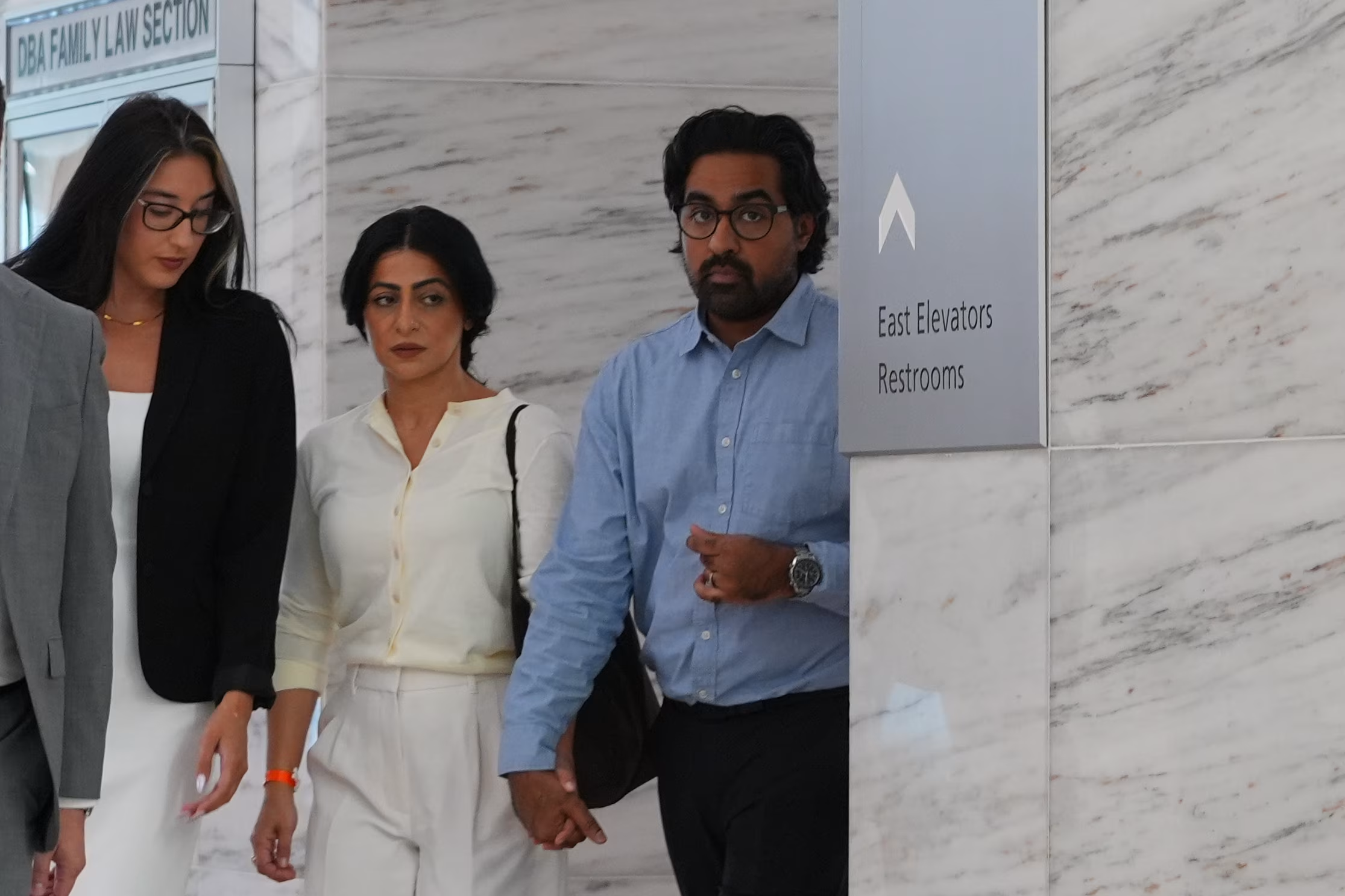
So Who Gets the Final Say Right Now?
For all the emotional complexity, the current legal answer is simpler than the moral debate.
Ahmed and Gilkar have been recognized by the California courts as the baby’s legal parents.
The Texas court honored that judgment and rejected West’s bid for custody.
Unless another court intervenes, West does not currently have the authority to make the baby’s medical decisions.
But the case has exposed a much harder question that U.S. law rarely confronts this dramatically.
What happens when the woman who carried a child believes the genetic parents will make the wrong life-or-death medical decision?
Surrogacy is not governed by one nationwide federal system. State laws vary substantially, which is part of why a dispute involving people from Alaska and California ended up being fought in Texas and has now reached Washington.
West says she is fighting to save the baby.
Ahmed and Gilkar say he is their son and that they, together with his doctors, must be allowed to decide what care is humane and appropriate.
The courts have so far sided with the parents on custody.
Now West is asking the U.S. Supreme Court to stop that result before, she argues, an irreversible medical decision is made.
And while the justices decide whether they will intervene at all, a critically ill newborn remains at the center of a conflict in which both sides insist they are the ones trying to protect him.