The Girl Whose Name Became a Lifeline: Amber Hagerman’s Tragedy and the Alert System That Changed America

An ordinary afternoon that became a national tragedy
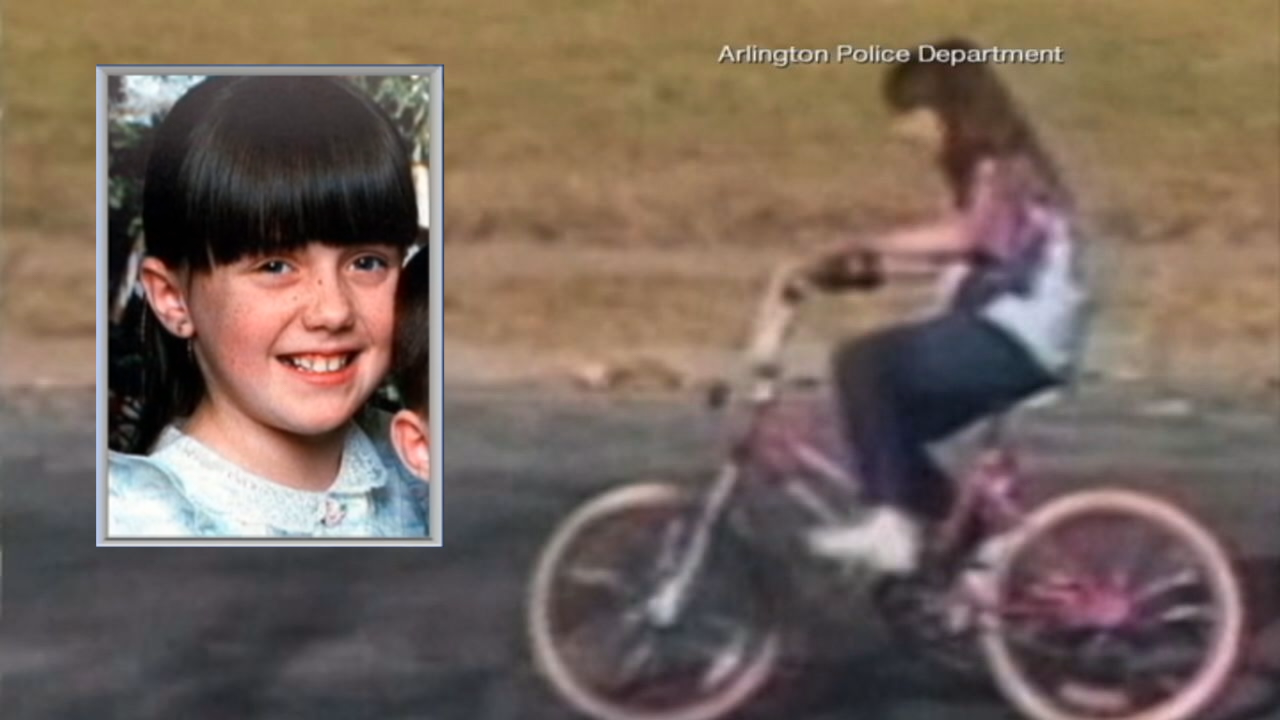
On January 13, 1996, nine-year-old Amber Hagerman climbed onto her bicycle and rode through a familiar area near her grandparents’ home in Arlington, Texas.
It should have been an ordinary childhood afternoon.
Amber and her five-year-old brother, Ricky, rode approximately two blocks to the parking lot behind an abandoned grocery store. The children had visited the area before and reportedly enjoyed riding their bicycles on a ramp there.
After several minutes, Ricky decided to return to their grandparents’ house. Amber told him that she would follow shortly.
She never made it home.
At approximately 3:18 p.m., a witness saw a man approach Amber in a dark-colored pickup truck. The witness reported that the stranger grabbed the girl from her bicycle as she screamed and forced her into the vehicle before driving away.
The witness immediately called 911, launching a search that would grip the entire Arlington community.

A desperate search for a missing child
Police officers, investigators, volunteers and local residents joined the effort to find Amber.
Her photograph was shared throughout the community. Search teams examined nearby streets, fields and waterways. Amber’s relatives waited desperately for a phone call telling them she had been found alive.
But in 1996, there was no coordinated nationwide emergency system capable of instantly warning millions of people about a child abduction.
Information moved more slowly. Television and radio stations could report the disappearance, but there was no established process for immediately interrupting broadcasts with descriptions of the child, suspect or vehicle.
For four days, Amber’s family held onto hope.
That hope ended on January 17, when her body was discovered in a drainage culvert behind an apartment complex in Arlington, several miles from where she had been abducted.
Amber was only nine years old.
The discovery devastated her family, the investigators searching for her and an entire community that had prayed for her safe return.
A case that remains unsolved
Police launched an extensive murder investigation and assigned dozens of detectives to the case.
Investigators interviewed witnesses, examined physical evidence and followed thousands of tips. The witness who saw the abduction described the suspect as a man in his twenties or thirties, of medium build and under six feet tall. He was reportedly driving a black or dark-colored pickup truck.
Despite the enormous investigation, no one has ever been publicly identified or charged with Amber’s murder.
More than 7,000 leads were investigated during the tenure of the original investigative supervisor. Yet none produced the evidence required to make an arrest.
Amber’s case is often described by the public as a cold case, but investigators have said it has never truly gone cold. Tips have continued to arrive, and detectives remain committed to finding the person responsible.
Nearly three decades later, investigators still receive phone calls, letters and emails concerning the case on a regular basis.
New technology brings renewed hope
Advances in forensic science have solved crimes that once appeared impossible to resolve.
Modern DNA testing, improved databases and genetic genealogy have allowed investigators across the United States to revisit evidence collected decades ago. In some cases, even a small biological sample has been enough to identify a suspect.
The detective currently leading Amber’s case has said that the available physical evidence is limited. Because some testing methods could consume part or all of a sample, investigators must carefully select laboratories capable of examining the evidence while preserving as much of it as possible.
The Arlington Police Department continues to review old reports, reconsider previous leads and evaluate new information.
A framed photograph of Amber remains near the lead detective’s desk—a daily reminder that the investigation is not simply a file from the past.
It is an unfinished promise to a child and her family.
The question that changed everything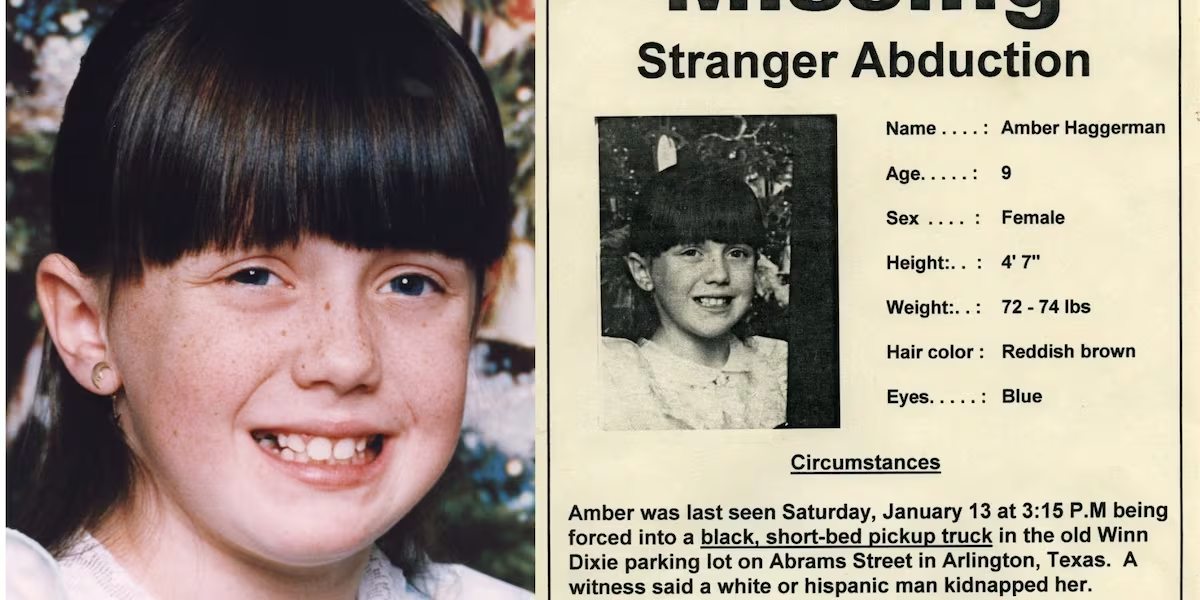
In the aftermath of Amber’s murder, residents across the Dallas–Fort Worth area began asking a painful question:
Could a faster public warning have made a difference?
At the time, alerts already existed for severe weather and other public emergencies. But there was no comparable system that immediately asked an entire community to look for an abducted child.
A local resident, Diana Simone, reportedly contacted a radio station and suggested that broadcasters create an emergency notification system for child abductions. Her idea was simple but powerful: when police confirmed that a child had been taken and was in immediate danger, radio and television stations should quickly distribute the child’s description and any available information about the suspect or vehicle.
Dallas–Fort Worth broadcasters then worked with local law-enforcement agencies to develop the first version of the system.
It was named in Amber’s honor.
AMBER later became an acronym for America’s Missing: Broadcast Emergency Response. The system began locally in 1996 before being adopted by other cities and states across the country.
How an AMBER Alert works
An AMBER Alert is not issued for every missing-child report.
Although individual jurisdictions may have slightly different requirements, the U.S. Department of Justice recommends several key criteria. Law enforcement must have a reasonable belief that an abduction occurred and that the child faces an imminent risk of serious injury or death.
Authorities must also have enough descriptive information—such as details about the child, suspected abductor or vehicle—to make public participation useful. The missing child must generally be 17 years old or younger, and the case must be entered into the appropriate national law-enforcement database.
Once an alert is activated, information may be distributed through television, radio, highway signs, digital billboards, websites, social media and mobile phones.
The goal is to quickly place millions of eyes on the same search.
A driver may recognize a license plate. A gas-station employee may notice a suspicious vehicle. A neighbor may recognize the suspect’s description. Someone who would otherwise know nothing about the abduction may provide the detail that brings a child home.
From a local idea to a worldwide safety network
What began as a partnership between North Texas broadcasters and police grew into one of the most recognizable child-safety systems in the world.
AMBER Alert plans now operate across all 50 U.S. states, the District of Columbia, Puerto Rico and the U.S. Virgin Islands. The program has also expanded into Tribal communities and is used internationally in dozens of countries.
Wireless Emergency Alerts have made the system even faster. A targeted notification can now reach compatible mobile phones in a specific geographic area without requiring people to download an application or subscribe to a service.
The sudden sound of an alert may interrupt a meeting, a meal or a night’s sleep. But behind each notification is a child believed to be in serious danger—and a family waiting for help.
As of December 31, 2025, the U.S. Department of Justice reported that 1,312 children had been successfully recovered because of AMBER Alert activations. At least 252 of those children were rescued with help from Wireless Emergency Alerts.
The child behind the famous name
For millions of people, the word “Amber” is now associated with emergency notifications, highway messages and missing-child reports.
But before her name became an alert, Amber Hagerman was simply a little girl.
She was a daughter, granddaughter, sister and student. She loved riding her bicycle and spending time with her younger brother. She had schoolwork, favorite activities and a future that should have stretched far beyond that January afternoon.
The scale of the alert system bearing her name can sometimes overshadow the child at the center of its history.
Amber did not choose to become a national symbol. Her name became famous because someone stole her opportunity to grow up.
Remembering her story means remembering more than the system created after her death. It means remembering the life that was lost—and the family that still has no final answer.
A legacy of protection, but justice remains unfinished
Amber could not be brought home safely in 1996.
But the public response to her death created a system designed to give other abducted children a better chance. Every successful recovery connected to an AMBER Alert is part of the legacy that grew from her tragedy.
Children have been located because motorists recognized vehicles. Suspects have released victims after learning that an alert had been issued. Families who feared the worst have been reunited because information reached the right person at the right moment.
Yet the system’s success does not erase the unresolved crime that inspired it.
Amber’s killer has still not been brought to justice.
Investigators continue to hope that new technology, a reexamined piece of evidence or information from someone who has remained silent will finally provide the breakthrough they need.
Someone may remember the dark pickup truck.
Someone may have noticed unusual behavior in the days following the murder.
Someone may know a detail that seemed unimportant at the time.
For Amber’s family and the detectives who continue working on her case, it is never too late for that person to come forward.
The name that still echoes
Whenever an AMBER Alert appears on a mobile phone or highway sign, it carries a message larger than the words displayed on the screen.
It says that a missing child matters.
It says that strangers can become part of a rescue.
It says that communities will stop, look and help when a child is in danger.
Amber Hagerman’s life ended before she could understand the impact her name would have. She never saw the system spread across the United States or witnessed the children brought home because millions of people were warned in time.
Her story began with an unimaginable crime.
Her legacy became a lifeline.
But until the person responsible for her death is identified, one final question will remain unanswered:
Who killed Amber Hagerman?