A Baby Gorilla and a Tiger Cub Found Friendship Through a Rope—Then Their Separation Changed Everything
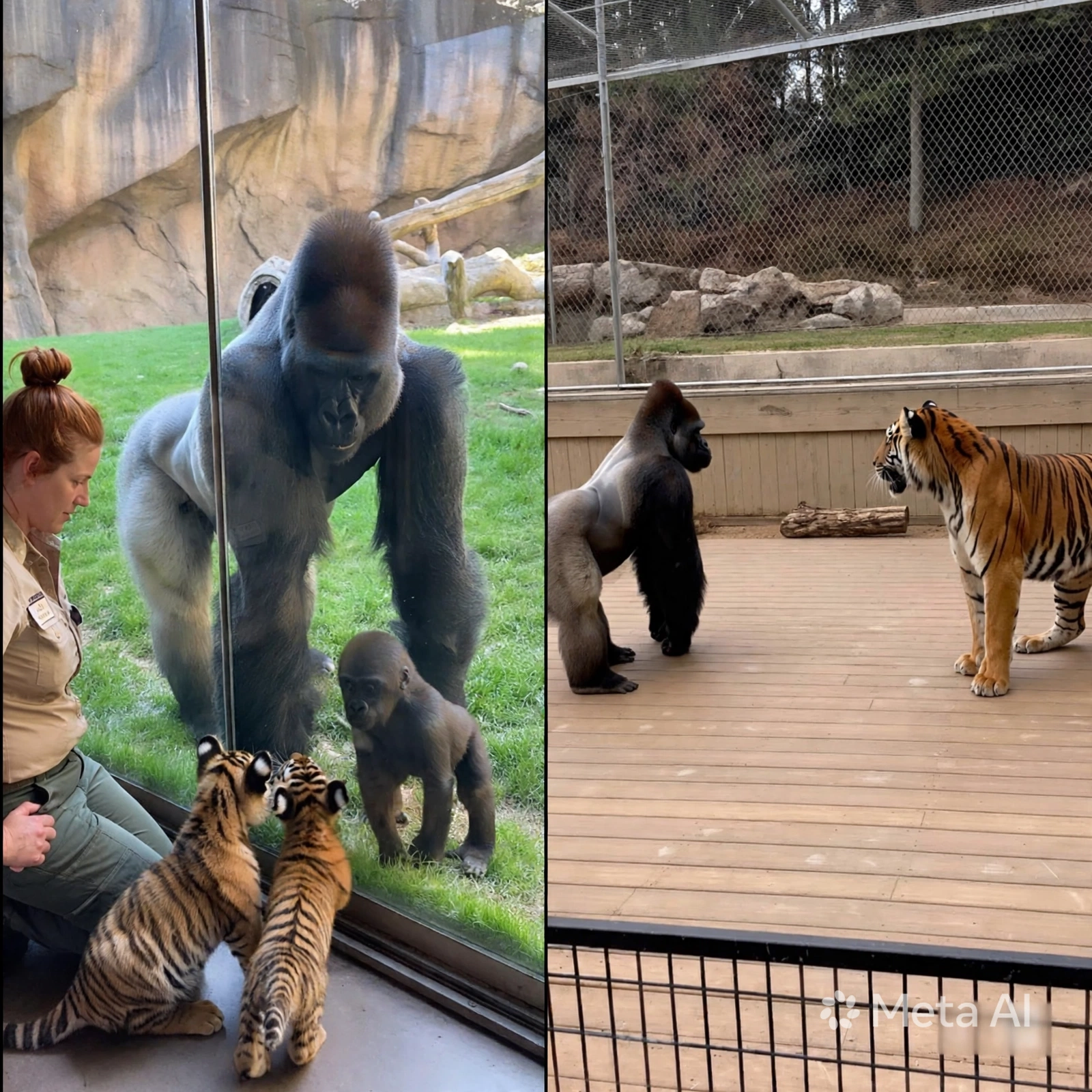
Two young animals from completely different worlds
Inside an unidentified zoo, two young animals reportedly formed a connection that no one had expected.
One was a baby gorilla—curious, intelligent and naturally drawn to social interaction.
The other was a tiger cub—a young predator that would eventually grow into a powerful and largely solitary adult.
They lived in neighboring enclosures and could not freely enter each other’s space. At first, their interest appeared to be ordinary curiosity. The gorilla watched the tiger. The tiger watched the gorilla. Each seemed fascinated by the unfamiliar creature on the opposite side.
They were not natural enemies, despite the dramatic description commonly attached to the story. In the wild, gorillas and tigers live in entirely different environments and would not normally encounter each other.
Yet within the artificial setting described in the online account, distance did not prevent the two juveniles from finding a way to interact.
Their connection began with something remarkably simple:
A rope.
The game that brought them together
The rope reportedly stretched through or near the doorway separating the two enclosures.
One day, the young gorilla grabbed one end.
The tiger cub took the other.
Then they began to pull.
To visitors, it looked like a playful tug-of-war. Sometimes the gorilla appeared to have the advantage. At other times, the tiger cub refused to release its end.
Neither animal seemed concerned with winning.
The reward appeared to be the interaction itself.
The same game soon became a daily routine. When one animal approached the rope, the other would respond. Their movements grew excited whenever they noticed each other nearby.
The rope allowed them to play while remaining physically separated. It became a safe bridge between two enclosures—and, according to the story, between two very different lives.
Zookeepers reportedly began to realize that the animals were no longer interacting only because the rope was entertaining.
They appeared to be waiting for each other.
More than simple curiosity
Young animals frequently investigate unusual sounds, smells and movements. A tiger cub staring at a gorilla, therefore, would not by itself prove that a deep emotional relationship existed.
But the repeated nature of the interaction reportedly caught the keepers’ attention.
The animals returned to the same place each day.
They watched for one another.
Their energy increased when the game began.
They also appeared willing to continue the routine even when neither animal gained any obvious material benefit.
The online story describes the pair as companions rather than merely neighbors. Their rope game functioned like a shared ritual—an activity whose significance came from performing it together.
Scientific research has documented social relationships between members of different species in a wide variety of animals and environments. Such connections can provide companionship, protection, information or other benefits, although scientists caution against automatically interpreting every animal interaction through human emotions.
In this case, the strength of the reported attachment became apparent only after the routine suddenly ended.
The separation
As the animals grew, zoo staff reportedly became concerned about allowing the unusual interaction to continue.
That concern would have been understandable. A young tiger can quickly become much stronger, while a growing gorilla also develops enormous physical power. Even behavior intended as play can become dangerous when large wild animals are involved.
According to the story, keepers decided to separate the two completely.
The rope disappeared.
The neighboring companion was no longer visible or accessible.
Staff expected the animals to show temporary confusion before adjusting to the change.
Instead, both reportedly changed almost immediately.
Their playful energy vanished.
They began pacing and appeared unable to settle. Most concerningly, the account claims that both animals lost interest in food.
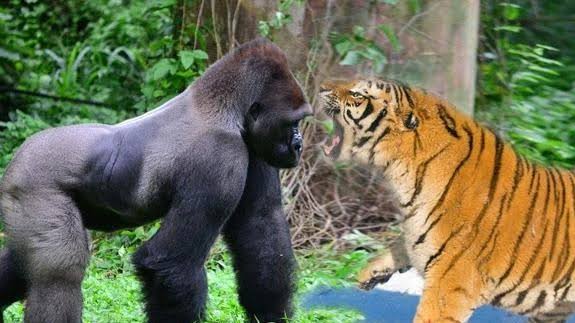
When the absence became impossible to ignore
A sudden change in appetite or behavior can have many possible causes, including illness, environmental stress or disruption of a familiar routine.
The story says veterinarians examined both animals but found no obvious physical condition that explained the changes.
Attention then turned toward the separation.
The timing seemed difficult to dismiss: the gorilla and tiger had appeared healthy and active while they were able to interact. After that access ended, both became withdrawn.
The source claims a veterinarian described their condition as resembling depression. However, because the article provides no named professional, veterinary records or identifiable institution, that characterization cannot be independently confirmed.
Animals do not need to experience emotions in exactly the same way humans do for social separation to affect their welfare. Research has found that many vertebrates develop consistent social bonds, and disruptions to important relationships or familiar social environments may produce measurable behavioral changes.
The keepers now faced a difficult decision.
Should they maintain the separation for safety—or restore some form of contact for the animals’ apparent emotional well-being?
The zoo reportedly changed its plan
After observing the animals’ decline, staff reportedly created a controlled arrangement that allowed them to interact again without sharing the same enclosure.
The rope returned.
So did the daily game.
According to the account, the effect was rapid. The gorilla became more energetic. The tiger cub showed renewed interest in its surroundings. Their appetite and familiar behavior reportedly returned.
Once again, they approached opposite ends of the rope and began pulling.
To visitors, the activity may still have looked like a competition.
To the keepers, it had acquired a different meaning.
The game was not important because either animal could win. It was important because it gave them a way to reconnect.
The source describes staff joking that tug-of-war had become the animals’ “love language.” Although that phrase is clearly a human interpretation, it captures the emotional appeal of the story: two animals repeatedly choosing to spend time with each other despite a physical barrier.
Growing stronger without growing apart
The pair reportedly continued the routine as they matured.
The rope game inevitably changed. The tiger became heavier and more powerful. The gorilla developed greater size and strength.
What had once involved two small juveniles now required more careful supervision.
Nevertheless, the excitement associated with seeing each other allegedly remained.
They still approached the shared space.
They still reached for the rope.
They still appeared eager to participate.
The story suggests that the relationship endured because it had been established during a vulnerable stage in both animals’ development. Each had become part of the other’s familiar environment.
Shared experiences can play an important role in the development and maintenance of animal social bonds. Researchers have observed such relationships across many classes of vertebrates, although the precise mechanisms vary among species and individuals.
For the gorilla and tiger described in this account, the repeated game may have represented stimulation, familiarity and a predictable social reward.
What visitors saw—and what the animals may have experienced
Humans naturally interpret animal behavior through stories.
A rope becomes a symbol.
A repeated game becomes friendship.
A period of withdrawal becomes heartbreak.
These interpretations can inspire compassion, but they should be used carefully. Without detailed behavioral observations, veterinary documentation and information about the animals’ broader environment, it is impossible to know exactly what either animal experienced.
The story’s central claim—that the gorilla and tiger developed an attachment—is plausible in a general biological sense. Cross-species sociality has been documented in numerous animals, and relationships between unlike species are not automatically imaginary or impossible.
However, the specific account remains unverified.
It does not identify the zoo.
It does not provide the animals’ names or species classifications.
It does not link to original footage, a keeper interview, a veterinary statement or an institutional announcement.
Those omissions mean readers should distinguish between the broader scientific possibility of interspecies bonding and the unsupported details of this particular viral narrative.
Why unusual animal friendships fascinate people
Stories involving unlikely animal companions spread quickly because they challenge the categories people use to understand nature.
Predator and prey.
Social and solitary.
Powerful and vulnerable.
Wild and domesticated.
Such labels can be useful, but individual behavior is often more flexible than a simple category suggests.
Animals learn from experience. They respond to familiar individuals. They may seek proximity, play, protection or stimulation in ways that are not entirely predictable from species-level descriptions.
Studies of animal sociality increasingly examine relationships as a continuum rather than assuming that meaningful interaction can occur only between members of the same species.
Still, an unusual bond in captivity should not be used to suggest that wild predators are safe pets or that fundamentally different species should routinely be placed together.
Professional animal care requires careful attention to natural behavior, physical risk and long-term welfare. What appears charming in a short video may involve considerations that viewers cannot see.
The ethical question behind the heartwarming story
The account is emotionally appealing, but it also raises questions about captivity.
Why were the animals housed in neighboring enclosures?
Why did a rope connect their spaces?
Were both being raised without members of their own species?
Did staff separate them because of a genuine safety risk, or was the separation part of ordinary management?
Did the animals have access to species-appropriate companions and enrichment?
The original article does not answer any of these questions.
A friendship with another species may provide comfort, but it should not replace appropriate care, habitat and social opportunities. Gorillas have complex social needs, while tigers require environments designed around their own behavior and development.
The well-being of the animals must remain more important than producing an appealing moment for visitors or social media.
If the interactions occurred as described, the safest interpretation is not that gorillas and tigers should be raised together. It is that caretakers noticed a behavioral relationship and attempted to manage it without allowing unsafe physical contact.
A rope as a bridge
The most memorable part of the story is not the size or strength of either animal.
It is the simplicity of the connection.
They did not need to share an enclosure.
They did not need to behave in identical ways.
They only needed access to a familiar routine and a willing partner on the other side.
Each day, one reportedly picked up the rope.
The other answered.
That repeated choice gave the object its meaning.
The rope became a bridge not because of what it was made from, but because of what happened whenever both animals held it.
Friendship does not erase difference
It would be easy to conclude that the story proves differences do not matter.
But the more responsible lesson is subtler.
The animals remained profoundly different.
Their bodies, instincts and future needs did not become identical because they played together. Those differences were exactly why their interaction required barriers and professional supervision.
Connection did not erase biology.
It existed alongside it.
This distinction matters because genuine care does not require pretending differences are unimportant. It requires recognizing them while still responding to the individual in front of us.
The gorilla did not need the tiger to become another gorilla.
The tiger did not need the gorilla to behave like another tiger.
According to the story, they simply found enjoyment and familiarity in each other’s presence.
The unanswered questions
The account ends with a hopeful message, but several basic facts remain unknown.
Where did the animals live?
Were they truly a gorilla and a tiger, or were images from unrelated animals used to illustrate the narrative?
How long did their interaction continue?
What ultimately happened when they became adults?
Were their alleged eating problems documented by veterinarians?
Without answers, the story cannot responsibly be treated as verified zoo news.
It can, however, be presented transparently as an inspirational animal narrative built around a scientifically plausible theme: animals sometimes form social connections that cross species boundaries.
The lesson readers carried away
Whether every detail occurred exactly as described or the story was shaped for emotional effect, its popularity reveals something meaningful about its human audience.
People want to believe that connection can appear where it is least expected.
They are moved by the idea that two beings separated by instinct, appearance and physical barriers could still develop a shared routine.
They recognize something familiar in the image of each animal returning to the rope each day.
Friendship is often built in exactly that way—not through a single dramatic gesture, but through repeated moments of attention.
Showing up.
Responding.
Remembering.
Choosing to interact again.
The baby gorilla and tiger cub reportedly began with a game.
Only after the game was taken away did their keepers understand how important the relationship might have become.
When the rope returned, so did the behavior that had made the pair remarkable.
Two different animals stood on opposite sides of a barrier.
Each held one end.
And for a little while, the distance between their worlds seemed smaller.