Atlas the K9 Stayed When Others Couldn’t—The Battlefield Loyalty That Refused to Let a Soldier Die Alone
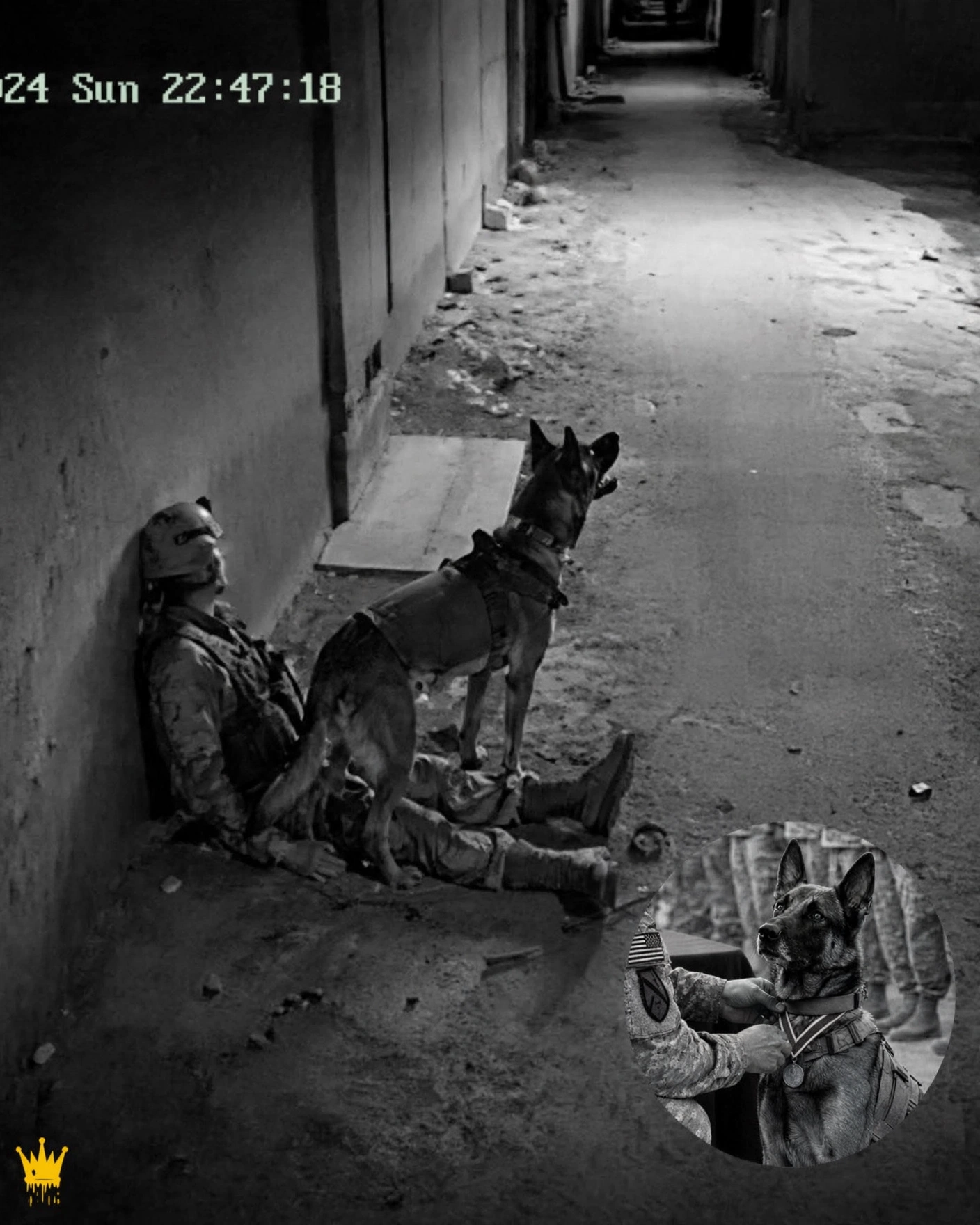
The gunfire had faded, but the danger had not.
Dust hung in the air, the kind that settles slowly after chaos. Somewhere in that silence lay a wounded soldier, barely conscious, unable to move. Around him, the battlefield had gone still—except for one presence that refused to leave.
Atlas stayed.
The military working dog had already done what he was trained to do: detect threats, move ahead of his unit, protect his handler. But in that moment, training alone could not explain what happened next. While others were forced to fall back, Atlas remained beside the injured soldier, guarding him with unwavering focus, as if he understood that leaving was not an option.
That decision would define his story.
Atlas was not just any dog. He was a highly trained K9, part of a military unit operating in a dangerous combat zone where every step could trigger an explosive and every shadow could hide a threat. Like many working dogs, he had undergone months of intense preparation, learning to detect danger, follow commands under pressure, and build an unbreakable bond with the soldiers he served alongside.
That bond was strongest with his handler—the person he trusted above all others.
In military K9 units, the connection between a dog and handler goes far beyond simple obedience. It becomes a partnership built on trust, repetition, and shared risk. They move together, rely on each other, and, in many ways, survive because of one another.
For Atlas, that connection extended beyond commands.
It became loyalty in its purest form.
The mission that changed everything began like many others—carefully planned, executed with discipline, and filled with uncertainty. The unit advanced into hostile territory, fully aware that danger could come without warning.
Then it did.
An explosion tore through the operation, leaving one soldier severely wounded and the team momentarily disoriented. The situation shifted instantly from controlled movement to urgent survival.
Evacuation became the priority.
Under normal circumstances, units are trained to secure the area, extract the injured, and regroup. But in the chaos of that moment, not everyone could move at once. The wounded soldier was left behind temporarily as the team adjusted to the unfolding danger.
Atlas did not follow the retreat.
Instead, he stayed beside the fallen man.
Witnesses later described how the dog positioned himself protectively, scanning the surroundings, alert to any movement. Despite the noise, confusion, and potential threats, Atlas refused to abandon his post.
It was not a command.
It was instinct.
Minutes felt like hours.
The wounded soldier drifted in and out of consciousness, but he was not alone. Atlas remained close, offering something no training manual could fully explain—a presence that brought both protection and a strange sense of calm in the middle of chaos.
When the rescue team finally returned, they found the scene unchanged.
The soldier was still there.
And Atlas was still guarding him.
The moment left a lasting impression on everyone involved. In a place defined by uncertainty and danger, the dog had demonstrated a level of loyalty that transcended his role.
He had not simply performed a task.
He had made a choice.
Stories like Atlas’s are not entirely unique within military history, but each one carries its own emotional weight. Military working dogs have long played critical roles in combat, from detecting explosives to locating hidden threats. They save lives, often at great personal risk, and their contributions are widely respected within the armed forces.
Yet what sets Atlas apart is the clarity of that moment.
When the situation broke down and survival became uncertain, he did not retreat. He stayed with a wounded human being who could not defend himself, holding his ground until help returned.
That image—of a dog standing guard beside a fallen soldier—captures something deeply human.
It speaks to loyalty without hesitation, courage without calculation, and a kind of devotion that asks for nothing in return.
For the soldiers who witnessed it, Atlas became more than a working dog.
He became a symbol.
A reminder that in the most difficult moments, strength is not always measured by force or strategy, but by the willingness to stand beside someone when they need it most.
After the mission, the story of Atlas spread through the unit and beyond. It was retold not as a tale of heroism in the traditional sense, but as something quieter and, in many ways, more powerful.
A story about presence.
About not leaving.
About choosing to stay.
For the wounded soldier, survival meant more than medical care or evacuation. It meant enduring long enough for help to arrive. And during that critical window, Atlas played a role no one else could.
He filled the space between danger and rescue.
In doing so, he reminded everyone around him of something easily forgotten in war—that even in the harshest environments, compassion can still exist.
The bond between humans and animals has been written about for centuries, but stories like this bring it into sharp focus. They show that loyalty is not always taught. Sometimes, it is simply lived.
Atlas did not speak.
He did not explain his actions.
He stayed.
And in that decision, he gave one wounded soldier a chance to make it home.
Long after the mission ended, that moment continues to resonate—not just as a military story, but as a reflection of something deeper.
In a world often defined by uncertainty, the image of a dog refusing to leave a fallen soldier behind offers a simple, powerful truth.
Sometimes, the greatest act of courage is not advancing forward.
It is standing your ground when someone else cannot.