The Girl Who Couldn’t Be Forgotten: The Story Behind Czeslawa Kwoka and the Photograph That Still Speaks
- NgoPhong
- July 29, 2026
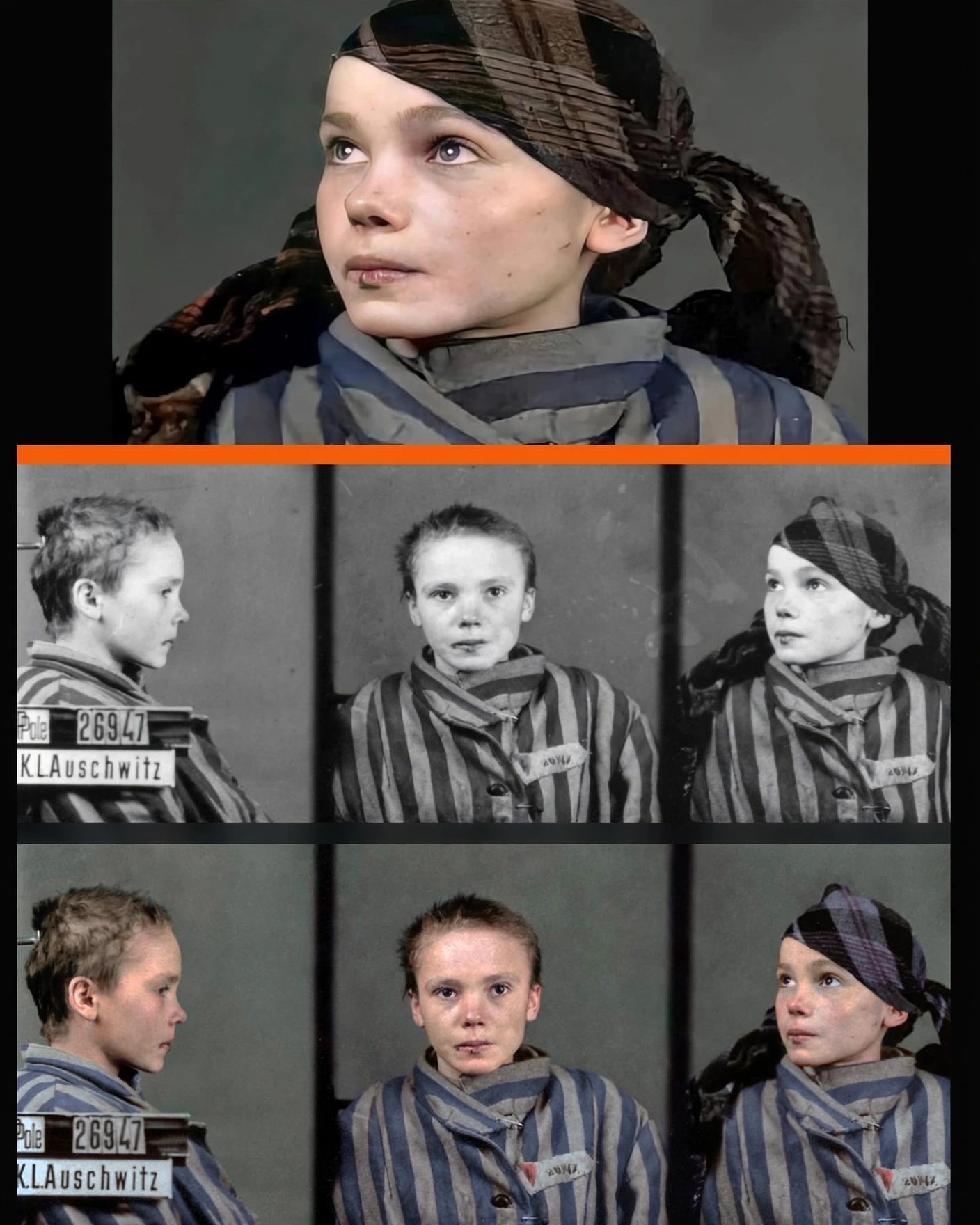
Her eyes meet the camera, but there is no comfort in them.
A young girl stands alone, her expression caught somewhere between confusion and fear. A streak of blood runs from her lip. Her hair is unevenly cut. She is dressed in clothing that does not belong to her, marked not by identity, but by a number.
That image has endured for decades.
And behind it is the story of Czeslawa Kwoka—a child whose life was cut short, but whose face continues to remind the world of what should never be forgotten.
Czeslawa was just 14 years old when she was taken from her home in Poland during World War II. Like countless others, she was caught in a system that stripped people of their names, their families, and their futures.
She was sent to Auschwitz.
For those who arrived there, the experience was immediate and overwhelming. Everything familiar disappeared in an instant. Families were separated. Personal belongings were taken. Even the most basic sense of identity was erased, replaced by numbers and strict control.
Czeslawa entered this world as a child.
And like so many others, she had no control over what would happen next.
The photograph that would later become so widely recognized was taken shortly after her arrival. It was part of a process—documenting prisoners, cataloging them, reducing their existence to records.
But something about her image stands apart.
It is not just the setting or the circumstances. It is her expression.
There is a visible wound on her lip, a detail that has drawn attention and raised questions for years. It suggests a moment of fear, of resistance, or of confusion in an environment where none of those emotions were allowed.
Yet despite everything, she looks directly into the camera.
That gaze has stayed with people.
Unlike many images from that time, which feel distant or abstract, hers feels immediate. It captures not just a moment in history, but a human being—young, vulnerable, and facing something she could not fully understand.
Her story did not continue for long.
Czeslawa died at Auschwitz only a short time after her arrival. Like millions of others, her life was taken in a system designed to erase individuals and reduce them to statistics.
But her photograph survived.
Over the years, it has been studied, shared, and remembered. Historians, artists, and educators have returned to it again and again, drawn not only by its historical significance but by its emotional weight.
It is a reminder.
Not just of what happened, but of who it happened to.
One of the most powerful aspects of her story is how it has been preserved. The image, originally taken as part of a cold administrative process, has taken on a completely different meaning over time.
It has become a symbol.
A representation of innocence caught in unimaginable circumstances.
And through that transformation, Czeslawa’s identity has been restored in a way the system that imprisoned her never intended.
Her name is known.
Her face is remembered.
Her story is told.
This is what makes the photograph so significant.
It does not allow distance.
It does not let the viewer see history as something abstract or removed. Instead, it brings it into focus, forcing a recognition of the individual lives behind the numbers.
For many, encountering her image is a deeply emotional experience.
There is something in her expression that feels universal—a mixture of fear, uncertainty, and quiet resilience. It speaks across time, connecting the past to the present in a way that words alone often cannot.
Her story also reflects the broader reality of the Holocaust.
Millions of people were affected, each with their own life, their own story, their own identity. But in large numbers, those individual stories can become difficult to grasp.
Czeslawa’s photograph changes that.
It brings the focus back to one person.
One life.
One moment.
And through that, it helps people understand the scale of what was lost.
In the years since the war, efforts have been made to preserve these histories—not just through documents and archives, but through personal stories that ensure the human side of history is never forgotten.
Czeslawa’s story is part of that effort.
It stands as a reminder that behind every statistic is a person, and behind every person is a life that mattered.
Her photograph continues to be shared, not because it is easy to look at, but because it is important.
It asks the viewer to pause.
To see.
To remember.
And to understand.
Because in that single image, there is a truth that cannot be ignored:
That even in the darkest moments of history, the humanity of those who suffered cannot be erased.
And as long as her face is remembered, neither is she.