From a Rat-Infested Apartment to EGOT History: How Viola Davis Refused to Remain Invisible

When Viola Davis won a Grammy Award in February 2023, the victory completed one of entertainment’s rarest achievements.
With an Emmy, Grammy, Oscar, and Tony now to her name, Davis had officially become an EGOT winner. She had conquered television, recorded performance, film, and theater—four industries in which recognition at the highest level is difficult for any artist to achieve.
The moment carried an even deeper meaning because of where her journey had begun.
Decades before the awards ceremonies and standing ovations, Davis was a hungry child living in a condemned, rat-infested building in Rhode Island. Food was so scarce that she searched through garbage and chose friends partly because their families served regular meals.
She grew up surrounded by poverty, shame, and fear. Yet the imagination that helped her endure those years eventually became the instrument through which she transformed her life—and expanded what Hollywood believed a leading woman could look like.
A Childhood Defined by Survival
Davis was born on August 11, 1965, on her grandmother’s farm in St. Matthews, South Carolina. Soon afterward, her family moved north to Central Falls, Rhode Island, a struggling former mill city.
She was one of six children.
Her father worked with horses at racetracks, while her mother held various jobs and became active in local civil rights efforts. Money was painfully limited, and the family lived for a time in buildings that were scheduled for demolition.
One home, at 128 Washington Street, became a lasting symbol of Davis’s childhood.
The property was overrun with rats. Davis later recalled sleeping with her sisters on the top bunk and wrapping sheets around their necks in an attempt to protect themselves from bites. The animals moved through the walls and rooms, making even sleep feel unsafe.
But hunger was more consuming than the rats.
Davis has spoken openly about going to bed without food, searching through trash, stealing from stores, and befriending children whose mothers regularly cooked. Hunger affected how she behaved, how she saw herself, and how much of childhood she was able to experience.
“I was a child who went to bed hungry every single night,” she said while discussing her later work against food insecurity.
The poverty also carried a social cost. Davis went to school wearing clothes that were not always clean. She was bullied and mocked, often feeling that the conditions of her home had marked her as different before she had a chance to define herself.
Her childhood was not a polished opening chapter designed to make later success appear more dramatic. It was an environment that left emotional wounds she would continue confronting as an adult.
Acting became one place where she could imagine something beyond survival.

Discovering a Way to Be Seen
Davis became interested in performance while still young. In high school, she participated in arts programs and found an outlet for emotions she had not always known how to express.
The stage offered something that poverty had denied her: control over how she was seen.
She attended Central Falls High School and participated in the federal Upward Bound program. Her talent helped carry her to Rhode Island College, where she studied theater and graduated in 1988.
From there, she entered the Juilliard School in New York.
Juilliard gave Davis intensive classical training, but entering the professional world revealed another obstacle. She was now highly educated and technically prepared, yet the industry offered limited opportunities to dark-skinned Black actresses.
Talent was necessary, but it did not erase the narrow imagination of casting directors and producers.
Davis began building her career in theater, where demanding roles allowed her to demonstrate the power, emotional precision, and commanding presence that would later define her screen work.
In 2001, she won her first Tony Award for her performance in August Wilson’s King Hedley II. She played Tonya, a woman struggling with the possibility of bringing another child into a world already filled with hardship.
The role required Davis to embody exhaustion, anger, love, and fear without reducing the character to a symbol of suffering.
Broadway recognized what Hollywood had not yet fully understood: Davis could make a character’s entire history visible, even when she was standing still.
Eight Minutes That Changed Everything
For years, Davis appeared in films and television programs without receiving roles equal to her ability.
Then came Doubt in 2008.
Davis played Mrs. Miller, the mother of a student at a Catholic school whose relationship with a priest has raised troubling suspicions. She appeared on screen for only a few minutes, performing primarily opposite Meryl Streep.
It was enough.
In a single extended scene, Davis revealed a mother caught between fear for her son, awareness of the prejudice he faced, and the painful compromises she believed might be necessary for his future.
The performance earned her an Academy Award nomination for Best Supporting Actress.
Hollywood could no longer claim it had not seen her.
Three years later, Davis starred as Aibileen Clark in The Help. The film became a commercial success, and her performance earned her a Best Actress nomination.
However, Davis later spoke critically about the film’s perspective, explaining that it did not fully center the voices and experiences of the Black domestic workers whose lives it portrayed. Her reflections demonstrated an important part of her evolution: success alone was not enough if the stories remained restricted by someone else’s viewpoint.
She wanted more than visibility.
She wanted agency.
Crossing a Line in Television History
In 2014, Davis accepted the role of defense attorney and law professor Annalise Keating in ABC’s How to Get Away with Murder.
Annalise was brilliant, intimidating, sensual, wounded, morally complicated, and frequently unpredictable. She was not written to reassure viewers or represent an idealized version of strength.
For Davis, the role challenged long-standing limitations imposed on Black women in mainstream television.
In September 2015, she became the first Black woman to win the Primetime Emmy Award for Outstanding Lead Actress in a Drama Series.
Standing onstage, Davis made clear that individual achievement could not be separated from access. She argued that women of color could not win awards for leading roles that had never been created for them.
“The only thing that separates women of color from anyone else is opportunity,” she said.
The victory was historic, but its significance went beyond being first. Davis had won for playing a middle-aged, dark-skinned Black woman whose complexity was not softened to make her acceptable.
Annalise Keating was allowed to occupy the center of the story.
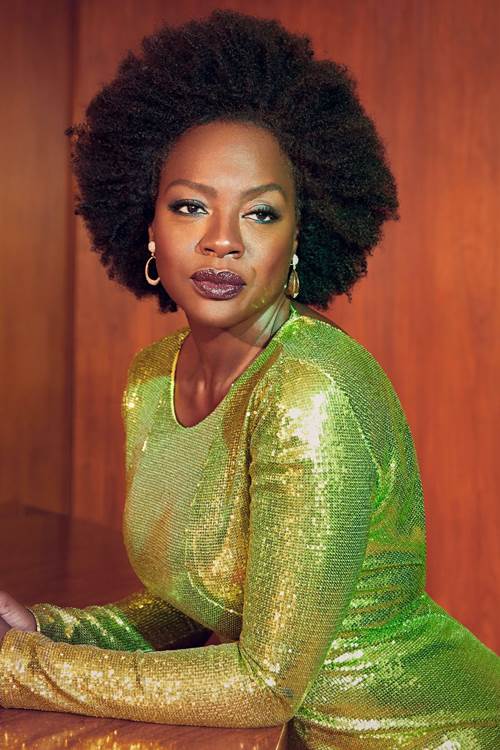
Returning to the Role That Defined Her Power
Davis returned to August Wilson’s work in the 2016 film adaptation of Fences, directed by and starring Denzel Washington.
She played Rose Maxson, a devoted wife forced to confront the consequences of her husband Troy’s betrayals and disappointments. Davis had previously performed the role on Broadway, winning her second Tony Award in 2010.
On film, Rose’s emotional reckoning became one of Davis’s most celebrated performances.
She won the 2017 Academy Award for Best Supporting Actress, completing what is known as the Triple Crown of Acting: competitive wins at the Emmy, Oscar, and Tony Awards.
The child who had once feared being seen because poverty exposed her shame had become an actress audiences could not look away from.
Building Her Own Table
Davis also began working to change the industry from behind the camera.
With her husband, actor and producer Julius Tennon, she established JuVee Productions. The company developed projects intended to broaden representation and create substantial roles for performers whose experiences were often excluded from mainstream entertainment.
Her later work reflected that growing control.
She portrayed blues legend Ma Rainey in Ma Rainey’s Black Bottom, receiving another Best Actress nomination and becoming the most Oscar-nominated Black actress at that time.
In The Woman King, Davis played General Nanisca, leader of an all-female military force in the West African kingdom of Dahomey. She also produced the film, helping bring a large-scale historical action drama centered on Black women to theaters.
These projects represented more than career variety. They challenged the idea that Black actresses had to remain inside a narrow range of supporting characters, servants, victims, or suffering mothers.
The Award That Completed the Journey
In 2022, Davis published her memoir, Finding Me, confronting childhood poverty, family trauma, racism, beauty standards, and the long process of accepting herself.
She narrated the audiobook in her own voice.
At the 2023 Grammy Awards, it won Best Audio Book, Narration, and Storytelling Recording. The victory completed her EGOT, making her the 18th person at the time to achieve the distinction and the third Black woman to do so.
Yet the most fitting detail was not the acronym attached to her name.
It was what she had won for: telling her own story.
The voice once shaped by hunger, humiliation, and the fear of invisibility had become the final instrument required to make entertainment history.
Davis also used her success to address the hardship from which she emerged. She partnered with campaigns fighting childhood hunger and supported programs in Central Falls, including initiatives benefiting local schools, libraries, and community services.
She did not describe hunger as a lesson she was grateful to have learned. She described it as a deprivation no child should endure.
That distinction keeps her story from becoming a simple fairy tale about escaping poverty.
Viola Davis did not succeed because suffering automatically creates strength. She succeeded despite conditions that could have silenced her before her talent had a chance to develop.
Her career became historic because she did more than enter rooms from which women like her had long been excluded. She forced those rooms to recognize a fuller range of beauty, power, vulnerability, and humanity.
The rats, the empty cupboards, and the condemned building remained part of her history.
But they no longer decided what her life was worth.