Baby Logan’s Fight Begins at Birth: Diagnosed With Rare Alveolar Rhabdomyosarcoma at Just 13 Days Old
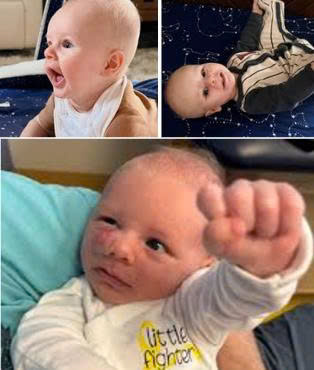
From the moment he was born, Logan has been described by his family as a remarkably happy and easygoing baby. He loves being around people, especially his doctors and nurses, lights up when he sees the family dogs and absolutely loves splashing in the bath. Affectionate and full of smiles, Logan enjoys cuddles, hugs and kisses—and continues to bring joy to everyone around him despite the difficult journey he has faced since birth.
Logan was born with a large mass attached to the upper right side of his nose and extending beneath his right eye. At first, doctors and pediatricians believed the mass could be a hemangioma, a common type of blood-vessel growth in infants. An ultrasound was performed, and the initial results were not considered concerning.
But then the mass began to bleed.
A pediatric dermatologist recognized that it did not appear to be a hemangioma, and Logan was sent to the emergency room. What followed was an 11-day hospital stay filled with tests and procedures, including CT and MRI scans and a biopsy performed under anesthesia.
At just 13 days old, Logan was diagnosed with stage 3, Group 3 alveolar rhabdomyosarcoma.
Rhabdomyosarcoma is a rare cancer that develops in soft tissues and is one of the more common soft-tissue cancers diagnosed in children. It can develop in many parts of the body, including the head and neck. The alveolar subtype is one of the recognized forms of rhabdomyosarcoma and can behave more aggressively than some other forms.
Modern diagnosis and treatment of alveolar rhabdomyosarcoma also increasingly consider the tumor’s molecular characteristics. Many tumors that appear alveolar have genetic changes involving the FOXO1 gene, most commonly through PAX3::FOXO1 or PAX7::FOXO1 fusions. FOXO1 fusion status is an important factor doctors use when assessing risk and planning treatment.
For Logan’s family, however, there was little time to process the diagnosis before treatment began.
At only 15 days old, Logan started VAC chemotherapy and has also required blood transfusions. The VAC regimen is a combination of vincristine, dactinomycin (also called actinomycin-D) and cyclophosphamide and is commonly used to treat rhabdomyosarcoma in children.
In August 2025, Logan underwent two surgeries—one to remove the tumor and another to ensure clean surgical margins and reconstruct his face. He has continued chemotherapy with the hope of avoiding radiation to his face because of the potential effects that radiation can have on a young child’s growth and long-term health.
For now, Logan is still receiving treatment and fighting his disease.
His parents have also had to confront the difficult realization that the tumor was visible in some of Logan’s 3D prenatal ultrasound images. Looking back at those images after his diagnosis was devastating and confusing for the family.
“We hope that one day, cancer research will be so comprehensive that families will not be surprised to have a baby born with cancer,” Logan’s mother, Sarah, said. “We know a diagnosis before birth wouldn’t have changed the outcome, but we at least could have been prepared and been immediately admitted for treatment.”
Rhabdomyosarcoma can sometimes occur in very young children, and researchers continue to study the genetic and molecular factors involved in its development. Although certain inherited cancer-predisposition conditions are associated with rhabdomyosarcoma, most children diagnosed with the disease do not have a known inherited cause.
Despite everything Logan has experienced, his personality has remained remarkably bright.
“Logan is our hero because he was born into a battle that he didn’t choose to fight, yet he’s handled treatment and all of the challenges that come with it with incredible strength, resiliency, and joy,” Sarah said. “We can’t get over how happy his spirit remains despite all of the things he has been through. His happy demeanor keeps us going when things are hard.”
For his family, the dream is simple: they want Logan to have a long, healthy and happy life. They hope that one day he will be able to enjoy a childhood filled with ordinary moments—playing, growing stronger and simply being a kid.
To other families facing a childhood cancer diagnosis, Sarah offers a message of encouragement: “You are stronger than you think and will do incredibly hard things because you have to. Know that you are not alone and that there are people willing to connect with you and help bring you understanding, hope, and strength especially during difficult times.”
Support has also come from Alex’s Lemonade Stand Foundation (ALSF), which has provided Logan’s family with resources including the ALSF Treatment Journal organizer, Alex and the Amazing Lemonade Stand children’s book, The Childhood Cancer Guides and the ALSF School Guide.
For Sarah, that support means more than practical resources.
“ALSF not only brings our family hope that a cure will be found, but also inspires us to be advocates for childhood cancer awareness and to highlight the strength of our little fighter and all of the fighters out there,” she said.
Logan’s treatment journey is still continuing. His family remains focused on each day and on the hope that their smiling little boy will one day be able to leave the hospital behind and experience the ordinary childhood they have dreamed of for him.
Through every procedure, treatment and difficult moment, Logan continues to smile, cuddle and find joy in the people and world around him.
His family holds onto the words of Matthew 17:20: “If you have faith as small as a mustard seed… nothing will be impossible for you.”
source: https://www.alexslemonade.org/hero/logan-hoffman