Police Told Her They Had Found Her Missing Son. She Took One Look at the Boy and Said: “That’s Not My Child.”
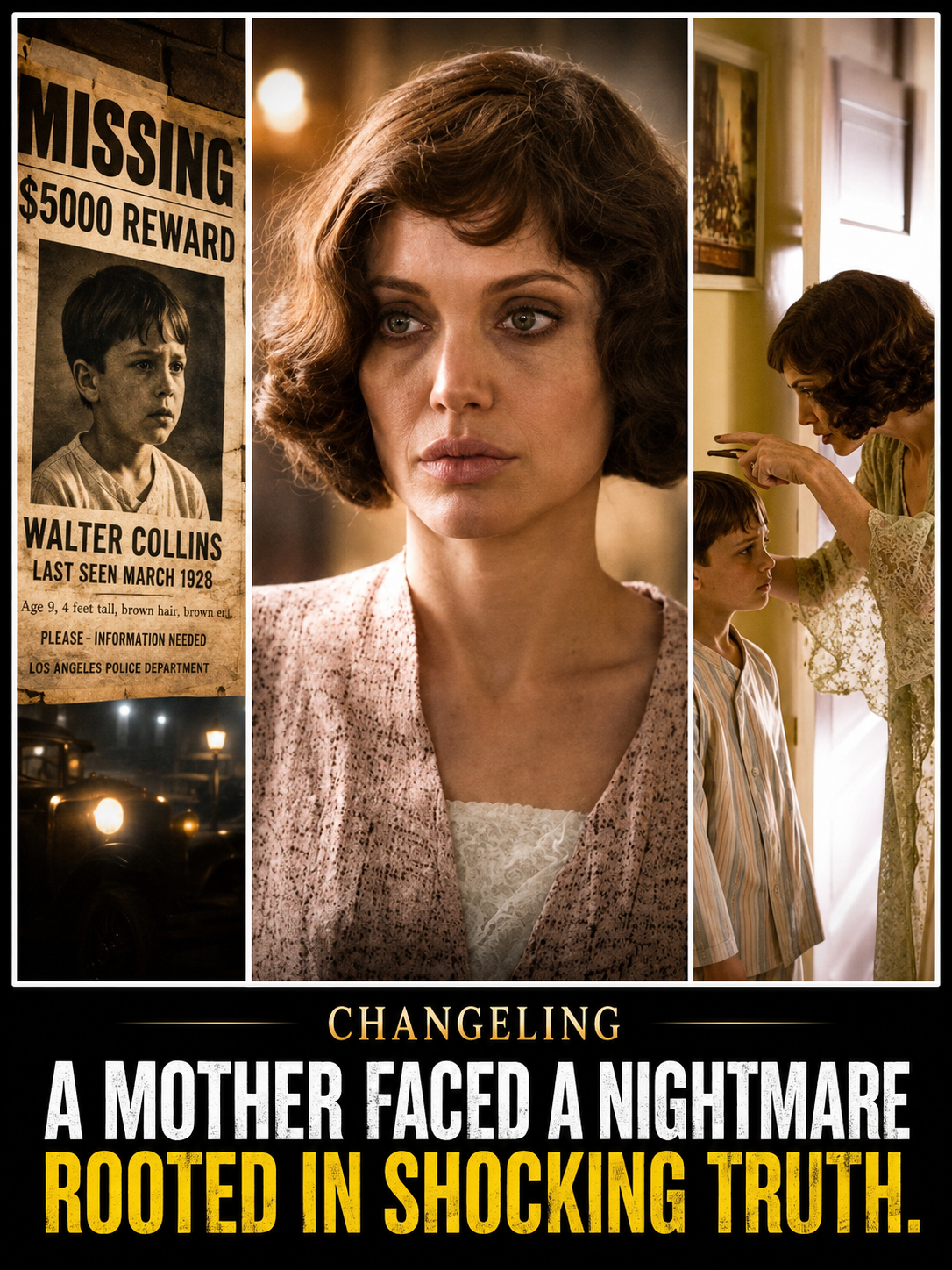
In Clint Eastwood’s 2008 film Changeling, Angelina Jolie plays a mother trapped inside a nightmare that sounds almost too cruel to be true.
Her son disappears.
Months later, police proudly announce that they have found him.
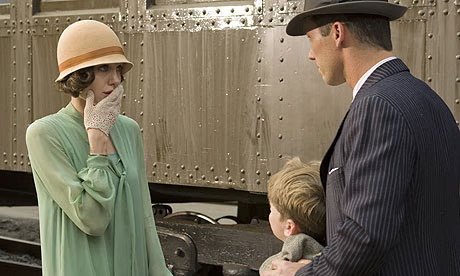
But when the boy steps off the train, she knows immediately that something is wrong.
He is not her child.
What happens next is what makes Changeling so disturbing: instead of admitting they may have made a mistake, authorities pressure the mother to accept the boy anyway. When she continues to insist they have returned the wrong child, police begin treating her as the problem.
It feels like the kind of storyline Hollywood might invent to make audiences furious.
But the basic story really happened.
The real woman was Christine Collins, a Los Angeles mother whose 9-year-old son, Walter, vanished in 1928. The stranger returned to her months later was eventually revealed to be a runaway named Arthur Hutchins.
And Christine’s fight to find out what happened to Walter became entangled with police corruption, psychiatric confinement and one of Southern California’s most notorious murder investigations.
The Real Story Began With a Dime and a Missing Boy
On March 10, 1928, Christine gave Walter a dime to go see a movie near their home in Los Angeles’ Mount Washington neighborhood.
He never came home.
Christine was a single working mother employed by a telephone company. When Walter disappeared, the case quickly attracted public attention.
Police searched extensively. Tips arrived from people claiming to have seen Walter around Los Angeles and even farther away. Investigators dragged a lake looking for his body.
Then, five months after Walter vanished, authorities announced what appeared to be a remarkable breakthrough.
They had found him.
A boy discovered in Illinois claimed to be Walter Collins, and the Los Angeles Police Department arranged a highly publicized reunion.
For an agency that had been receiving damaging press, returning a missing child to his mother offered a chance at good publicity.
There was only one problem.
Christine looked at the boy and knew he was not Walter.
She Said It Immediately: This Is Not My Son
At the reunion, Christine reportedly said, “I do not think that is my son.”
The differences were not subtle to her.
She knew Walter’s body, his teeth, his appearance and his personality. This child did not match.
Yet instead of stopping and thoroughly reconsidering the identification, police urged Christine to take him home.
She eventually agreed, under pressure.
For roughly three weeks, Christine lived with the child while continuing to gather evidence proving what she already knew.
She obtained dental records. People familiar with Walter supported her. The boy’s physical characteristics did not match those of her missing son.
Eventually, she returned to police and demanded that they acknowledge the truth.
That was when the situation became even darker.
Rather than concede that their celebrated reunion had been a mistake, police captain J.J. Jones attacked Christine’s credibility.
According to later testimony, Jones accused her of trying to embarrass the department and questioned whether she was refusing her responsibilities as a mother.
Christine continued insisting that the child was not Walter.
Jones responded by threatening to have her declared insane.
Then he did it.
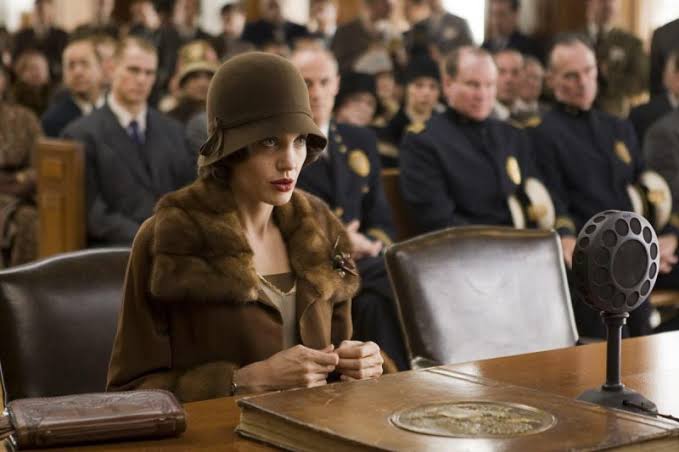
Police Put Her in a Psychiatric Ward
Christine was taken to the psychiatric ward of Los Angeles County General Hospital, where she remained for approximately a week.
Her supposed offense was essentially refusing to accept the police version of events.
The real case behind Changeling therefore goes beyond a missing-child mystery.
It became a story about institutional power.
Christine was a woman in the 1920s challenging male police officials who had already publicly celebrated solving the case. Admitting she was right meant admitting that they had made a spectacular mistake.
Screenwriter J. Michael Straczynski, who researched the case extensively using newspapers, court records and government documents, later argued that gender played an important role in the way she was treated.
A woman refusing to cooperate with authorities could be labeled unstable.
And once Christine became inconvenient, institutionalizing her became a way to silence her.
This is one of the areas where Changeling may feel exaggerated but is rooted closely in the historical record.
The real Christine really was confined.
And the boy really was not Walter.
The “Other Walter” Finally Admitted Who He Was
The mystery of the false son eventually unraveled.
The boy admitted that his actual name was Arthur Hutchins.
He was 12 years old and had run away from Illinois.
His reason for pretending to be Walter was remarkably childish compared with the damage his deception caused.
Arthur wanted to get to California.
Among his motivations was a desire to meet Tom Mix, one of the era’s biggest cowboy movie stars.
When he realized he resembled photographs of missing Walter Collins, he apparently decided to assume Walter’s identity.
The false reunion made headlines.
But once the truth came out, it humiliated the LAPD and vindicated Christine’s insistence that she knew her own son.
Unfortunately, exposing Arthur did not answer the question Christine actually cared about.
Where was Walter?
That question would soon collide with something far more horrifying.

Then Came the Wineville Chicken Coop Murders
At roughly the same time Christine was fighting police, investigators uncovered a series of crimes at a chicken farm in Wineville, a rural community near Riverside.
The farm belonged to Gordon Stewart Northcott.
Northcott was accused of abducting, abusing and murdering boys at the property. His nephew, Sanford Clark, eventually helped expose what had happened there.
Clark said Walter Collins had been one of Northcott’s victims.
That claim connected Christine’s missing-son case with what became known as the Wineville Chicken Coop Murders.
Northcott was ultimately convicted of murdering several boys and was executed in 1930.
But Walter’s fate was never conclusively established.
No remains positively identified as Walter were recovered from the property. Investigators also did not find the kind of physical evidence belonging to Walter that might have settled the question beyond doubt.
Christine therefore never completely gave up hope.
She continued searching for her son for the rest of her life.
That uncertainty is one of the most haunting parts of both the film and the real case.
There is no clean answer.

Reel vs. Real: How Accurate Was Changeling?
Surprisingly, many of the film’s most unbelievable elements are based on documented events.
Christine Collins existed.
Walter disappeared in 1928.
The LAPD returned the wrong boy.
Christine objected immediately.
Police pressured her to take him.
She later proved he was an impostor.
Authorities confined her in a psychiatric institution.
Arthur Hutchins admitted his real identity.
And investigators linked Walter’s disappearance to the Wineville murders, although his death was never proven conclusively.
Eastwood and Straczynski did make dramatic choices.
For example, Eastwood deliberately softened some of the horrifying details surrounding Northcott’s crimes rather than depicting the full brutality described in historical testimony.
But the core institutional nightmare faced by Christine was not invented for Hollywood.
In fact, the real case had consequences beyond Christine herself.
She sued over her false imprisonment, and public outrage grew around the LAPD’s conduct.
California later passed legislation restricting the ability of police to commit people to psychiatric institutions without proper legal authority.
The Real Mystery Never Received a Hollywood Ending
The title Changeling comes from old folklore about a child secretly replaced by another.
For Christine Collins, that nightmare effectively happened in real life.
Her son vanished.
Authorities gave her another boy.
Then, when she refused to accept their mistake, they tried to convince the world that she was irrational.
Angelina Jolie’s performance made Christine’s story familiar to millions of moviegoers.
But the real woman’s struggle was even more unsettling because there was never a definitive ending.
She proved the boy returned to her was an impostor.
She proved the police had treated her unjustly.
She fought back against powerful institutions and became the center of a scandal that shook Los Angeles.
But she never proved what happened to Walter.
For years afterward, she continued to hope that he might still be alive.
That may be the most devastating difference between an ordinary Hollywood mystery and the true story behind Changeling.
In movies, audiences expect the missing child to be found, the villain exposed and the mother given an answer.
Christine Collins got only two of those things.
She exposed a terrible mistake.
She survived an attempt to silence her.
But the one answer she wanted most remained out of reach:
What happened to her son?