THEY LEFT HER OFF THE GUEST LIST—THEN A GENERAL CALLED HER “ADMIRAL”
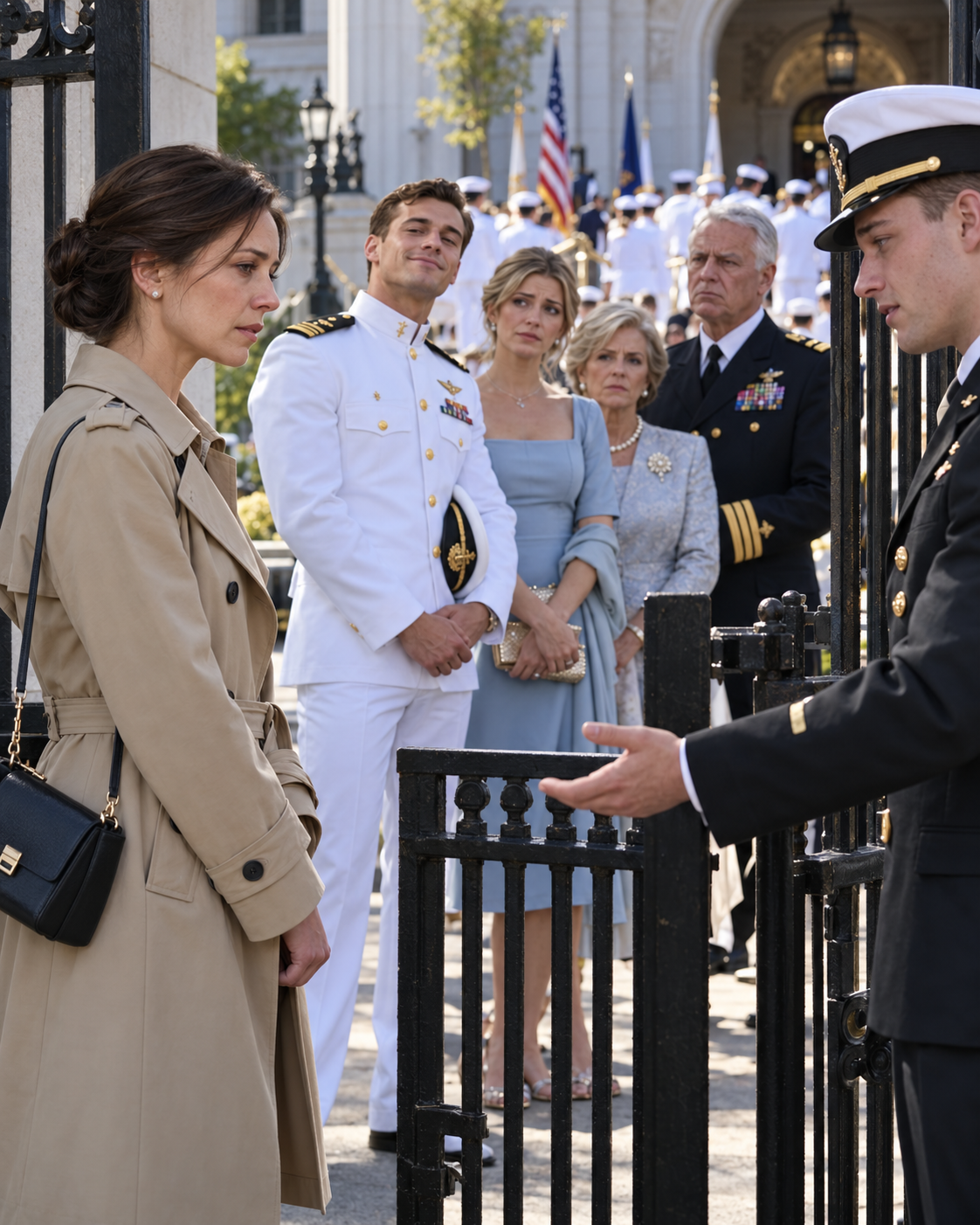
“SHE’S NOT EVEN ON THE LIST.”
My younger brother Ethan laughed when he said it.
Not loudly.
He didn’t need to.
There was something worse about the casual way he said it, like my humiliation was simply another amusing detail in a morning that belonged entirely to him.
Then a black sedan stopped beside the entrance.
A general stepped out.
He looked straight at me.
“Admiral Hayes. Front row.”
My entire family froze.
Ethan’s smile disappeared.
And before that morning was over, his hand would start shaking for a reason that had nothing to do with finally discovering my rank.
Because my promotion wasn’t the only thing he didn’t know.
And unfortunately for Ethan, I already knew exactly what he had done.
The morning had begun beneath a bright Annapolis sky.
Clear blue overhead.
White uniforms everywhere.
Families gathered outside the ceremony entrance, taking photographs, fixing collars, checking programs, and positioning themselves beneath banners for pictures they would keep for decades.
I arrived early.
I wore a beige trench coat over my uniform and carried a small purse.
Nothing about me looked important.
That was intentional.
I had spent most of my adult life learning how to enter rooms without being noticed.
Sometimes survival depended on it.
Sometimes national security did.
And sometimes, apparently, family peace did too.
At the gate, a young officer checked the guest list.
Then checked it again.
His expression changed.
“Ma’am?”
“Yes?”
“I’m sorry. Your name isn’t here.”
I looked past him toward the entrance.
Ethan stood twenty feet away.
Full dress whites.
Perfect posture.
New decoration waiting to be formally recognized on his chest.
His wife, Claire, stood beside him in a pale blue dress.
Our parents were nearby.
All four of them could see exactly what was happening.
Ethan smiled.
Not sympathetically.
Amused.
“Probably some paperwork mix-up.”
He said it loudly enough that two nearby families turned.
Then he glanced at Claire.
“She should’ve married a real officer instead of spending her life playing with spreadsheets.”
Claire gave a small, uncomfortable laugh.
My mother immediately became fascinated by the clasp on her pearl brooch.
My father did something worse.
He frowned at me.
Not at Ethan.
At me.
As though my missing name was somehow proof that I had once again failed to understand how the real Navy worked.
Dad had retired as a captain.
He knew ceremonies.
He knew protocol.
He knew that family seating lists didn’t simply materialize from nowhere.
Yet he didn’t ask the officer to check again.
He didn’t walk over.
He didn’t say, “That’s my daughter.”
He sighed.
Then followed Ethan through the gate.
Mom went with him.
Claire followed.
None of them looked back.
The young officer shifted awkwardly.
“Ma’am, I’m going to need you to step aside while we continue processing guests.”
I nodded.
“Of course.”
I moved.
No argument.
No raised voice.
No demand for special treatment.
No tears.
That was the part Ethan never understood about me.
He always believed that when I went quiet, he had won.
He never realized silence was simply where I had learned to place things that could not yet be spoken.
For fifteen years, my family had treated Ethan’s Navy career like a family monument.
Mine had been treated like an office hobby.
When Ethan received his Naval Academy appointment, Dad threw a party.
Not dinner.
A party.
Neighbors.
Family friends.
Former officers.
Banners.
A sheet cake big enough to feed fifty people.
Across the top, blue icing read:
CONGRATULATIONS, FUTURE ADMIRAL.
Dad loved that cake.
He photographed Ethan beside it.
Printed the photo.
Framed it.
Put it in his study.
That same week, I received a national science award for a cryptography project I had spent nearly a year developing.
I came home with the medal still inside its case.
Dad examined it for maybe three seconds.
“Good job, sweetie.”
Then somebody asked Ethan about Plebe Summer.
Dad turned away.
The medal disappeared into a drawer in my bedroom.
Nobody ever asked about it again.
Years later, when I told the family I had chosen naval intelligence, Dad’s reaction came immediately.
“Intelligence?”
“Yes.”
“That’s a support role, Sophia.”
I stared at him.
Mom tried to soften it.
“That may be better for her.”
Dad looked at her.
Mom smiled at me.
“Safer.”
Safer.
I never forgot that word.
Not because safety was shameful.
Because it showed me how little they understood.
Dad imagined a desk.
Mom imagined fluorescent lights and coffee cups.
Ethan imagined spreadsheets.
None of them imagined windowless rooms at two in the morning.
Satellite feeds.
Threat matrices.
Secure communications arriving faster than analysts could process them.
Decisions made with incomplete information and consequences measured in human lives.
They didn’t imagine me briefing commanders twice my age.
They didn’t imagine operations cancelled because of one anomaly my team caught.
They didn’t imagine the nights I slept three hours in forty-eight because something halfway around the world had started moving.
They imagined spreadsheets.
So eventually, I let them.
My work came with restrictions anyway.
There were locations I couldn’t confirm.
Assignments I couldn’t discuss.
Operations I could never tell as stories over Christmas dinner.
Even my job titles were sometimes easier to leave vague.
When Ethan joked that I pushed paper while he performed “real service,” I stopped correcting him.
When Dad called my career administrative, I nodded.
When Mom said she was relieved I had chosen something safe, I changed the subject.
Eventually I understood something.
They had already decided who I was.
There was no point begging them to look harder.
So that morning, standing outside the gate while my family disappeared inside, I simply waited.
Another family entered.
Then another.
The young officer kept glancing at me.
He knew something didn’t feel right.
He just didn’t know what.
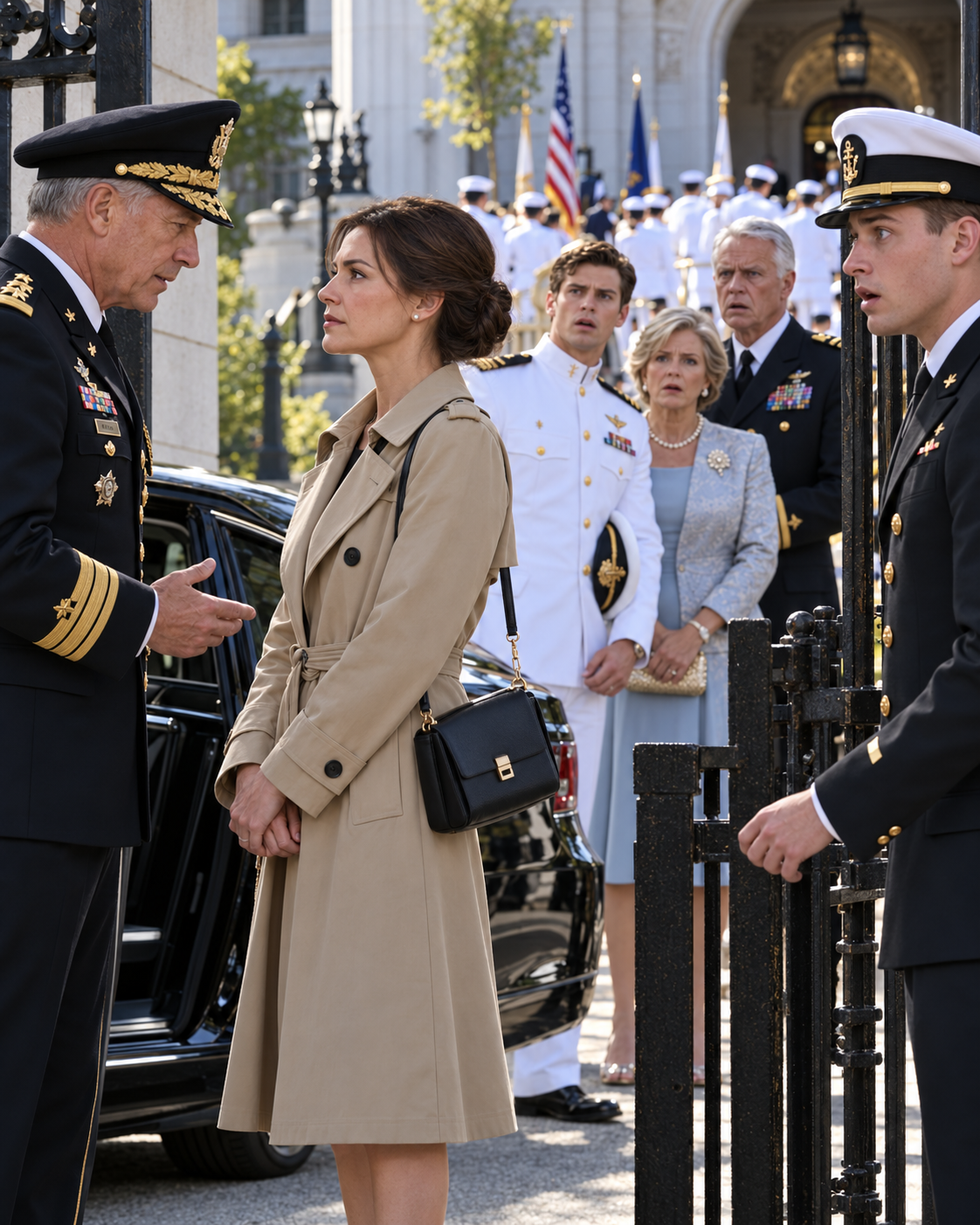
Then the black sedan appeared.
It rolled toward the curb and stopped.
The rear door opened.
General Miller stepped out in full dress uniform.
The gate officer straightened immediately.
Miller looked toward the entrance.
Then at the families.
Then at me.
His eyes moved once between me, the barrier and my family already standing on the other side.
Understanding reached him almost instantly.
Then he smiled.
“There you are.”
He approached.
“Admiral Hayes.”
The young officer beside me went completely still.
Across the walkway, my father heard the title.
He turned.
Ethan turned too.
His smile disappeared.
I said nothing.
General Miller stopped beside me.
“Would you like me to straighten this out?”
I looked beyond him.
My parents were staring.
Claire had gone pale.
Ethan looked as if somebody had spoken in a language he almost understood.
“No, General.”
Miller waited.
“I think they’ll understand soon enough.”
Something close to amusement crossed his face.
“Very well.”
He turned to the gate officer.
“She’s with me.”
“Yes, sir.”
I walked through.
Past my parents.
Past Claire.
Past Ethan.
“Sophia?”
I kept moving.
General Miller escorted me through a private corridor behind the stage.
Only after the door closed did I finally exhale.
He looked at my trench coat.
“You kept it covered.”
“That was the idea.”
“Still avoiding attention?”
“Always.”
He smiled.
“Not much longer.”
He left me alone to prepare.
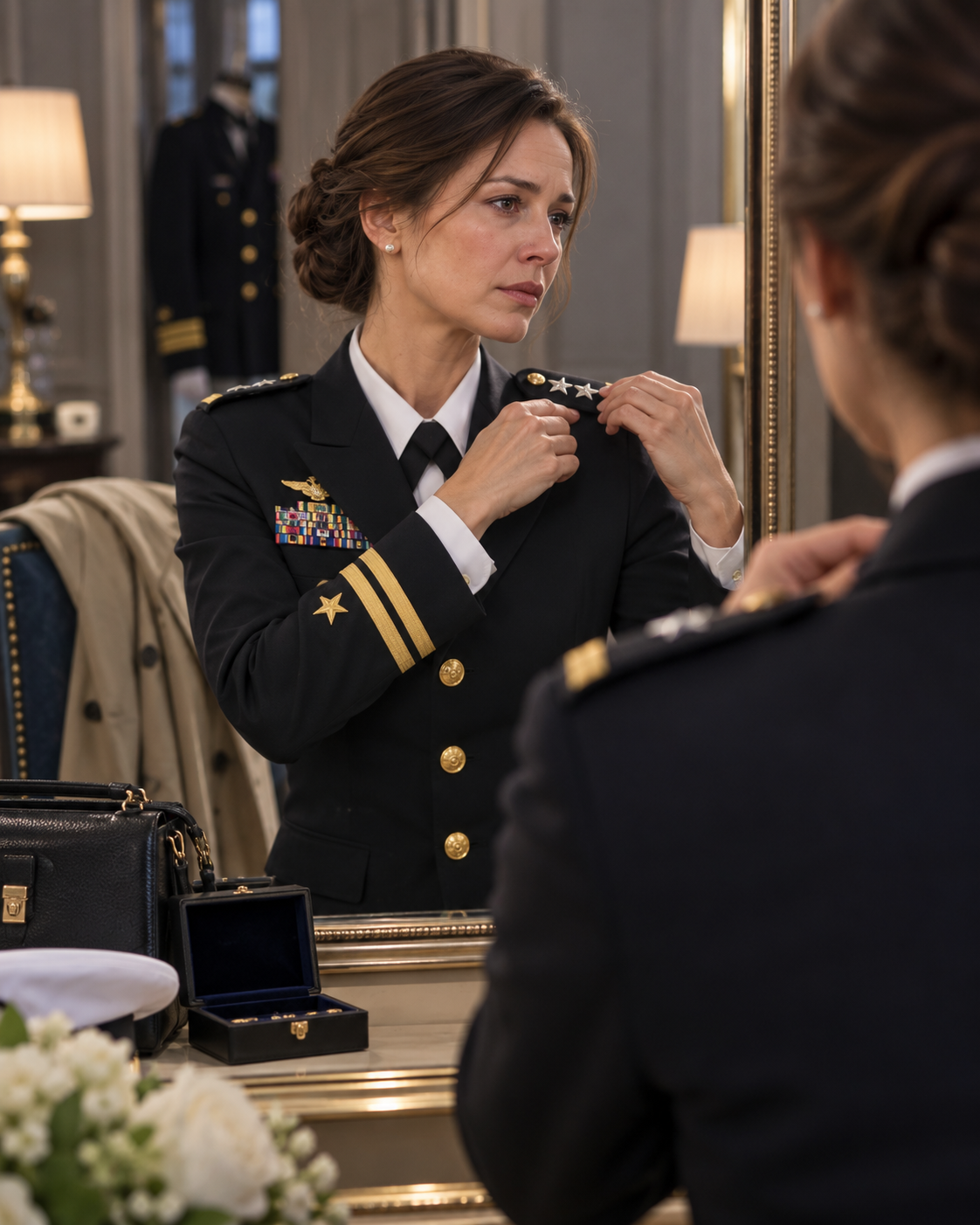
I removed the trench coat.
Underneath was my service dress uniform.
Perfectly pressed.
Ribbons aligned.
Insignia positioned exactly where they belonged.
I opened my purse.
Inside was a velvet-lined box.
Two silver stars waited inside.
I lifted one.
Cool metal.
Small.
Heavier than it appeared.
Not physically.
Because of everything attached to it.
Years my family had never understood.
Names they would never know.
Crises they never realized had almost happened.
Teams who had carried burdens together and gone home without ever being allowed to explain why they were exhausted.
I fastened the first shoulder board.
Click.
Then the second.
Click.
For years, my family had believed my plain clothing concealed an ordinary staff officer who spent her career behind a desk.
That morning, the trench coat had been concealing a rear admiral.
I looked at myself in the mirror.
Not because I needed to see the stars.
Because for a second I saw the twenty-three-year-old woman whose father had called intelligence “support work.”
I wished I could tell her one thing.
Don’t waste years trying to convince people committed to misunderstanding you.
Then I left the room.
The VIP section was already filling.
“Admiral Hayes.”
“Congratulations.”
“Good to see you, Admiral.”
A vice admiral shook my hand.
“Long overdue.”
A Marine general approached.
He congratulated me on an operation that had only recently been cleared for limited public acknowledgment.
“Excellent coordination.”
“Thank you, General.”
“You saved us a very ugly week.”
“That was the team.”
He smiled.
“That sounds like you.”
Across the aisle, I could feel my family watching.
I didn’t look.
I had spent my entire childhood measuring myself by their attention.
That day I refused.
The ceremony began.
Ethan was recognized first.
His name was announced.
Applause filled the auditorium.
He walked onto the stage.
For a few minutes, he appeared confident again.
He accepted his medal.
Shook hands.
Then stepped behind the microphone.
His remarks were polished.
He thanked the Navy.
His command.
His mentors.
Then Dad.
“My father taught me what honor and duty look like.”
Dad sat straighter.
Mom smiled.
Ethan thanked her too.
“For believing in me every step of the way.”
Then Claire.
“My rock through everything.”
Claire wiped her eyes.
Ethan looked toward my side of the auditorium.
Our eyes met.
One second.
Then he continued.
He never said my name.
I wasn’t surprised.
The applause rose and faded.
Ethan returned to his seat.
The program should have continued.
Instead, General Miller walked to the podium.
He wasn’t listed.
People noticed immediately.
Programs shifted.
Whispers died.
Miller adjusted the microphone.
“Ladies and gentlemen.”
Silence settled.
“We have one recognition this morning that does not appear in your printed program.”
Ethan leaned toward Dad.
Dad didn’t answer.
“For years, the work of one officer in this room could not be acknowledged publicly.”
Mom lowered her program.
“Her service was measured differently.”
Miller looked across the auditorium.
“Not in headlines.”
A pause.
“Not in photographs.”
Another.
“Not in public attention.”
My father’s expression changed.
“Her victories were measured in threats identified before they became crises. In operations protected. In lives preserved. In disasters prevented before the public ever knew how close they had come.”
Ethan’s shoulders stiffened.
“For much of her career, silence was not modesty.”
Miller paused.
“It was duty.”
My throat tightened.
Several officers around me already understood.
My family did not.
Not completely.
“Today, enough of that work has been cleared for public recognition that we are finally permitted to acknowledge one portion of what this officer has given.”
Dad stopped blinking.
Mom raised one hand toward her mouth.
Ethan stared at me.
Miller said my name.
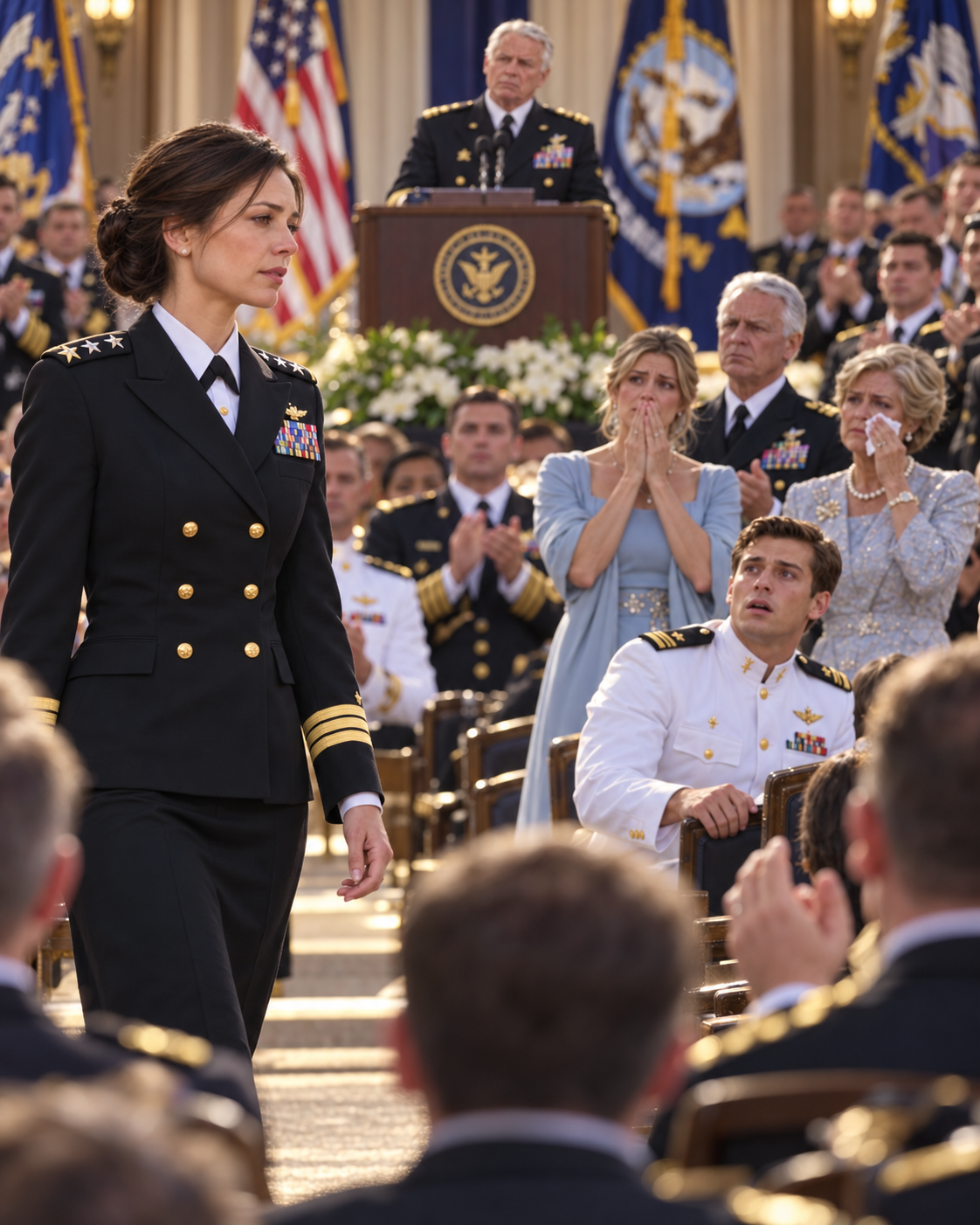
“Rear Admiral Sophia Hayes.”
Every officer around me stood.
Chairs moved almost simultaneously.
“Please join me onstage.”
My family remained seated.
Not intentionally.
They simply seemed unable to move.
I stood.
Adjusted my jacket.
Stepped into the aisle.
Ethan stared at my shoulders.
Two stars.
His eyes widened.
His hand began to tremble.
I walked toward the stage.
Past officers.
Past families.
Past some of the same people who had watched me get stopped outside.
General Miller met me at the top.
“Admiral.”
“General.”
An aide brought an official presentation folder.
Miller opened it.
He began reading.
Strategic intelligence coordination.
Joint operational planning.
Threat disruption.
Interagency support.
Lives safeguarded.
National-security consequences avoided.
The language was carefully cleared.
Specific enough to matter.
Vague enough to protect everything that still needed protecting.
With each paragraph, the room became quieter.
I finally looked at my family.
Mom was crying.
Dad looked stunned.
Claire had both hands folded tightly in her lap.
Ethan had gone pale.
My brother, who had laughed because I wasn’t on his guest list, now looked as if he were trying to reconstruct fifteen years of assumptions in real time.
Then General Miller reached the final paragraph.
His voice slowed.
I knew what was coming.
Apparently Ethan did too.
Miller looked down at the citation.
Then, briefly, toward my brother.
Ethan saw it.
And for the first time that morning, something like fear entered his face.
Not fear of me.
Fear of what the room was about to learn.
Miller began reading.
“Rear Admiral Hayes’s contributions also included the identification and containment of a serious compromise involving unauthorized circulation of restricted operational assessment material within a joint planning environment.”
Dad’s head turned sharply toward Ethan.
Ethan stopped breathing.
Miller continued.
“The resulting internal review prevented further dissemination, protected ongoing activities and allowed commands to correct procedural failures before those failures produced operational consequences.”
Nobody outside a small circle understood the full significance.
But Ethan did.
So did Dad.
And I did.
Because eight months earlier, my brother had almost ended his own career.
It happened on a Thursday night.
I had been in Washington reviewing an intelligence coordination package when an anomaly appeared in the access logs.
A restricted assessment had been opened from an authorized account.
That by itself wasn’t unusual.
What was unusual was what happened afterward.
Portions of the assessment appeared in an unsecured draft briefing distributed to personnel who were not cleared for every section it contained.
It was not espionage.
It was not treason.
It wasn’t some dramatic act of sabotage.
It was something far more ordinary.
And therefore far more dangerous.
Carelessness.
The draft had originated from Ethan’s planning cell.
His credentials had accessed the original material.
His initials appeared on the working document.
I remember staring at the screen when the investigator said his name.
Commander Ethan Hayes.
My younger brother.
The future admiral from Dad’s cake.
At that point, I had a choice.
Not whether to protect him.
That was never an option.
The process had to move forward.
My choice was whether to recuse myself completely and allow another flag officer to supervise the response, or disclose the relationship and remain involved under additional oversight because my team had already mapped the compromise.
I disclosed everything.
Every relationship.
Every possible conflict.
Then I told my superior:
“If you believe my presence damages the integrity of the review, remove me.”
He studied me.
“Can you be objective?”
“Yes.”
“That wasn’t my question.”
I looked him directly in the eye.
“I will treat him exactly as I would any other officer.”
He nodded.
“Then do your job.”
So I did.
The review found that Ethan had copied portions of a restricted assessment into working notes for an upcoming planning meeting.
He intended to simplify the material.
He was rushing.
He believed one distribution list was identical to another.
It wasn’t.
One recipient should never have received part of that information.
Nothing suggested malicious intent.
Nothing showed anyone exploited the mistake.
But intent did not erase the breach.
And rank did not excuse it.
The investigation continued.
Ethan never knew I was involved.
My name did not appear on the documents he saw.
That was deliberate.
But what he also didn’t know was that the first recommendation submitted by one reviewing officer had been severe.
Removal from his upcoming assignment.
Suspension of access pending full adjudication.
Possible administrative action that could have stalled his career for years.
I did not erase that recommendation.
I did not pressure anyone to dismiss it.
I did something else.
I forced the review to distinguish between negligence and intentional misconduct.
Because facts mattered even when the person being investigated was my brother.
I demanded the same thing I would have demanded for a stranger.
Evidence.
Proportionality.
Accountability without exaggeration.
The final finding was still serious.
Formal reprimand.
Mandatory retraining.
Loss of one highly desirable assignment.
Temporary restrictions.
A warning clear enough that one more similar failure could end Ethan’s advancement.
But his career survived.
Not because I saved him.
Because the evidence did not support destroying him.
There was a difference.
Ethan never understood that.
He only knew the investigation had somehow concluded less catastrophically than he feared.
He assumed his record had carried him.
He assumed his reputation had protected him.
He assumed Dad’s favorite phrase was true.
Good officers are recognized.
Standing on that stage while General Miller read the cleared citation, I watched Ethan realize the truth.
The sister he had mocked for “playing with spreadsheets” had been sitting above the process that reviewed one of the greatest mistakes of his career.
Miller carefully avoided Ethan’s name.
That detail was not public.
And I intended to keep it that way.
The recognition ended.
Applause filled the room.
I shook Miller’s hand.
The audience stood.
For several seconds, I could barely hear anything beyond the blood moving in my ears.
Then I returned to my seat.
The rest of the ceremony continued.
Ethan didn’t look at me again.
Afterward, families gathered beneath the colonnade for photographs.
Officers congratulated one another.
Parents hugged sons and daughters.
People moved toward receptions.
I made it thirty feet outside before Dad called my name.
“Sophia.”
I stopped.
My family stood together.
Dad.
Mom.
Claire.
Ethan.
For the first time all morning, none of them seemed certain what to say.
Mom spoke first.
“You’re… a rear admiral?”
“Yes.”
“For how long?”
“The promotion became effective recently.”
Dad stared at the stars.
“Two-star.”
“Yes.”
His jaw tightened.
“Why didn’t you tell us?”
The question was so extraordinary that I almost laughed.
Instead, I looked at him.
“When?”
Dad frowned.
“What?”
“When should I have told you?”
He didn’t answer.
“At Ethan’s birthday dinner when he spent ten minutes explaining that intelligence officers aren’t operational?”
Dad looked away.
“Or Christmas when you told Uncle Robert that Ethan was the only one of your children who had made the Navy a career?”
Mom whispered, “Sophia…”
“I was standing beside you.”
Dad’s face changed.
“I didn’t mean it that way.”
“I know.”
That seemed to relieve him for half a second.
Then I continued.
“You meant exactly what you believed.”
Silence.
“That’s different.”
Mom started crying again.
“We didn’t know.”
“No.”
I looked at her.
“You didn’t ask.”
That hurt her.
I could see it.
But it was true.
For years, whenever I tried to explain even the parts of my career I was permitted to discuss, someone changed the subject back to Ethan.
Eventually I stopped volunteering.
Dad rubbed one hand over his face.
“I thought…”
“I know what you thought.”
I didn’t say it cruelly.
That was what made it land harder.
Ethan finally spoke.
“The review.”
His voice was low.
Claire looked at him.
“What review?”
He ignored her.
He stared at me.
“That was you?”
“No.”
His brow tightened.
“I mean, were you the one who—”
“I supervised part of the response after disclosing our relationship.”
Claire looked between us.
“What are you talking about?”
Ethan’s face flushed.
“Not here.”
I turned to him.
“You’re right. Not here.”
He took a step closer.
“Did you know it was me from the beginning?”
“Once your identity appeared in the access review, yes.”
“And you never said anything?”
“I wasn’t permitted to.”
“You could have warned me.”
That sentence changed everything.
Dad looked sharply at him.
I stared at my brother.
“Warned you?”
“You’re my sister.”
“And you were an officer under review for mishandling restricted material.”
His voice became tense.
“I made a mistake.”
“Yes.”
“You could have told me what they were looking at.”
“No.”
“Why not?”
“Because that would have been misconduct.”
He looked almost offended.
“So you chose them over family?”
I could have answered immediately.
Instead, I let the question sit between us.
Then I said:
“I chose my oath.”
Dad’s eyes dropped.
Ethan laughed once without humor.
“Easy for you to say now.”
“No. It was easy then too.”
He stared.
“What was difficult was making sure anger didn’t affect my judgment.”
His expression changed.
“Anger?”
“Yes.”
“You were angry with me?”
“I was your sister, Ethan. Of course I was.”
“For what?”
That question almost impressed me.
“For fifteen years of jokes.”
He went still.
“For every time you called my work fake service. For every dinner where you introduced me as the sister who ‘does spreadsheets.’ For telling people this morning that I should have married a real officer.”
Claire looked down.
Ethan’s face reddened.
“But none of that went into your review.”
I stepped closer.
“Do you understand that?”
He didn’t respond.
“I made sure it didn’t.”
His breathing slowed.
“The initial recommendation was worse than what you received.”
His head lifted.
“What?”
Dad stared at me.
I continued.
“One reviewer wanted your access suspended pending adjudication and recommended removing you from your next assignment immediately.”
Ethan’s face drained.
“I didn’t overturn that recommendation for you.”
I paused.
“I required everyone involved to support every conclusion with evidence. When the evidence showed negligence instead of intentional disclosure, the outcome changed accordingly.”
“So you did help me.”
“No.”
That answer came sharper than I intended.
“I protected the integrity of the process.”
I lowered my voice.
“If the evidence had shown intentional misconduct, I would have signed whatever action the facts supported.”
Ethan stared at me.
“You would’ve ended my career?”
“If you had knowingly endangered an operation?”
I held his gaze.
“Yes.”
Mom whispered my name in shock.
But Dad said nothing.
Because Dad understood.
He had worn the uniform too long not to.
For the first time that day, he looked at me not as his daughter, not as Ethan’s sister, but as another officer.
And strangely, that hurt more than the disrespect ever had.
Because I had wanted that look from him for twenty years.
I just hadn’t realized how little I would need it once it finally arrived.
Claire broke the silence.
“Ethan, why didn’t you tell me there had been an investigation?”
He turned toward her.
“It was handled.”
“That’s not what I asked.”
“Claire—”
“You told me the assignment changed because of scheduling.”
He looked around.
“This isn’t the place.”
She folded her arms.
“You seem to say that whenever the truth becomes inconvenient.”
Then she walked away.
Ethan started after her.
Dad caught his arm.
“Let her go.”
Ethan pulled free.
“This is unbelievable.”
I almost asked which part.
His mistake?
His lie to his wife?
My rank?
Or the fact that for once the room wasn’t revolving around him?
Instead, I picked up my trench coat.
“I have another engagement.”
Mom stared.
“You’re leaving?”
“Yes.”
“But we were supposed to have lunch together.”
I looked at Ethan.
“I don’t think that’s a good idea today.”
Mom reached for my arm.
I didn’t pull away.
“Sophia, please.”
Her voice cracked.
“We need to talk.”
“We do.”
“When?”
“When the point of the conversation isn’t my rank.”
She looked confused.
I continued.
“If you want to know me now because there are stars on my shoulders, then we have nothing to discuss.”
Her hand fell.
“But if you want to understand why your daughter stopped telling you about her life years ago…”
I looked at both her and Dad.
“…then call me when you’re ready to talk about that.”
I left.
No dramatic music.
No shouting behind me.
No one begging me to return.
Real life rarely gives you that kind of clean scene.
I got into a government vehicle beside General Miller.
He glanced at me.
“Family?”
I looked out the window.
“Something like that.”
He nodded.
“Those can be harder than adversaries.”
“Adversaries are usually more predictable.”
He laughed.
Then the car pulled away.
For almost a week, nobody called.
That surprised me.
Then I realized they were probably waiting for me.
The old family pattern.
Something uncomfortable happened.
Sophia stayed quiet.
Everyone waited.
Sophia eventually returned and behaved as though nothing had happened.
Except this time I didn’t.
On the eighth day, Mom called.
I let it ring twice before answering.
“Hi, Mom.”
She was quiet.
Then:
“Can I come see you?”
Not we.
I noticed that.
“Yes.”
She arrived Saturday morning.
No pearls.
No carefully selected outfit.
Just jeans, a sweater and a bakery box she carried like a peace offering.
We sat at my kitchen table.
For several minutes, she said nothing.
Then she looked around my home.
There were almost no photographs of my family.
I hadn’t done that intentionally.
Or maybe I had.
“I found your science medal,” she said.
I looked at her.
“What?”
“At the house.”
She twisted her hands.
“When your father and I came home from Annapolis, I went into the old storage closet.”
My childhood belongings had been boxed years ago.
“I found the medal you won before Ethan went to the academy.”
I waited.
Mom’s eyes filled.
“I didn’t remember what it was.”
That confession cost her something.
Good.
It needed to.
“I had to read the engraving.”
I looked down at my coffee.
“I’m sorry.”
I didn’t answer.
She continued.
“I spent that afternoon going through old photographs.”
Her voice became uneven.
“Ethan’s academy appointment. His graduation. His first ship. Promotions. Ceremonies.”
She swallowed.
“There were entire albums.”
I knew.
“Then I tried to find pictures from your career.”
I looked at her.
“I found almost nothing.”
“That makes sense.”
“No.”
She shook her head.
“It doesn’t.”
A tear slid down her cheek.
“I used your secrecy as an excuse.”
I said nothing.
“You would say you couldn’t discuss work, and instead of asking about what you could discuss—how you were doing, whether you were tired, whether you were proud, whether you were lonely—I just assumed there was nothing interesting to ask.”
That was the closest anybody in my family had ever come to understanding.
Mom wiped her face.
“I made you invisible.”
The sentence hurt.
Because it was true.
Not just her.
All of them.
But she was the first to say it.
“I don’t know how to fix that.”
“You can’t fix fifteen years in an afternoon.”
“I know.”
“But you can stop repeating it.”
She nodded.
Then she pushed the bakery box toward me.
Inside was a small lemon cake.
No writing.
No blue icing.
No title.
Just cake.
I laughed before I could stop myself.
Mom smiled weakly.
“I figured we’ve had enough ceremonial cakes in this family.”
That was the first good moment.
Small.
But real.
Dad took longer.
Three weeks passed before he called.
When he did, his voice was formal.
“Could you meet me at the Naval Academy museum?”
It was exactly the kind of place my father would choose for an emotional conversation.
Neutral territory.
History nearby.
Plenty of objects to stare at when feelings became inconvenient.
I agreed.
He was already waiting when I arrived.
We walked for almost ten minutes before he spoke.
“When you selected intelligence, I was disappointed.”
“I know.”
“I thought you were wasting your potential.”
I stopped.
He turned.
“That’s supposed to help?”
“No.”
He exhaled.
“I’m trying to tell you how wrong I was.”
I waited.
He continued.
“I understood one version of service.”
He looked toward an exhibit.
“Ships. Commands. Visible things. Things I could explain to people.”
“And Ethan fit that version.”
“Yes.”
“And I didn’t.”
“No.”
The honesty was almost refreshing.
Dad put his hands in his coat pockets.
“I thought I was encouraging excellence.”
“You were encouraging Ethan.”
“Yes.”
He looked directly at me.
“And measuring you against him.”
I didn’t rescue him from the discomfort.
“I need you to know something.”
He paused.
“At Annapolis, when Miller called you Admiral, my first feeling wasn’t pride.”
That surprised me.
“What was it?”
“Shame.”
He looked away.
“Because I immediately knew what those stars meant. I knew how difficult that rank was to reach. I knew nobody arrives there accidentally.”
His jaw tightened.
“And my first thought was: How did my own daughter become a two-star admiral without me knowing?”
I said nothing.
“Then I realized that was the wrong question.”
He looked at me.
“The right question was: What kind of father makes his daughter feel there’s no reason to tell him?”
For years I had imagined apologies.
In those imaginary conversations, I delivered perfect speeches.
Dad admitted everything.
I forgave him elegantly.
We hugged.
Music swelled.
Reality was quieter.
My eyes burned.
I looked toward a display case.
“You missed a lot.”
“I know.”
“Things you can’t get back.”
“I know.”
“I’m not going to pretend that one apology erases it.”
“I’m not asking you to.”
That mattered.
Then Dad reached into his coat.
He removed a small photograph.
The old backyard party.
Ethan.
The enormous cake.
CONGRATULATIONS, FUTURE ADMIRAL.
Dad had cut the picture from its frame.
“I took this out of my study.”
I almost smiled.
“Dad, you don’t need to erase Ethan because you ignored me.”
He looked at the photograph.
“I know.”
“Then why remove it?”
“Because the frame was wrong.”
He reached into his pocket again.
Another photograph.
Me.
At twenty-three.
Holding my cryptography medal.
I recognized the picture.
Mom must have taken it.
I hadn’t seen it in years.
Dad held both photographs side by side.
“I ordered a larger frame.”
My throat tightened.
“Both pictures are going in.”
It wasn’t enough.
Of course it wasn’t enough.
But it was a beginning.
Ethan was harder.
For two months, I heard almost nothing from him.
Mom said he and Claire were having problems.
I refused to become involved.
Dad said Ethan had been removed from consideration for another competitive assignment.
That wasn’t because of me.
His previous reprimand was part of his record, and apparently his recent reaction to increased scrutiny hadn’t helped.
Then one evening, Ethan appeared at my door.
No uniform.
No Claire.
No confidence.
He looked tired.
“Can I come in?”
I considered saying no.
Then stepped aside.
He walked into the living room but didn’t sit.
For several seconds, neither of us spoke.
Finally he said:
“Claire left.”
I kept my expression neutral.
“I’m sorry.”
“She says she doesn’t know what else I haven’t told her.”
“Have you told her everything now?”
He looked at the floor.
“Yes.”
“Then give her time.”
He nodded.
More silence.
“I hated you.”
That made me look up.
He gave a bitter laugh.
“After Annapolis.”
“I assumed.”
“I thought you embarrassed me on purpose.”
“I didn’t.”
“I know that now.”
He sat.
“I kept replaying the ceremony. Miller looking at me. Dad looking at me. Everybody standing for you.”
He rubbed his hands together.
“And I kept thinking you’d planned the whole thing.”
“I didn’t even choose the timing of the recognition.”
“I know.”
He looked at me.
“That almost made it worse.”
“How?”
“Because none of it was about me.”
There it was.
The first completely honest thing my brother had said.
He leaned back.
“I think I spent my entire life assuming I was the main character in this family.”
I almost smiled.
“Dad didn’t exactly discourage that.”
“No.”
He looked toward the window.
“When I got the academy appointment, everybody acted like I’d saved the country.”
“You were seventeen.”
“I believed them.”
“That part isn’t your fault.”
“What happened afterward is.”
I waited.
He continued.
“The first time I joked about your spreadsheets, Dad laughed.”
I remembered.
“I liked it.”
His voice became quieter.
“Because suddenly there was something I could always beat you at.”
“You thought.”
“Yeah.”
He looked embarrassed.
“You were always smarter than me.”
“Ethan—”
“No, let me say it.”
I stayed quiet.
“You won competitions. Scholarships. That science award. You understood things I couldn’t even follow.”
He gave a humorless smile.
“Then I got into Annapolis, and suddenly I had something that made Dad look at me the way he used to look at you when we were little.”
That was new.
I frowned.
“He used to look at me like that?”
“You don’t remember?”
“No.”
Ethan nodded.
“Before high school. You were his genius.”
I remembered math problems at the kitchen table.
Dad smiling when I solved them.
A science fair when he stayed up helping me build a display.
Then Ethan started swimming competitively.
Then JROTC.
Then Annapolis.
Somewhere along the way, the family story had rewritten itself.
“I was afraid if your Navy career looked important too, I’d lose that.”
I stared at him.
“So you diminished it.”
“Yes.”
“Repeatedly.”
“Yes.”
“For years.”
His eyes lowered.
“Yes.”
I wanted to be angry.
I was.
But underneath it was something sadder.
Two children had spent adulthood competing for a father’s attention.
One had been crowned.
The other had withdrawn.
Neither had really won.
Ethan took a breath.
“The security mistake happened because I was rushing.”
“I know.”
“I wanted that next assignment.”
“I know.”
“I knew people thought I was on track for flag someday.”
I said nothing.
“I started believing every delay was something to beat. Every rule was an obstacle. Every warning was somebody slowing me down.”
He looked at me.
“When the review ended without destroying my career, I didn’t learn the lesson.”
“I know.”
“I thought I’d beaten that too.”
“Yes.”
He laughed softly.
“You really do know everything.”
“No. Just more than you thought.”
For the first time, he smiled at me without competition behind it.
Then the smile disappeared.
“Why didn’t you bury me?”
“What?”
“You could have.”
“No.”
“Maybe not illegally. But you could’ve stepped back and let the harshest recommendation stand.”
“That would still have been using the process against you.”
“After everything I said to you…”
“That wasn’t relevant.”
He stared at me.
I leaned forward.
“This is the part you never understood about service, Ethan.”
His face tightened.
“It isn’t a stage where we prove which one of us matters more.”
He remained silent.
“It’s responsibility. Especially when nobody is clapping.”
His eyes filled.
I had never seen my brother cry as an adult.
Not even at our grandfather’s funeral.
He wiped his face quickly.
“I’m sorry.”
I didn’t answer immediately.
He continued.
“Not for Annapolis.”
He swallowed.
“For making you smaller so I could feel bigger.”
That was the apology.
Not “sorry you were hurt.”
Not “sorry you misunderstood.”
Not “sorry things got out of hand.”
Specific.
Ugly.
True.
I nodded slowly.
“Thank you.”
“Do you forgive me?”
I looked at him.
“Not all at once.”
He seemed surprised.
Then he nodded.
“Fair.”
“But I think I can eventually.”
His shoulders dropped.
That was enough for one evening.
Over the following year, things changed slowly.
Not magically.
Mom started calling once a week.
Sometimes she asked about work.
When I said I couldn’t discuss something, she didn’t change the subject.
She asked about me instead.
Dad stopped introducing Ethan as “the military one.”
The first time I heard him tell a friend, “Both my children served, just in very different worlds,” I pretended not to notice.
But I did.
Claire eventually returned home.
She and Ethan entered counseling.
Their marriage survived, although not because anyone pretended the lies hadn’t happened.
Ethan completed additional security training voluntarily.
Then, to the surprise of nearly everyone who knew his ambition, he withdrew himself from consideration for one prestigious assignment.
When Dad asked why, Ethan said:
“I think I need to learn the job I have before chasing the next one.”
I heard about it secondhand.
I didn’t congratulate him.
He wasn’t a child.
Doing the responsible thing wasn’t a performance.
But privately, I was proud.
Nearly fourteen months after the Annapolis ceremony, Ethan invited the family to dinner.
Nothing formal.
Just the four of us plus Claire.
At dessert, Dad disappeared into his study.
He returned carrying a frame.
Two photographs.
On the left, seventeen-year-old Ethan beside the blue cake.
CONGRATULATIONS, FUTURE ADMIRAL.
On the right, twenty-three-year-old me holding the cryptography medal nobody had remembered.
Below both pictures, Dad had added a small brass plaque.
It did not list ranks.
It did not list awards.
It simply read:
ETHAN AND SOPHIA
WE SHOULD HAVE BEEN PROUD OF BOTH.
Mom started crying.
Dad looked embarrassed.
Claire squeezed Ethan’s hand.
I stared at the plaque.
Then at Dad.
“You know this is incredibly sentimental for a retired captain.”
He cleared his throat.
“I’m getting old.”
“That must be it.”
Everyone laughed.
Even me.
Especially me.
Later, Ethan walked me to my car.
The night was cool.
For a moment, we stood beneath the porch light like two people learning how to be siblings again.
He looked at my shoulder.
No uniform that night.
No stars.
Just a black sweater.
“You know what’s funny?”
“What?”
“When we were kids, I really did think you’d become an admiral.”
I stared at him.
“You did?”
“Yeah.”
“Why?”
“You were terrifying.”
I laughed.
He smiled.
Then his expression softened.
“I’m serious. You always knew where everything was. You always had a plan. Dad would lose his keys, Mom would forget an appointment, I’d miss a deadline…”
“And?”
“You fixed it.”
I shook my head.
“That doesn’t make someone an admiral.”
“No.”
He put his hands in his pockets.
“But maybe we were all looking at the wrong things.”
I understood what he meant.
For years, Dad had thought rank was visible.
Mom had thought danger was obvious.
Ethan had thought service needed applause.
And I had made my own mistake.
I had decided that because they misunderstood me, I no longer needed anything from them.
That wasn’t entirely true.
I had needed respect.
I had needed curiosity.
I had needed the simple dignity of being seen.
What changed was that I finally stopped begging for those things.
And once I stopped begging, my family had a choice.
Look harder.
Or lose me.
They chose to look.
Not perfectly.
Not immediately.
But they did.
Before I got into my car, Ethan called after me.
“Sophia.”
I turned.
He smiled.
Not the mocking smile from the gate.
Something quieter.
“Congratulations, Admiral.”
For once, there was no jealousy in it.
No joke.
No competition.
Just my brother.
I nodded.
“Thank you, Commander.”
He laughed.
Then I drove home.
Months later, I attended another Navy ceremony.
This one had nothing to do with me.
A young intelligence officer I had mentored was receiving recognition for work that would never be fully described in public.
Her parents sat in the audience.
When her name was announced, her father stood first.
He applauded so hard that people around him smiled.
Afterward, I watched him hug his daughter.
“I don’t understand half of what you do,” he told her.
“But I know it matters.”
I had to look away for a moment.
Not because I envied her.
Because I finally understood what I had wanted all those years.
It had never been a bigger cake.
It wasn’t photographs.
It wasn’t Dad bragging about my rank.
It wasn’t the auditorium standing when General Miller said my name.
It was that sentence.
I don’t understand everything you do.
But I know it matters.
My family had taken a long time to learn that.
So had I.
Because somewhere along the way, I had also learned something more important.
Your worth does not begin when somebody finally recognizes it.
I had been the same officer outside the gate that I was when General Miller called me Admiral.
Same record.
Same sacrifices.
Same two stars beneath the trench coat.
Ethan’s laughter had not made me smaller.
The auditorium standing had not made me larger.
The truth had existed before either reaction.
That may have been the most satisfying part of all.
My brother didn’t lose his career.
My parents weren’t destroyed by guilt.
I didn’t cut everybody off and walk away while they begged for forgiveness.
Real accountability was less dramatic.
And harder.
Ethan had to become the kind of officer who no longer needed to be the most important person in the room.
Dad had to admit that the version of excellence he celebrated had been too narrow.
Mom had to learn that loving a child silently was not the same as making that child feel loved.
And I had to decide whether being right was more important than leaving room for people to become better.
I chose the second.
Not because they deserved an easy forgiveness.
They didn’t get one.
They earned their way back slowly.
One phone call.
One honest conversation.
One corrected assumption at a time.
And me?
I kept serving.
There were more briefings.
More impossible hours.
More rooms without windows.
More moments the public would never hear about.
The stars eventually stopped feeling heavy.
They became what rank was always supposed to be.
Responsibility.
Not revenge.
Not validation.
Responsibility.
But every now and then, when I visited my parents, I passed Dad’s study.
And there on the wall were two photographs.
Ethan with his ridiculous blue cake.
Me with a forgotten medal.
Neither photograph was bigger.
Neither sat above the other.
And beneath them was the same small plaque.
WE SHOULD HAVE BEEN PROUD OF BOTH.
One afternoon, I found Dad standing in front of it.
He didn’t know I was behind him.
He reached up and straightened the frame even though it was already perfectly level.
“You know,” I said, “you’ve adjusted that thing about three hundred times.”
He turned.
“Habit.”
“Military precision?”
“Fatherly guilt.”
I raised an eyebrow.
At least he was honest.
He smiled.
Then he looked back at the photographs.
“I wish I could redo some things.”
“I know.”
“You ever wish that?”
“Sometimes.”
“What would you change?”
I thought about it.
Then shook my head.
“Nothing important.”
He looked surprised.
“Really?”
“If you had understood my career from the beginning, maybe things would’ve been easier.”
I looked at the photograph of my younger self.
“But I learned how to work without applause.”
Dad nodded slowly.
“That sounds lonely.”
“It was.”
That answer hurt him.
I let it.
Then I added:
“But it also made me very difficult to intimidate.”
He smiled.
“That part I believe.”
I started toward the kitchen.
Dad called after me.
“Sophia?”
I turned.
He stood beside those photographs.
Not Captain Hayes.
Not the proud Navy father.
Just Dad.
“I’m proud of you.”
Years earlier, those words might have meant everything.
Now they meant something different.
Something healthier.
They were no longer proof that I mattered.
I already knew I mattered.
They were simply words from a father who had finally learned to see his daughter.
And that was enough.
I smiled.
“Thanks, Dad.”
Then I walked into the kitchen, where Mom was arguing with Ethan over whether he had ruined dinner by adding too much salt.
Claire was laughing.
Ethan pointed at me the second I entered.
“Admiral. Settle this.”
I took one look at the food.
“No.”
He blinked.
“You haven’t even tasted it.”
“I’ve assessed the available intelligence.”
Mom burst out laughing.
Ethan stared at me.
Then he laughed too.
And for once, when someone mentioned intelligence in my family, nobody called it spreadsheets.