What happened when a White man carrying a large wooden cross met a Black man at the nation’s largest Confederate monument
Stone Mountain, Georgia —
Jean Shifrin was hiking up a steep mountain trail on the Fourth of July when she was startled by something approaching her from behind.
“What in the world is going on here?” she wondered as she squinted in the morning sun at what was coming.
It was a White man and two Black men marching an 8-foot wooden cross up the slippery slope. One of the Black men, built like a linebacker, led the way. He balanced the head of the cross on his left shoulder while barking in a drill sergeant’s baritone, “Yessir! Yessir!”
The White man, his sinewy, tattooed arms already beet-red from the sun, shouldered the cross from the center beam. Another stout Black man brought up the rear. They were trailed by a cheering entourage, including a boy carrying a Bible and a middle-aged Chinese woman who kept shouting “Jiayou!,” or “Keep going!” inMandarin.
Shifrin, a wiry, 68-year-old photographer, is accustomed to strange sights on this mountain, a 825-foot-high rock monolith near Atlanta. The place itself is an historical oddity. Stone Mountain is known as the “Mount Rushmore of the Confederacy” and a shrine to White supremacybecause of a gigantic carving blasted into one side of its granite face.
The carving depicts the holy trinity of the Confederacy — Robert E. Lee, Thomas “Stonewall” Jackson and Jefferson Davis — mounted on horseback. It stands taller than the iconic presidents on Mount Rushmore and is the largest Confederate monument in the nation.
Not long ago, though, the only White men who carried crosses up Stone Mountain burned them. The mountain was the birthplace of the modern-day Ku Klux Klan, and a frequent rallying site for other White supremacist groups. It’s also been a frequent target for Black Lives Matter protestors and others who seek the removal of the more than 600 Confederate monuments that still stand across America.
Shifrin, too, had once only seen the mountain as a symbol of hatred. But it became a source of healing at a time in her life when she was suffering a debilitating genetic condition and didn’t know if she would walk again.
Could they show her yet another side of this place? She wanted to find out.
But when she began to climb the mountain and photograph the people who gathered at its summit, she made a discovery: There’s more than one way to tear down a Confederate monument.
Shifrin has spent years documenting the people who come to Stone Mountain. But she’d never seen anything like the men carrying the cross on July 4. Could they show her yet another side of this place? She wanted to find out.
What she learned yielded another surprise: What drove these men went beyond religion.
Defenders of Confederate public symbols have long insisted that they are defending heritage, not hate. Southern leaders, though, were clearabout why they seceded from the US, triggering the Civil War.
In his infamous “Cornerstone Speech,” Alexander Stephens, vice president of the Confederate States of America, explicitly rejected Thomas Jefferson’s proclamation in the Declaration of Independence that “all men are created equal.”
“Our new government is founded upon exactly the opposite idea,” Stephenson said in a speech three weeks before the start of the Civil War. “Its foundations are laid; its corner stone rests upon the great truth that the Negro is not equal to the White man; that slavery, subordination to the superior race is his natural and normal condition.”
The creation of the Confederate memorial at Stone Mountain was driven by some of those same beliefs. It began in the early 20th century at the urging of a Confederate widow who also considered adding KKK members to the carving. More than 50 years passed before the carving was completed in 1972. It’s now part of Stone Mountain Park, a theme park 16 miles outside Atlanta that opened on April 14, 1965 — 100 years to the day after Abraham Lincoln’s assassination.
Shifrin recalled her reaction when she first gazed at the carving in the 1990s. As a Jewish woman who had experienced antisemitism, she was angered by any form of prejudice.
“I was revolted,” she said. “The more I learned about the history of it and how it was started — it just got uglier and uglier.”
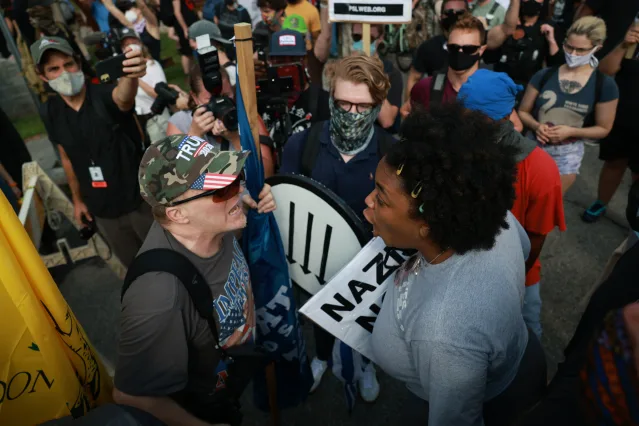
But in recent decades, the mountain has undergone a transformation. It has become a mini-United Nations, a daily gathering spot for people of different races, religions and cultures. They climb the mountain to workout, mediate, celebrate anniversaries and mourned loved ones. This symbol of hatred has quietly bloomed into a snapshot of the Rev. Martin Luther King Jr.’s “Beloved Community.”
Shifrin noticed this change because that’s what she’s done most of her life: see what others overlook. She’s not just any hiker — she’s one of the nation’s best photojournalists. Shifrin spent 30 years as an award-winning photographer, traveling the world to document Muslim women in the Middle East, a community of Hansen’s disease survivors in India and kids with terminal illnesses in the US.
The mountain is her latest focus. Armed only with a stainless-steel water bottle, a pack of roasted almonds, sunscreen and hand sanitizer, she’s been making regular treks to the monument for 12 years.
Using her iPhone, she captures the astonishing variety of characters who flock to the mountain every day: Buddhist monks, American soldiers carrying flags, a Congolese choir filming a music video — and once, two men in baggy clown costumes. Those snapshots are collected in her 2025 book, “Rise Above: On Top of Stone Mountain.”
“I can be up there and … hear five different languages, and English will be the least I hear,” Shifrin said.
One recent day, Shifrin showed a reporter how she works.
When we arrived at the monument about 8:30 that morning, it was already bustling with energy. A group of shirtless men stretched and did pushups in a parking lot. A hiker made fun of a friend’s new running shoes. And a jogger in camouflage shorts and a straw hat smiled flirtatiously at two young women, greeting them with a hearty, “Morning ladies!”
Our trek up the mountain required us to hopscotch over a trail pockmarked with craters and granite rocks. The climb became steeper as the summit loomed ahead, and the sun burned brighter.
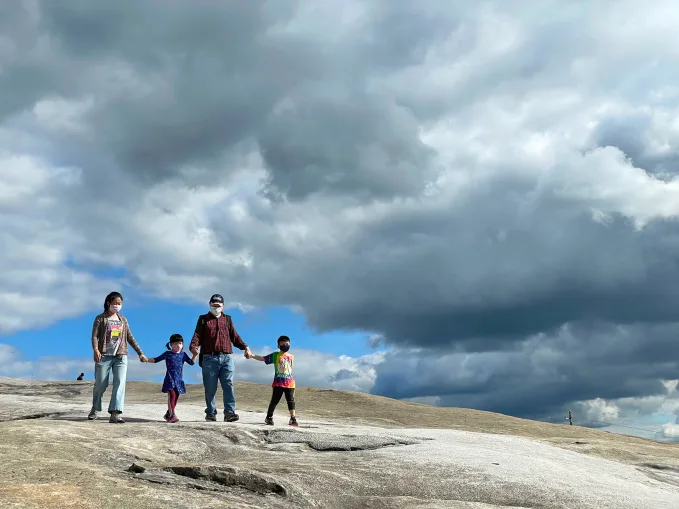
The carving may divide people, but there was no “us vs. them” on this climb. Gravity wouldn’t allow it. The challenge of getting to the top connected everyone. Strangers took the hands of weary climbers to help guide them to the top. Hikers returning from the summit encouraged those on the way up with, “You got this! Almost there.” The aroma of coconut sunscreen lingered in the air.
The scene was surreal. The crowd was a rainbow mixture of colors, age groups and languages, all chatting and laughing with one another while standing above a granite rendering of Confederate leaders who would have been aghast at what their monument had become.
The carving is invisible from the trail, but many visitors to the mountaintop knew where they stood. It looms over the landscape of Stone Mountain Park and is impossible to miss for visitors opting to catch a cable car to the summit, which runs right past the carving.
Still, many of the visitors to the top of the mountain didn’t seem to care.
Nerry Bumba, a native of the Democratic Republic of Congo, took deep breaths as sweat poured down his dark face. He had just made the summit. He’d heard about the carvings, and the controversies. He shrugged.
“It’s one of those things where you kind of live in the moment,” he said. “History is behind. The idea of us all getting up here. Everybody just wants to do their own thing. We respect each other.”
Was his presence in some way a form of protest? Bumba, 39, paused to consider the question.
“To say it’s a protest, I’ll say no,” he said. “But unspoken protest? Yes.”
Nearby, Kimberly Kilroy took in the view. It was a clear, blue-sky day, and the gleaming glass towers of Atlanta’s skyline were visible 16 miles to the west.
This was Kilroy’s third time at Stone Mountain. The 43-year-old White woman recalled what she thought when she first saw the carving.
It was “absolutely beautiful,” she said. “It’s just unique; it reminds us of our roots,” she added while wearing a pink visor and a pink tank top emblazoned with the slogan, “It’s always impossible until it’s done.”
Kilroy, who survived a childhood bout with cancer, was fascinated by the stunted pine trees that dotted the mountaintop. She seems them as symbols of resilience.
“You’ll see a tree just growing out of nowhere, and the thought process to me is, no matter where you are, you can grow,” she said.
King alluded to the mountain’s racist reputation in his 1963 “I Have a Dream” speech when he said, “Let freedom ring from Stone Mountain of Georgia.” But chants of “White power” still rang from the mountain for years afterwards. Members of the KKK shouted that phrase while holding rallies there as recently as the 1970s.
A 2001 Georgia law prohibits altering, concealing or removing the carving. The law was a compromise — lawmakers passed it in exchange for letting Georgia remove the Confederate battle emblem from its state flag.
“I’ve been in Atlanta since 1970, and Stone Mountain was a very different place,” said John Brieske, a regular visitor to the trail. “It was 98 percent White people climbing the mountain.”
Change at the monument seemed unlikely. But tectonic shifts have been quietly happening in Atlanta and across the South.
Georgia’s demographics have changed in recent decades, fueled in part by Black people returning to the South for better economic opportunities.
Non-Whites accounted for all the state’s growth over the past five years, according to the US Census Bureau, and Georgia is now almost equally divided between White and non-White residents. A large number of Black people now work in Stone Mountain Park and use the mountain trail.
As a photojournalist, Shifrin noticed these demographic changes when she began hiking Stone Mountain in 2014.
“I see things that other people aren’t seeing because they’re not looking,” she said. “They’re not attuned to it. It’s a different mindset.”
Shifrin had another reason to look deeper at Stone Mountain. She needed to find hope.
She suffers from osteoarthritis that weakened her knees and feet. She endured eight surgeries in 12 years and spent much of her time confined to crutches and wheelchairs.
There were times when she thought she might not walk normally again. But hiking the mountain became a form of therapy – both physical and otherwise, said Judy Shifrin, her sister.
“The need to climb that mountain got her through a lot of surgeries, got her through rehab — she could not give up,” her sister said. “She has to climb that granite. If she could not climb that mountain, I would be concerned about her mental health.”
When her early attempts to climb became a struggle, Shifrin drew inspiration from what she saw.
“I have seen blind people go up there with white canes,” she said. “I’ve seen people with cerebral palsy hike up there, really overweight or old people, and I’m thinking, ‘Oh my god, what I’m dealing with is nothing.’”
Her ability to notice is what directed her attention to the cross-bearing men on July 4.
Most of what happened next was caught by Shifrin’s camera. Some of it was also posted on Facebook and Instagram by people who participated and witnessed what unfolded. Two of the men later talked to CNN about that day.
The White man with the wooden cross was Joseph Colt Hamrick, a roofer in Macon, Georgia, and a father of two children. He had recently been baptized in the North Carolina mountains and felt called to carry the cross up Stone Mountain.
Hamrick started out alone. The cross weighed 75 pounds. He stopped halfway up, bent over from exhaustion. He recited the words he had tattooed on his muscular arms: “Lord, grant me strength.”
Then a middle-aged Black man in a sleeveless gym shirt and shorts appeared at his side.
“Brother, you need me to carry that cross?” he said. “I’ll carry it for you.”
Hamrick, panting heavily, smiled and accepted the offer. But as the two men continued up the steep incline, they began to falter.
“Can we just put this down under that tree?” Hamrick said to his companion, motioning to a spot short of the summit.
That’s when another Black man, wearing khaki shorts and a T-shirt that read “Pushing Peanuts,” appeared. His name is Shaun Quiovers.
“Do you mind if I help carry your burden?” Quiovers said.
Quiovers is a US Army veteran and professional mover who had spent months hiking up the mountain with a backpack for exercise. He hadn’t planned on hiking the mountain that day but decided to trek up with his wife and two boys at the last minute.
“I’ve been training for this,” Quiovers told Hamrick.
“Right place, right time,” Hamrick replied.
“Ready?” Quiovers asked.
“Let’s do this thing,” Hamrick responded.
The three men lodged their shoulders under the cross, and in unison they chanted “one, two, three.” They lifted the cross upward with a loud grunt.
Shifrin followed, snapping shots with her iPhone.
As they neared the top, onlookers began to applaud. One shirtless man, returning from the summit, slapped five with Quiovers’ free right hand.
At the summit they posed for snapshots with the cross and then leaned it against a tree as a crowd of Black, White and brown people hooted in appreciation.
“Happy Fourth of July!” a woman yelled.
The first Black man, who had struggled throughout the climb, walked away without giving his full name after accepting Hamrick’s thanks. But Quiovers lingered.
Shifrin caught up with the men and asked them what they were doing. “Wait, you guys don’t know each other?” she said, looking at Hamrick and Quiovers.
They laughed. “Nope,” both said in unison.
Hamrick decided to pray. He bowed his head, and Quiovers took off his hat and joined him.
“Lord, we thank you for this day,” Hamrick said. “If you would, put your hands on everyone on this mountain today, especially these kind souls who helped me carry this cross up this mountain.”
Some might not view the scene as so heartwarming. Was Hamrick trying to replace one exclusive vision of race with another exclusive vision of religion on top of the mountain?
He says no. He says he’s encountered people of different faiths in his business and he respects their beliefs.
“We all come from the same source,” he said. “We may not believe the same thing, but we’re a lot more alike than you can imagine.”
Hamrick said he knew he was standing on top of a Confederate monument that day. He doesn’t care.
“I don’t see people as Confederates, liberals or Republicans,” he said. “The Devil’s greatest trick is to make us forget that we’re all brothers and sisters in Christ, and we’re all together in this.”
“We all connected,” he added.
Quiovers said he also knew about the mountain’s ugly history. He grew up in Lithonia, Georga, a predominately Black community nearby. He said there are members of his family who still won’t go to Stone Mountain.
“We can’t continue to live in what used to be. We have to create our own narrative,” he said. “If not, we’re just a hamster on a wheel and we’re going to get nowhere.”
The two men left the cross atop the mountain. Both agreed they had each made a new friend, and they vowed to meet again after that day for a family cookout. Their young children — Quiovers had two boys with him, and Hamrick his daughter and son — were “already thick as thieves” by the time they got back down to the mountain, Hamrick later said.
Shifrin took more pictures. She would post them on her Facebook and Instagram pages. It’s her own “unspoken protest” — a way to tear down the message Stone Mountain’s Confederate memorial was built to send.
She’s no longer revolted by what she sees at Stone Mountain. She’s still repulsed by the carving, but her camera is drawn to something else.
“I get to see people living lives that are so different from mine,” she said. “And I see this at the top of the mountain. In a million years, I would not put on a clown costume and walk up a mountain. But I’m glad other people do.”
Hatred isn’t permanent, even when it’s carved in stone. The people who built the Confederate monument at Stone Mountain were trying to preserve the past. The people who climbed the mountain on the 250th anniversary of America’s birth, and who continue to gather there today, are embracing another vision.
It’s a vision of a future where enough of us accept a simple truth: “We all connected.”
https://www.cnn.com/2026/07/19/us/stone-mountain-cross-jean-shifrin