Terry Crews Nearly Lost His 37-Year Marriage—Then a Painful Confession Gave Them Another Chance

By the time Terry Crews finally told his wife the whole truth, Rebecca King-Crews was no longer interested in promises.
She had spent years sensing that something was wrong beneath the surface of their marriage. Now Terry was admitting to infidelity and a compulsive dependence on pornography—secrets that had damaged their intimacy and allowed him to live what he later described as a double life.
Rebecca’s response was immediate: she was leaving.
For Terry, the possibility of losing his wife was no longer an abstract warning. Their marriage, their family and the life they had built together were coming apart because of choices he could no longer minimize or conceal.
The confrontation became the lowest point in their relationship. It also marked the beginning of a difficult rebuilding process that would eventually transform their marriage.
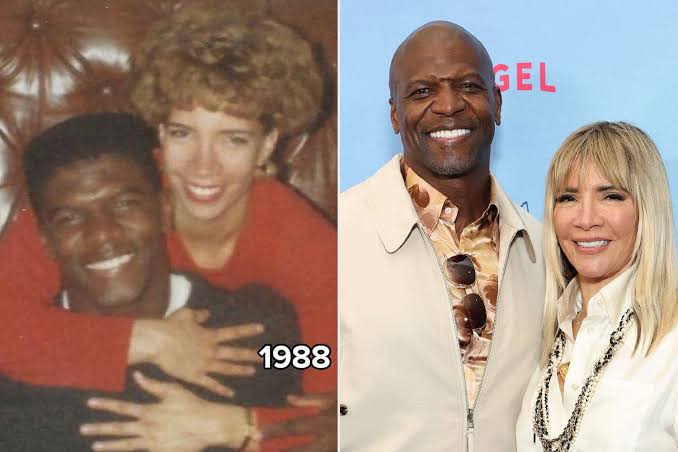
On July 29, 2026, Terry and Rebecca celebrated their 37th wedding anniversary. In a playful post, the couple recalled how skeptics once predicted they would last only three weeks. Photographs from different stages of their lives carried the joke forward—from “Day 1” to “Day 13,514.”
Behind the humor was a history far more complicated than a simple Hollywood love story.
Their marriage survived not because the damage was small, but because they eventually faced it without pretending it had never happened.
A Young Romance That Became a Family
Terry and Rebecca met in Michigan while they were still young. Rebecca was working as a music minister at a church, while Terry was a student and football player at Western Michigan University.
Their first impressions were not entirely cinematic. Rebecca has joked that Terry nearly ended up in the friend zone. The relationship nevertheless developed, and the couple married on July 29, 1989.
They went on to raise five children: Naomi, Azriél, Tera, Wynfrey and Isaiah. Terry adopted Naomi, Rebecca’s daughter from a previous relationship, and the family later welcomed a granddaughter.
Their early years included financial uncertainty and repeated transitions. Terry pursued professional football, playing in the NFL during the 1990s before moving into entertainment. His eventual success brought roles in movies and television, including “White Chicks,” “Everybody Hates Chris,” “Brooklyn Nine-Nine” and “America’s Got Talent.”
From the outside, the Crews family appeared to have endured the difficult climb together and reached stability.
Inside the marriage, however, Rebecca was becoming increasingly aware of a painful emotional distance.
The Secret Terry Could No Longer Hide
Terry has spoken publicly about being exposed to pornography at a young age and carrying the behavior into adulthood. As his dependence intensified, he said it affected the way he viewed intimacy, damaged his relationship with Rebecca and separated him emotionally from his family.
He also admitted that he had been unfaithful.
For years, Terry tried to compartmentalize his behavior. He could present himself as a successful husband and father while hiding actions that contradicted that image. Shame made him more secretive, and secrecy allowed the problem to continue.
Eventually, he confessed.
Rebecca later made clear that honesty did not instantly repair the betrayal. The disclosure destroyed the version of the marriage she believed she had been living in. She told Terry that she did not know him anymore and prepared to end their relationship.
Around their 20th year of marriage, Terry has said, the relationship was effectively over.
That moment forced him to decide whether he wanted merely to prevent Rebecca from leaving or whether he was prepared to become a different person—even if she never returned.
He entered therapy and treatment, began examining the roots of his behavior and accepted that recovery would require more than an apology. He could not demand forgiveness, dictate Rebecca’s response or place a deadline on her pain.
For approximately three months, the couple lived apart.
During that separation, Rebecca watched what Terry did rather than relying on what he said. He continued therapy, accepted accountability and worked to change patterns that had existed for years.
The process extended far beyond the initial crisis. Rebuilding trust took time, difficult conversations and repeated proof that honesty was becoming a way of life rather than a temporary strategy to save the marriage.
What Their Second Chance Required
Terry and Rebecca eventually reconciled, but both have resisted describing their survival as effortless.
Terry has said they had to rebuild their relationship from the ground up. Remaining married was a decision followed by years of work, not a single emotional reunion that erased the past.
One of his most important realizations was that love and control cannot exist together. Earlier in the marriage, he had confused being a husband and provider with having authority over the family. Healing required him to abandon the idea that he could control Rebecca’s choices or emotions.
Rebecca has emphasized forgiveness—but not as permission to avoid consequences.
For her, forgiveness meant refusing to remain permanently imprisoned by resentment. It did not mean forgetting what happened, excusing Terry’s conduct or pretending trust returned immediately.
Their experiences later became the basis of their 2021 memoir, Stronger Together, in which they discussed betrayal, addiction, recovery and the deliberate work of constructing a healthier partnership.
Their willingness to speak openly also challenged the polished image often attached to long celebrity marriages. The lesson they offered was not that lasting couples never fail one another. It was that genuine restoration requires truth, accountability and sustained change from the person who caused the harm.
After saving their marriage from one kind of crisis, the couple would face another—this time involving Rebecca’s health.
Cancer Arrived During an Already Frightening Year
In early 2020, Rebecca was diagnosed with stage 1 breast cancer after a mammogram and ultrasound led to a biopsy.
Because she had a family history of the disease, she had been careful about regular screening. The cancer was detected early, but the diagnosis still shook the family.
Rebecca chose to undergo a double mastectomy and reconstructive surgery. The operation took place as the COVID-19 pandemic was beginning, adding fear and isolation to an already difficult recovery.
Terry later described watching his wife confront cancer with extraordinary courage. Rebecca, however, credited him with stepping fully into the role of caregiver—handling practical needs, helping her through recovery and remaining beside her during a period when medical appointments and hospital visits carried new risks.
She was subsequently declared cancer-free.
The experience revealed how dramatically their relationship had changed. Years earlier, Rebecca had been forced to protect herself from Terry’s deception. During her cancer treatment, she could depend on him to remain present when she was most vulnerable.
Yet another diagnosis had already been shaping their lives in private.

Rebecca’s 11-Year Parkinson’s Journey
In April 2026, Rebecca publicly revealed that she had been living with Parkinson’s disease for more than a decade.
Her symptoms had begun around 2012, when she noticed changes affecting her body, including tremors and difficulty with movement. She said some physicians initially attributed her symptoms to anxiety before she received a Parkinson’s diagnosis in 2015.
For years, she kept the condition largely private while continuing her work as a singer, author, designer and producer.
By 2026, the disease had made ordinary tasks increasingly difficult. Rebecca said she had been unable to write properly with her right hand for roughly three years and had struggled with balance and other symptoms.
She then underwent an FDA-approved focused-ultrasound procedure at Stanford. The noninvasive treatment targeted a specific area of the brain responsible for some of her symptoms.
Rebecca reported meaningful improvement on the treated side of her body. She could write her name and dates with her right hand again, a seemingly simple ability that carried enormous emotional weight after years of decline.
She decided to disclose her diagnosis partly to give hope to others and draw attention to emerging treatments that remain expensive and inaccessible to many patients.
Terry called Rebecca the family’s superhero and said they were confronting Parkinson’s together. After everything she had carried—their marital crisis, cancer and years of neurological symptoms—he described supporting her as his responsibility and privilege.
More Than an Anniversary Number
When Terry and Rebecca reached 37 years of marriage in July 2026, the milestone represented more than longevity.
They had raised a family, survived unstable years before fame and navigated the pressures of public life. They had also reached a point where Rebecca believed the marriage needed to end—and where Terry finally understood that keeping his family required surrendering the secrets and control that were destroying it.
Honesty did not spare them pain. It exposed pain that had already been present.
But once the truth was visible, change became possible.
Their marriage today is not powerful because it remained untouched for 37 years. It is powerful because it broke under the weight of betrayal, was rebuilt through accountability and later became a source of strength during Rebecca’s most serious health battles.
The doubters who gave them three weeks were wrong.
But Terry and Rebecca did not prove them wrong merely by remaining married. They did it by choosing, after the truth nearly ended everything, to build a relationship neither of them had experienced before.