Stanley Tucci Lost His First Wife, Survived Cancer and Feared He Might Never Eat Again — Now Food Means More Than Ever
For Stanley Tucci, a plate of pasta is rarely just dinner.
A particular sausage can unlock a forgotten memory. A kitchen can become a record of an entire marriage. A meal shared around a table can connect the living with people who are no longer there.
And after surviving oral cancer that once threatened his ability to eat at all, food has taken on an even deeper meaning.
Tucci has built an unusual second act around that passion. The acclaimed actor known for films including The Devil Wears Prada, Julie & Julia and The Hunger Games has also become one of television’s most recognizable food personalities.
But behind the elegant meals, cocktails and Italian travel lies a life shaped by profound grief, illness and the knowledge that pleasure can disappear unexpectedly.
Those experiences run through Tucci’s book What I Ate in One Year, which uses meals as a doorway into memories of family, loss, work and survival.
For Tucci, 63 at the time, writing about food often led somewhere he had not expected.
A simple ingredient could suddenly bring an entire period of his life rushing back.
The Grief That Never Completely Leaves
One loss sits at the center of many of those memories.
Tucci’s first wife, Kate, died of breast cancer in 2009 at age 47. They had been married for 14 years and shared three children.
More than a decade later, Tucci made clear that grief had not vanished.
It had changed shape.
He explained that in the earliest period after someone dies, grief can dominate nearly everything. But remaining permanently inside that intensity would make ordinary life impossible.
A surviving parent still has children to raise.
There is work to do.
There are meals to make.
Life demands movement even when part of a person wants time to stop.
Tucci said the pain remains with him, only differently than before.
That recognition surfaced especially powerfully when a widower once approached him in Somerset and suggested that Tucci write a cookbook for bereaved people — recipes designed for one person.
The conversation hit him hard.
He understood exactly what the man was describing.

A House That Held an Entire Life
One of Tucci’s most emotional memories centers on the Westchester home he once shared with Kate and their children.
Years after leaving it, he discovered that television host Willie Geist had purchased the property and made it his family’s full-time residence.
Seeing a photograph of the kitchen brought memories flooding back.
Tucci and Kate had bought the home together and raised their children there for five years.
They renovated it extensively, adding bedrooms, transforming a barn, planting trees and building a large indoor-outdoor cooking and dining space.
Three apple trees were planted — one for each child.
It became the backdrop for birthdays, school mornings, dinners and family celebrations.
It was also the place where they learned Kate was ill.
And eventually, it was where she died.
Some of her ashes were scattered near a magnolia tree overlooking the property.
After Kate’s death, the same home later became part of Tucci’s next chapter.
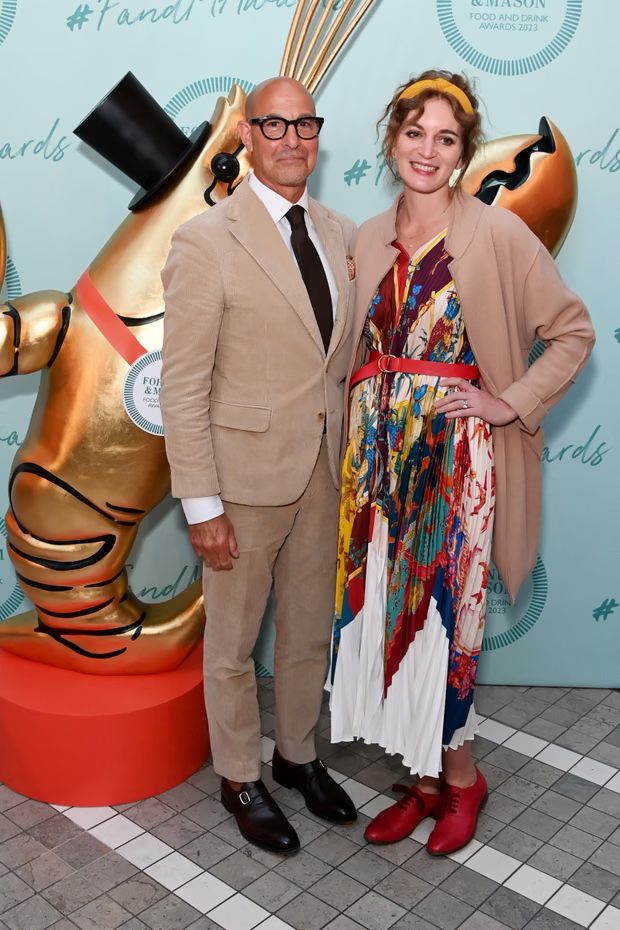
Felicity Blunt moved there with him and the children. Tucci and Blunt eventually married beneath an old oak tree on the property before the family later left America to begin a new life in England.
For Tucci, seeing another family creating memories there did not erase what had happened inside those walls.
It added another layer.
The house now belonged to someone else, but the life he had lived there remained part of it.

Love Arrived Again Through an Unexpected Connection
Tucci met Felicity through her sister, Emily Blunt, his costar in The Devil Wears Prada.
The pair married in 2012.
Their wedding guests included Meryl Streep, Colin Firth and Julianne Moore, while Steve Buscemi served as Tucci’s best man.
Tucci and Felicity later had two children together, Matteo and Emilia, creating a family that now spans adult children and young children.
He describes himself and Felicity as both romantic and slightly cynical about romance — capable of deep affection while also teasing each other about it.
His sense of humor remains an important counterweight to the darker subjects he discusses.
Tucci can move from talking about death to joking that when he dies, he wants Felicity to remain terribly unhappy.
That balance — grief alongside comedy, mortality alongside appetite — has become characteristic of the way he talks about life.
Then Cancer Threatened the Thing He Loved Most
Years after watching Kate endure cancer, Tucci faced the disease himself.
The first sign arrived in 2017 as severe pain in his jaw that eventually spread toward his throat.
It took roughly two years for doctors to identify a tumor at the base of his tongue.
Treatment presented Tucci with an especially cruel possibility.
He might never be able to eat normally again.
For a man whose life, family history and creative identity were so deeply connected to food, the prospect was devastating.
Tucci initially resisted treatment.
He knew what cancer therapies could do because he had seen the effects of the disease and treatment before.
Felicity strongly pushed him toward conventional medical care.
Eventually, he underwent radiation and other treatment.
The experience was brutal.
Tucci remembers becoming so weak that climbing stairs felt like an enormous physical task.
Nausea left him barely able to lift his head.
Some periods are almost missing from his memory entirely. Felicity has recalled incidents, including him collapsing on the floor, that Tucci himself cannot remember.
At one point, he required a feeding tube.
And during that period, he would watch cooking programs.
For someone unable to eat, it was an almost absurd form of torment.
Recovery Came Slowly
Tucci eventually recovered, but the illness left lasting effects.
Radiation created continuing difficulty with swallowing.
He also believes the experience aged him significantly and left him with a fundamental sense of exhaustion.
Still, he returned to work.
Remarkably, he filmed the first season of Stanley Tucci: Searching for Italy while recovering from cancer.
The series sent him across Italy exploring regional cooking and the history behind the dishes he ate.
To viewers, it could look like an enviable job: beautiful scenery, wine, restaurants and endless plates of extraordinary food.
Tucci is quick to point out that the reality involves exhausting travel, intense heat, long production days and enormous logistical demands.
Yet the project also brought together nearly every major strand of his life.
Italy.
Family.
Acting.
History.
Food.
And the ability to eat — something he could no longer take for granted.
Food Became His Way of Remembering
Tucci grew up in New York in an Italian-American family.
His parents, Joan and Stanley Sr., were children of Italian immigrants, and food was deeply embedded in family life.
Tucci and his siblings even spent a year in Florence when they were young.
Those early experiences followed him throughout his career.
He later co-wrote and directed the 1996 film Big Night, centered on two Italian immigrant brothers running a restaurant.
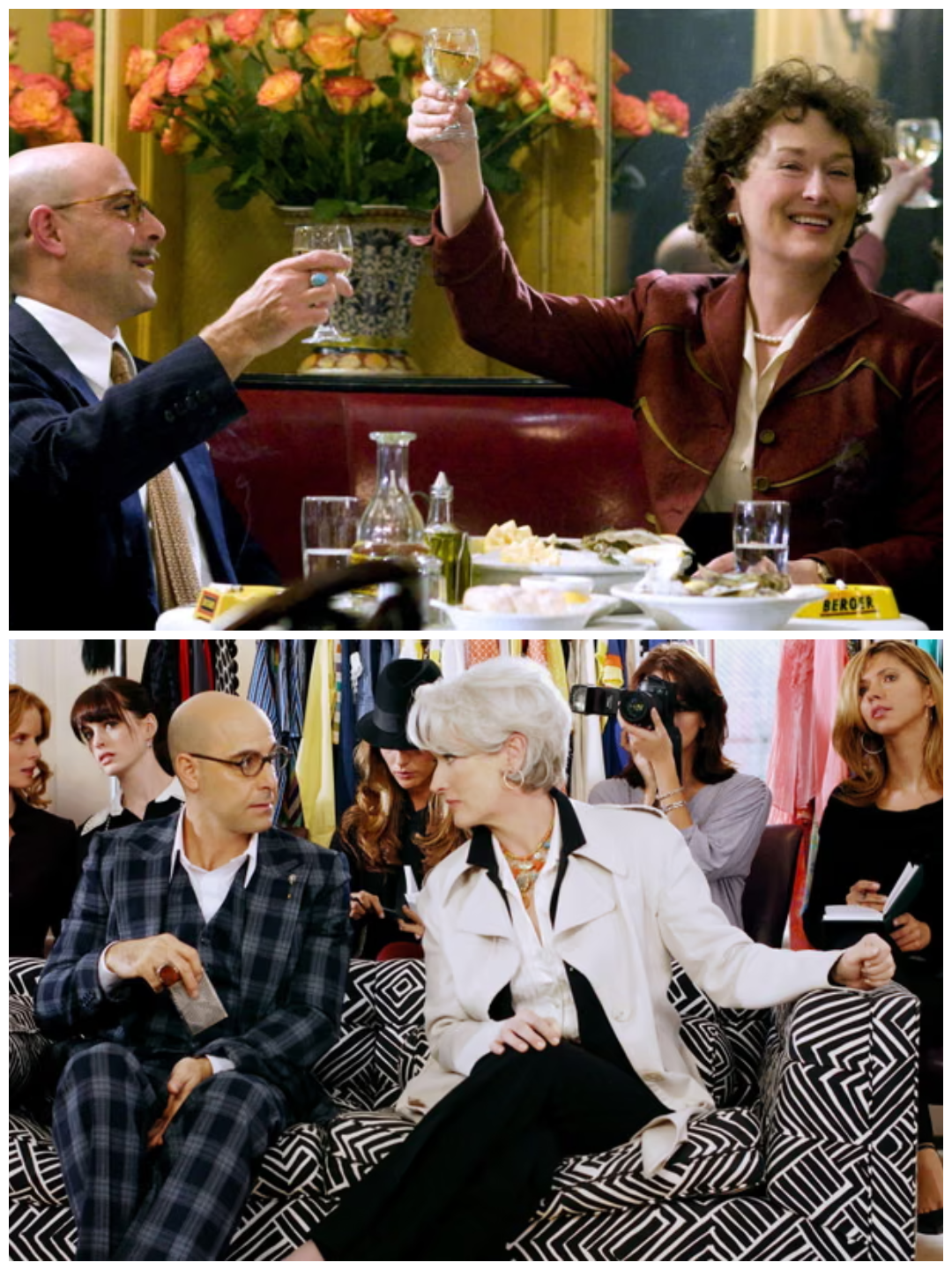
He played Julia Child’s husband opposite Meryl Streep in Julie & Julia.
And decades later, food became almost as closely associated with Tucci as acting itself.
During the COVID pandemic, a video filmed by Felicity showing him calmly preparing a Negroni unexpectedly transformed him into an internet heartthrob in his 60s.
Tucci finds the attention amusing.
But fame itself does not occupy much of his thinking.
Food does.
He says he can taste a spice and immediately begin wondering why it appears in that dish, how it reached that region and what centuries of trade or migration might explain its presence.
The meal becomes history.
History becomes memory.
And memory becomes personal.
Mortality Is Never Far Away
Tucci speaks openly about death.
He says he has thought about it throughout his life and links some of that awareness to his Italian background, where conversations about death and mourning were common in his childhood.
Now his age has added another dimension.
Tucci worries about the age gap between himself and Felicity, who is 21 years younger.
He thinks about what life might look like when he is 80 and his younger children are still relatively young.
He hopes to live a long time.
But after losing Kate and surviving cancer himself, mortality is not theoretical.
It is something he has already lived beside.
Perhaps that explains the urgency behind his pleasures.
Around five o’clock, Tucci does not want to remain buried in work.
He wants a cocktail.
He wants to cook.
He wants people around the table.
He wants conversation, food and then sleep before getting up to work the next morning.
And after everything he has experienced, the repetition does not bore him.
It comforts him.
The meals continue.
The table fills again.
Grief remains present, but so does love.
Cancer changed his body, but he can still taste and cook.
The people from earlier chapters of his life are carried forward in memories that sometimes begin with nothing more complicated than a piece of sausage, an onion or a familiar kitchen.
For Stanley Tucci, that may be why food occupies so much of his mind.
It is not merely what keeps a person alive.
It is one of the ways life itself is remembered.