Boston Strangler: The True Story Behind the Movie and the Reporters Who Saw the Pattern First
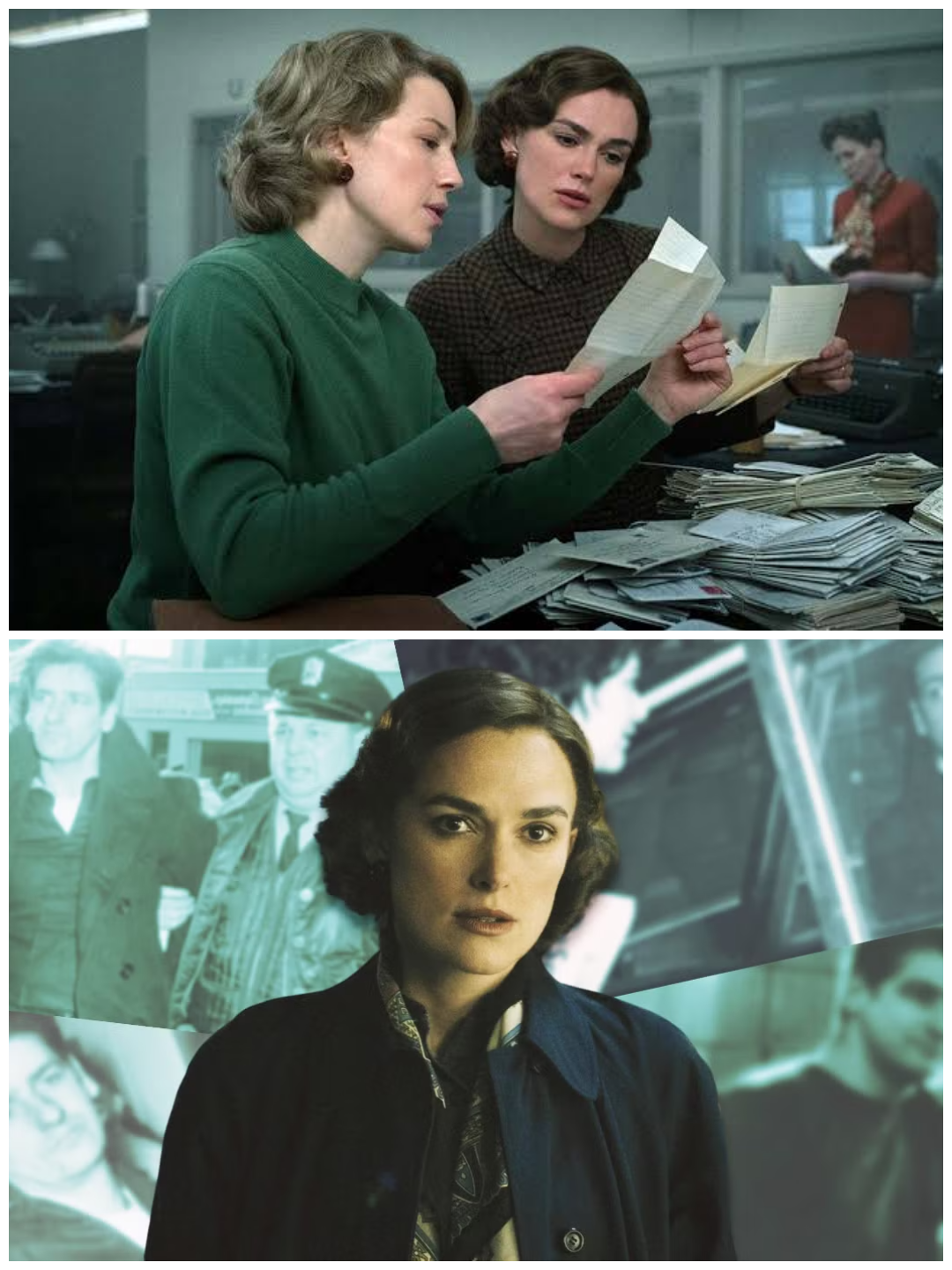
Hulu’s Boston Strangler approaches one of America’s most infamous unsolved crime sagas from an unusual direction.
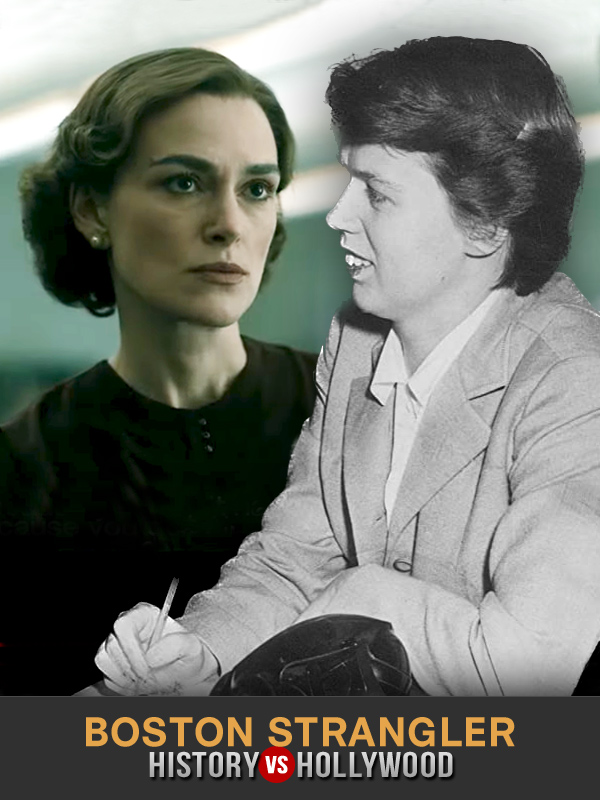
Instead of making Albert DeSalvo the center of the story, the 2023 film focuses on two women whose names were largely overshadowed by the killer they investigated: Boston Record American reporters Loretta McLaughlin and Jean Cole.
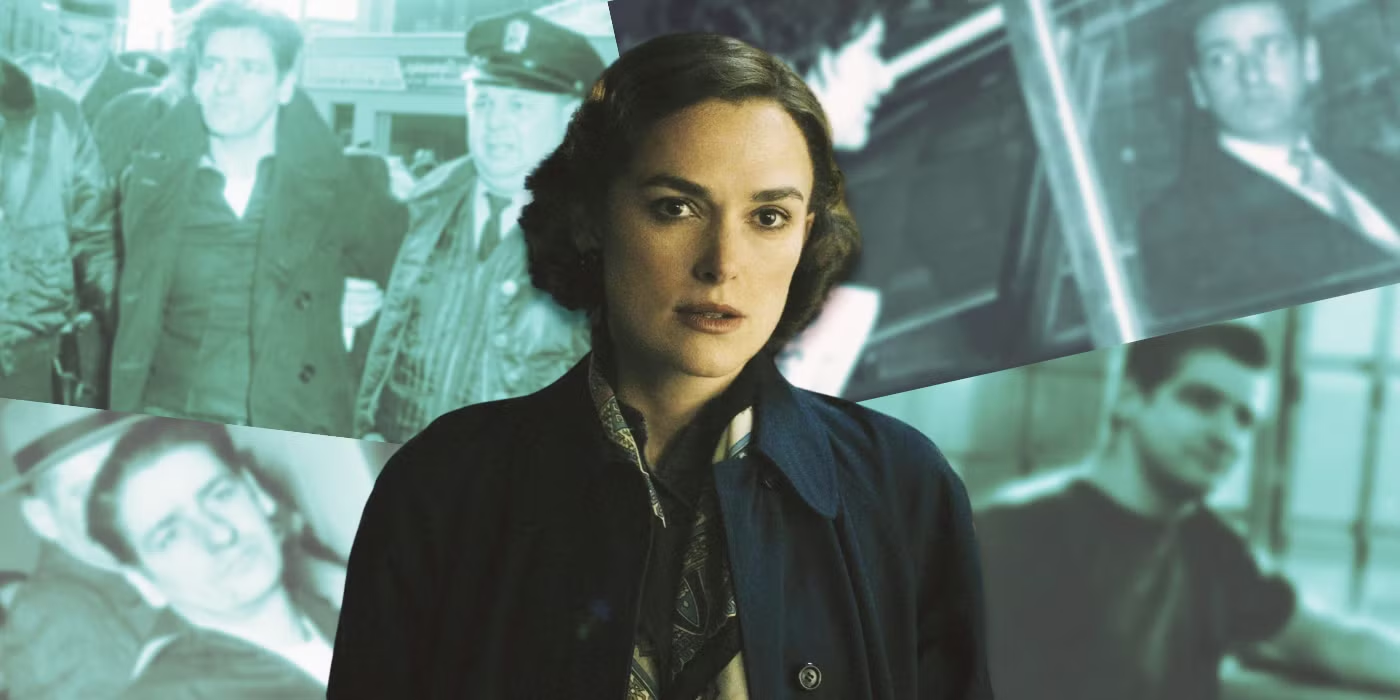
Keira Knightley portrays McLaughlin, the journalist who began noticing similarities among a series of murders that authorities had not yet publicly connected. Carrie Coon plays Cole, the more experienced investigative reporter who eventually joined her.
Together, the women reported extensively on the killings, challenged the police investigation and helped popularize the name by which the crimes would become permanently known: the Boston Strangler.
But how much of the movie really happened?
The broad story is remarkably grounded in history. McLaughlin and Cole were real journalists. They did face sexism inside the newsroom. They did believe the murders were connected before many officials publicly accepted that idea.
The movie, however, also compresses years of uncertainty, creates composite characters and pushes McLaughlin deeper into the final Albert DeSalvo mystery than the historical record supports.
And even today, one enormous question remains unresolved:
Did Albert DeSalvo actually commit all of the murders attributed to the Boston Strangler?
How Many Women Were Linked to the Boston Strangler Murders?
Thirteen women are traditionally associated with the Boston Strangler series.
The killings took place across Greater Boston between June 1962 and January 1964. The victims ranged dramatically in age, from 19 to 85, which later became one of the reasons investigators questioned whether a single person could really have committed every murder.
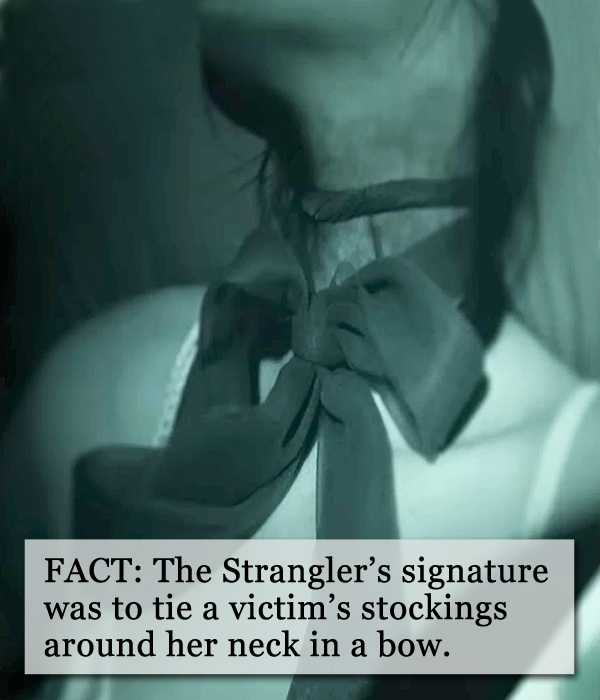
Most of the women were attacked inside their homes, and many were sexually assaulted before being strangled. Personal items of clothing were frequently used as ligatures.
Boston was eventually gripped by fear.
Women changed their routines. Door locks and chains became increasingly important. Authorities warned residents to be suspicious of strangers.
The terrifying part was that there were usually no obvious signs of forced entry.
Whoever was responsible appeared capable of convincing women to open their doors.
Who Was the First Victim?
Anna Slesers, 55, is generally listed as the first victim in the series.
Her son discovered her inside her apartment on Gainsborough Street in Boston on June 14, 1962.
At that point, nobody knew the city was entering a period that would produce one of the most notorious criminal investigations in Massachusetts history.
Additional deaths followed rapidly.
By the end of June, several older women had been found dead under circumstances that appeared disturbing enough to attract attention — but authorities had not yet publicly concluded that a single killer was responsible.
Was Loretta McLaughlin a Real Reporter?
Yes.
Loretta McLaughlin was born in Massachusetts in 1928 and studied journalism at Boston University.
By the early 1960s, she was working for the Boston Record American.
Her career would eventually extend far beyond the Strangler investigation. She later became an important medical journalist, covered the emerging AIDS crisis and joined The Boston Globe, eventually becoming the second woman in the newspaper’s history to serve as editor of its editorial page.
But it was the Boston murders that first placed her at the center of a historic story.
McLaughlin later recalled that the fourth killing was what convinced her something larger might be happening.
Her editor initially questioned whether the victims were important enough to justify a major investigation.
They were essentially ordinary women without celebrity, wealth or political power.
For McLaughlin, that was precisely the point.
Why were seemingly anonymous women being murdered in such similar circumstances?
She wanted to know.
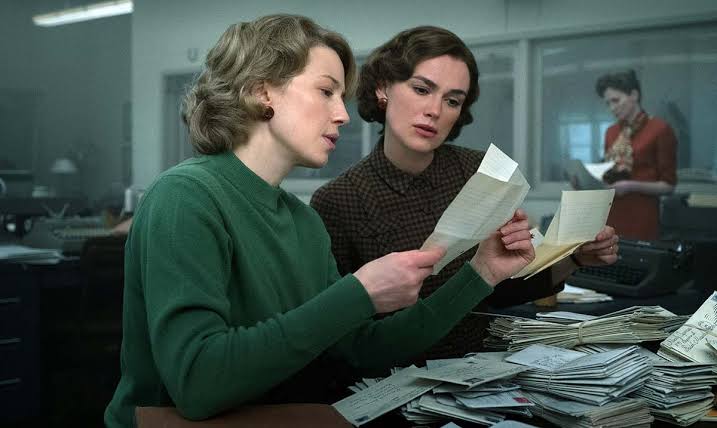
Did Her Editor Really Dismiss the Victims as “Nobodies”?
Something very close to that really happened.
The movie dramatizes McLaughlin approaching her editor and arguing that the deaths deserve serious attention.
Historical accounts support the core of the exchange.
McLaughlin later remembered an editor questioning the value of pursuing the deaths because the victims were essentially “nobodies.”
Rather than discouraging her, the remark sharpened her interest.
The victims’ apparent ordinariness made the pattern more disturbing, not less.
The film therefore uses a dramatized conversation, but the underlying attitude was real and was later described by McLaughlin herself.
Was Editor Jack MacLaine a Real Person?
Yes, although the movie slightly changes his name.
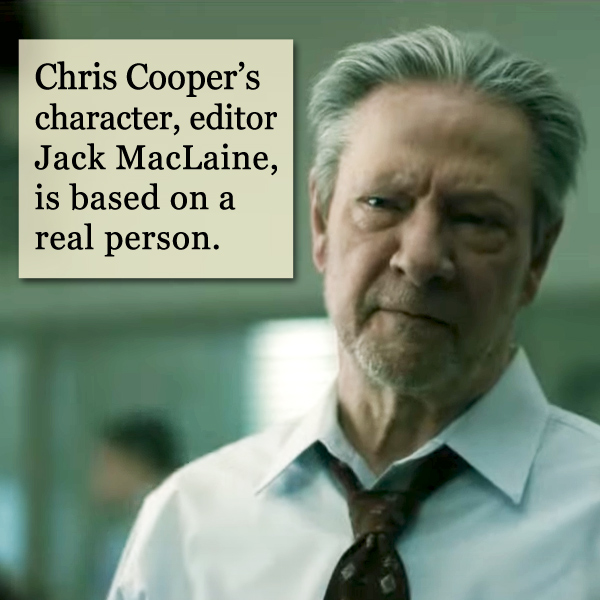
Chris Cooper plays Jack MacLaine, McLaughlin’s newsroom boss.
History vs. Hollywood reported that the character was based on Record American city editor Jack McLean, whose surname was spelled differently from the movie character’s.
The film uses him partly to represent the culture of a 1960s newsroom where women reporters frequently struggled to be taken as seriously as their male colleagues.
Did Jean Cole Really Investigate the Murders With Loretta?
Absolutely.
Jean Cole wasn’t invented to give McLaughlin a partner.
She was already an experienced investigative journalist before the Strangler case became national news.
Cole had demonstrated that she was willing to pursue difficult assignments, including undercover reporting related to conditions in nursing homes.
When she and McLaughlin began working together on the strangler story, their investigation became unusually aggressive.
They examined similarities among the crime scenes, scrutinized how law enforcement agencies were handling information and wrote extensively about the possibility that the deaths were connected.
The women ultimately produced a remarkable run of coverage on the case.
Their work challenged both police and newsroom expectations about what women journalists were supposed to cover.
Did They Really Help Connect the Murders?
Yes, although the historical situation was more complicated than simply “the reporters figured it out and the police didn’t.”
Different police departments were investigating different homicides, and there was significant disagreement over whether one person was responsible.
McLaughlin and Cole became prominent advocates of the theory that the murders formed a pattern.
Their reporting reconstructed the crimes, compared details and criticized the fragmented law-enforcement response.
They also drew attention to problems created by multiple departments working separate cases.
Massachusetts eventually established a more coordinated investigative effort.
The reporters were not police detectives solving murders themselves, but their journalism played an important role in pushing the idea of a connected series into public view.
Did Loretta McLaughlin Help Create the Name “Boston Strangler”?
Yes.
Before the name became permanent, newspapers and the public used different labels for the unknown attacker.
McLaughlin and Cole’s Record American coverage helped establish “Boston Strangler” as the name that survived.
It eventually became so familiar that the phrase now sounds almost inevitable.
At the time, however, even the idea that there was one “Strangler” was itself an argument.
Calling the attacker the Boston Strangler reinforced McLaughlin and Cole’s belief that the murders were connected and likely involved one offender.
That conclusion would later become much more controversial.
Did the Newspaper Really Call Them “Girl Reporters”?
Yes.
One of the most striking details in the movie reflects the reality of journalism in that era.
McLaughlin and Cole were experienced professionals in their 30s.
Yet their own newspaper ran coverage identifying them as “girl reporters.”
The phrase captures the contradiction the women faced.
They were being trusted to investigate one of Boston’s most terrifying stories while simultaneously being presented to readers in language that diminished their professional status.
McLaughlin later wrote about how female journalists were routinely labeled by gender in headlines even when covering major stories.
The sexism shown in the film is therefore not simply a modern interpretation of the past. It was embedded in the newsroom culture in which McLaughlin and Cole worked.
Did the Reporters Really Receive Frightening Phone Calls?
Yes, at least in Jean Cole’s case.
As their names and photographs became closely associated with the investigation, the women had reason to wonder whether the person responsible for the murders was reading their work.
Cole later described receiving disturbing calls involving heavy breathing and an unclear male voice.
She eventually changed her telephone number.
Both reporters acknowledged that covering the case affected them psychologically.
Their photographs were appearing publicly while they were writing about an unidentified killer believed to be targeting women.
That created an unsettling possibility:
What if he knew exactly who they were?
Is Detective Conley a Real Police Officer?
Not exactly.
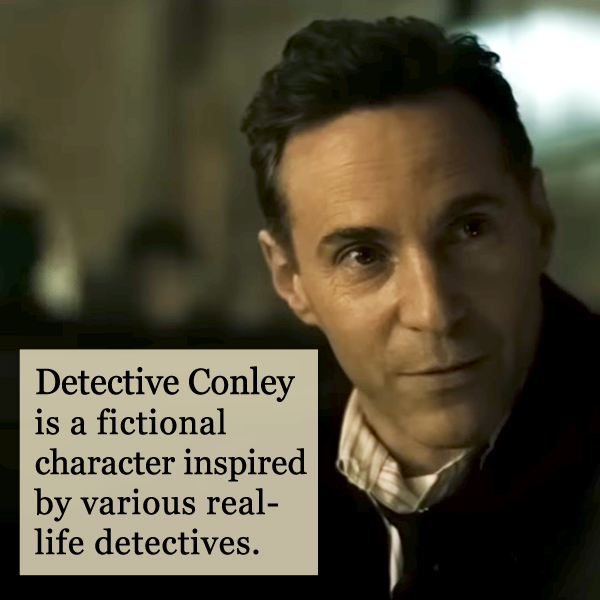
Alessandro Nivola plays Detective Conley, a police investigator who becomes increasingly receptive to McLaughlin’s theories.
There was no single Detective Conley who filled that exact role.
The character was created by combining elements of several real investigators who were willing to communicate with McLaughlin and Cole.
That allows the movie to simplify a sprawling investigation involving multiple police departments and numerous detectives into one recognizable character.
Who Was the Boston Strangler’s Final Victim?
Mary Sullivan, 19, was the final victim traditionally attributed to the Boston Strangler.
She had only recently moved into an apartment on Charles Street in Boston’s Beacon Hill neighborhood when she was killed in January 1964.
Her death became particularly important decades later because biological evidence from the crime scene survived.
At the time, DNA testing did not exist.
Nearly half a century later, that preserved evidence would provide investigators with the strongest scientific answer the Boston Strangler case had ever received.
How Did Albert DeSalvo Enter the Investigation?
DeSalvo had a significant history of sexual offenses before he ever confessed to the Boston Strangler murders.
One of his earlier schemes earned him the nickname “Measuring Man.”
He approached women while claiming to represent a modeling agency, talked his way inside and used the pretense of taking measurements to assault them.
Later came a series of more serious sexual attacks associated with an offender nicknamed the “Green Man.”
Police eventually identified DeSalvo as a suspect in those assaults and arrested him.
It was after his arrest — not during the original Strangler homicide investigation — that his name became connected to the murders.
That distinction is important.
DeSalvo was not captured while fleeing one of the Boston Strangler crime scenes.
His connection to those murders emerged through confession.
Did DeSalvo First Confess to Fellow Inmate George Nassar?
Yes.
While confined at Bridgewater State Hospital, DeSalvo became acquainted with convicted murderer George Nassar.
DeSalvo reportedly began telling Nassar that he was responsible for the Boston Strangler murders.
Nassar passed information about the confession to attorney F. Lee Bailey, who would become DeSalvo’s lawyer.
DeSalvo subsequently gave investigators extensive descriptions of the murders.
Some details were impressive enough to convince people involved in the case that he knew things only the killer should have known.
Other parts of his confession were inaccurate.
That inconsistency became one of the central reasons the case never completely settled into a simple conclusion.
Was Albert DeSalvo Ever Convicted of the Boston Strangler Murders?
No.
This is one of the most frequently misunderstood facts about the case.
Albert DeSalvo confessed to being the Boston Strangler, but he never stood trial for the murders traditionally attributed to the killer.
At the time, prosecutors lacked physical evidence tying him conclusively to the homicide scenes.
DeSalvo was instead prosecuted for unrelated robberies and sexual assaults.
His attorney, F. Lee Bailey, tried to use the Strangler confession as part of an insanity defense.
The strategy failed.
DeSalvo was convicted in 1967 and received a life sentence.
So although newspapers and popular culture increasingly identified him as the Boston Strangler, the legal system never convicted him of being one.
Why Did Some Investigators Doubt DeSalvo’s Confession?
There were several reasons.
The victims varied enormously in age.
Certain details of the attacks differed.
DeSalvo made mistakes when describing some crimes.
And because newspapers had published considerable information about the murders, skeptics questioned whether he could have learned some details without actually being the killer.
There was also DeSalvo’s personality.
He had a reputation for exaggeration and boasting, leading some observers to wonder whether confessing to the most notorious crimes in Boston might have been another attempt to make himself important.
This produced an alternative theory that remains difficult to completely dismiss:
Perhaps there wasn’t one Boston Strangler.
Maybe several killers committed murders that were eventually grouped under one famous name.
Could George Nassar Have Been the Real Strangler?
The theory has existed for decades, but it has never been proved.
Because DeSalvo first discussed the murders with Nassar, skeptics wondered whether the information might actually have traveled in the opposite direction.
Could Nassar have known details and fed them to DeSalvo?
Could the men have planned to exploit publicity surrounding the crimes?
Adding to the suspicion was the fact that Nassar was himself a convicted murderer and was free during the general period when the Strangler murders occurred.
Two women who had encountered a suspicious attacker reportedly thought Nassar resembled the man they remembered.
But there are major weaknesses in the theory.
Nassar’s known murders involved male victims and firearms, while he had no established history matching the Strangler’s pattern of sexual attacks on women.
Nassar himself denied being the Strangler and insisted that DeSalvo was responsible.
No physical evidence has proved that Nassar committed the Boston Strangler murders.
Did Albert DeSalvo Escape From Custody?
Yes.
In February 1967, DeSalvo and two other inmates escaped from Bridgewater State Hospital.
The escape triggered a major search.
DeSalvo remained free only briefly before surrendering roughly a day and a half later.
He was subsequently transferred to the maximum-security Walpole State Prison.
The escape added yet another sensational chapter to a case that already attracted enormous media attention.
But DeSalvo’s story still had one final violent turn ahead.
Did DeSalvo Later Take Back His Confession?
Yes.
After his imprisonment, DeSalvo recanted his claim that he was the Boston Strangler.
That only deepened the mystery.
Was the original confession genuine and the recantation an attempt to regain control of his case?
Or had the confession itself been false?
For decades, there was no forensic evidence capable of answering the question.
The uncertainty became one of the major themes explored by the Hulu movie.
Is the Movie’s Daniel Marsh Based on a Real Suspect?
Partly.
The movie introduces Daniel Marsh, a troubled former Harvard student whose behavior makes him appear potentially connected to one of the victims.
According to History vs. Hollywood’s fact-check, Marsh is inspired by an actual suspect whose true identity was not publicly disclosed and who has been referred to elsewhere under a pseudonym.
However, the movie significantly condenses the chronology by linking the character to similar murders in Michigan much more tightly than history allows.
The Michigan killings referenced in the movie occurred several years later, mainly between 1967 and 1969.
A different man, John Norman Collins, was eventually convicted of one of those murders and suspected in others.
The film uses these events to strengthen its idea that the Boston killings may have produced imitators, but the real timeline was more complicated.
Did Albert DeSalvo Call Loretta McLaughlin Right Before His Death?
No.
This is one of the film’s more important dramatic inventions.
Near the end of Boston Strangler, DeSalvo appears ready to reveal something significant to Loretta McLaughlin.
Historically, there is evidence that DeSalvo suggested he had something important to discuss shortly before his death.
But McLaughlin was not the person he was planning to tell.
The movie brings its protagonist directly into the mystery in order to create a stronger dramatic climax.
In reality, DeSalvo reportedly indicated to psychiatrist Dr. Ames Robey that he had important information.
Whatever DeSalvo intended to reveal never became clear.
How Did Albert DeSalvo Die?
DeSalvo was killed in prison in November 1973.
He was 42.
He was stabbed while incarcerated at Walpole State Prison, years after his conviction on the unrelated sexual-assault and robbery charges.
Several inmates became associated with the investigation into his death, and trials were held, but nobody was ultimately convicted of murdering him.
Various theories have been proposed about why DeSalvo was killed, including disputes involving the prison drug trade.
His murder inevitably created even more speculation around the Boston Strangler story.
A man who had confessed, recanted and hinted that he still had something important to say was suddenly dead.
For anyone hoping for a clean confession or final explanation, the opportunity appeared to be gone.
Did DNA Finally Prove DeSalvo Was the Boston Strangler?
DNA answered one major question — but not all of them.
For decades, investigators lacked physical evidence connecting DeSalvo to any of the murders.
Then advances in genetic testing changed the case.
Investigators returned to biological evidence preserved from the 1964 rape and murder of Mary Sullivan.
DNA testing first established a strong familial link to DeSalvo’s male relatives.
Authorities then exhumed DeSalvo’s remains in July 2013.
DNA extracted directly from his body matched genetic material recovered from Sullivan’s crime scene.
According to the National Institute of Justice, specialists calculated the odds of the evidence coming from another white male at approximately one in 220 billion.
The result established that DeSalvo raped and murdered Mary Sullivan.
Did the DNA Prove He Killed All 13 Women?
No.
This distinction matters enormously.
The DNA evidence conclusively connected DeSalvo to Mary Sullivan.
Comparable biological evidence does not exist for all of the other victims.
Massachusetts officials said at the time that the Sullivan result strengthened the argument that DeSalvo was responsible for the larger series.
But scientifically proving one murder is not the same thing as proving twelve others.
That leaves the central Boston Strangler mystery partially unresolved.
DeSalvo was unquestionably responsible for at least one murder attributed to the Strangler.
Whether he committed every killing traditionally included in the series remains debated.
Did Loretta McLaughlin Believe DeSalvo Was the Killer?
Yes.
Despite decades of competing theories, McLaughlin remained convinced.
She placed substantial weight on DeSalvo’s ability to describe details from the victims’ apartments during questioning.
To McLaughlin, his knowledge went beyond what an ordinary reader could have absorbed from newspaper reports.
She continued to support the conclusion that Albert DeSalvo was the Boston Strangler long after questions about his confession became part of true-crime history.
Not everyone agreed with her.
And that disagreement is part of what makes the case so enduring.
What Happened to Jean Cole After the Case?
Jean Cole continued working as an investigative journalist.
She remained with the Record American and its successor publications for years, reporting on crime and other difficult subjects before retiring in 1981.
Her work on the Boston Strangler case was only one part of a much longer career.
Before the murders, she had already gone undercover to investigate the treatment of elderly people in Massachusetts nursing homes.
Later, she continued covering stories that female reporters of her era were often discouraged from pursuing.
Cole died in 2015 at age 89.
Unfortunately, she never saw Carrie Coon portray her in the Hulu film.
What Happened to Loretta McLaughlin?
McLaughlin’s career became even more influential after the Strangler investigation.
She eventually specialized in health and medical reporting.
After joining The Boston Globe in 1976, she became one of the journalists who recognized the importance of the emerging AIDS crisis relatively early.
She later joined the Globe’s editorial page and became its editor in 1992 — only the second woman in the newspaper’s history to hold that position.
McLaughlin died in 2018 at age 90.
Like Cole, she died before Boston Strangler brought their reporting to a new generation of viewers.
Is the Boston Strangler Case Officially Solved?
Only partly.
The DNA evidence provides a scientifically strong conclusion in Mary Sullivan’s murder.
Albert DeSalvo killed her.
The other murders traditionally grouped under the Boston Strangler name are more complicated.
Because DeSalvo was never tried for them and because comparable forensic evidence has not connected him to every crime, questions remain about whether all 13 victims were killed by one man.
That uncertainty is one of the areas where the Hulu movie stays surprisingly close to history.
There is no perfectly clean ending.
Boston Strangler Is Really Two True Stories at Once
The obvious true story behind Boston Strangler is about murder.
Between 1962 and 1964, thirteen women were killed in Greater Boston in crimes frightening enough to alter the daily lives of women across the city.
A man named Albert DeSalvo eventually confessed.
He was never convicted of the murders.
He later recanted.
Then he was killed in prison.
Decades afterward, DNA finally proved that he had murdered Mary Sullivan — while leaving the rest of the series surrounded by uncertainty.
But the film is also telling another true story.
It’s about two women sitting in a newsroom at a time when female journalists could investigate serial murder and still be introduced to readers as “girl reporters.”
Loretta McLaughlin noticed a pattern because she took victims seriously when someone else dismissed them as insignificant.
Jean Cole brought investigative experience and determination to the reporting.
Together they questioned police methods, examined connections among the crimes and helped transform a series of individual murders into a story the public understood as a larger threat.
The movie rearranges some events.
It invents or combines several characters.
And it places McLaughlin closer to Albert DeSalvo’s final days than she actually was.
But the most important part of its premise is real.
Before the name “Boston Strangler” became part of American true-crime history, two reporters looked at a group of murdered women whom others could easily have treated as unrelated statistics.
They saw a pattern.
And they refused to stop asking questions.