‘Another dinosaur has entered the luxury collectibles market’: Gus the T. rex just sold for $50 million. Here’s what its loss means to science.
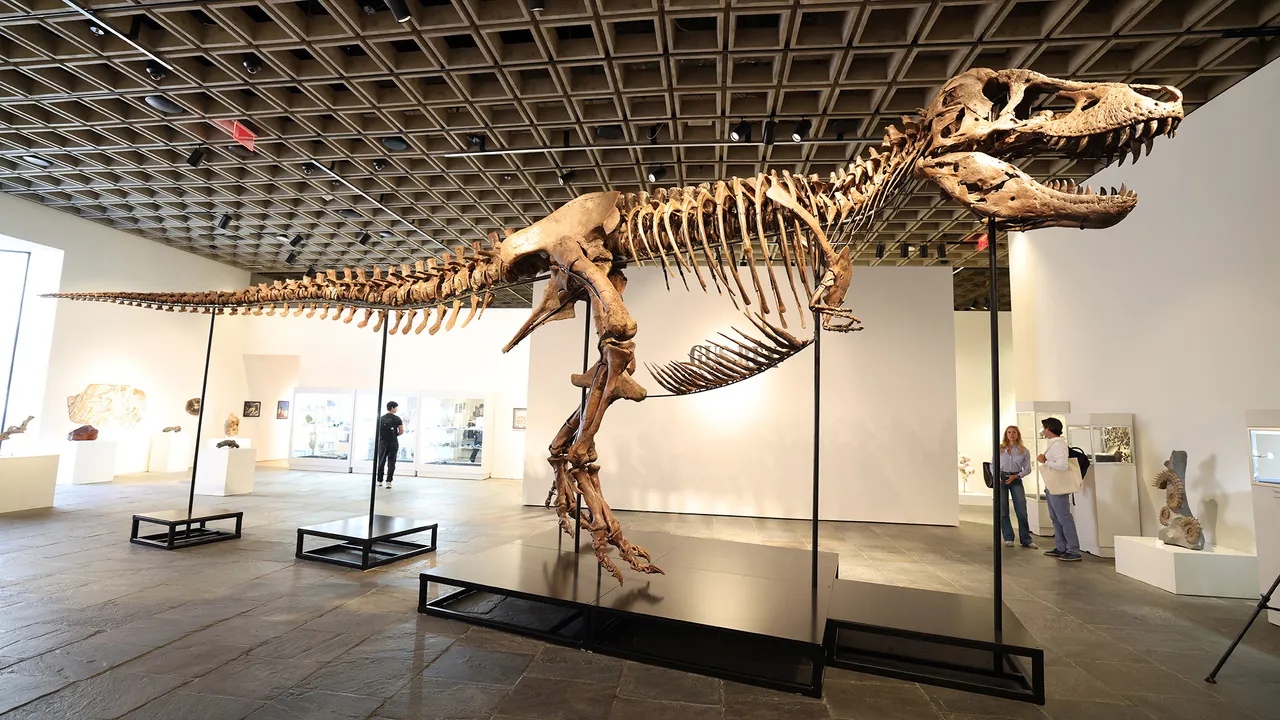
On July 14, 2026, “Gus,” one of the most complete specimens of Tyrannosaurus rex, went to an as yet unidentified buyer for US$50.1 million. This auction at Sotheby’s set a record for most valuable fossil ever sold. Another dinosaur has entered the luxury collectibles market, a reminder that even Earth’s deepest history can be sold to the highest bidder.
To paleontologists like me, however, a fossil like “Gus” — excavated from the Hell Creek Formation in South Dakota over three years starting in 2021 by commercial collector Thomas Heitkamp and his team — is not a trophy or a work of art. It is an irreplaceable scientific archive. Fossils preserve evidence of evolution, extinction, growth, disease, injury and ancient ecosystems. They are finite, nonsubstitutable records of life’s history on Earth.
Science depends on independent verification of claims and healthy debate. Researchers must be able to revisit specimens, test earlier conclusions and ask new questions.
But once a scientifically important fossil enters a private collection, access for researchers is no longer guaranteed. Collectors typically sequester their fossils in their homes. Even when privately owned specimens are loaned to museums, the owners can change their minds, ending access at any time. This issue is especially of note when it comes to Tyrannosaurus rex; a 2025 study found that while there were 61 T. rex fossils in public trusts at that time, 71 were privately held.
That is why the Society of Vertebrate Paleontology, of which I’m a long-term member and president-elect, has long argued that scientifically significant vertebrate fossils belong in the public trust, curated in museums and universities that preserve them permanently, make them available for research and share them with the public.
Supporters of commercial fossil sales often argue that without sales to private collectors, specimens like “Gus” would remain buried or erode away. They’re right about one thing: Discovery matters. Many extraordinary fossils have been found by ranchers, hikers, amateur collectors and commercial excavators. Paleontology is accessible to everyone who has an eye for observing nature — you don’t need to be an expert with academic credentials to make an important discovery.
But discovery is only the beginning. A fossil’s scientific value depends on careful documentation of where it was found, the rocks surrounding it, and the plants and animals preserved alongside it. Those details allow scientists to reconstruct ancient ecosystems, understand how an animal lived and died, and interpret how its remains became fossilized. When that contextual information is incomplete or lost, much of the fossil’s scientific value is lost as well.
Sources: https://www.livescience.com/animals/dinosaurs/another-dinosaur-has-entered-the-luxury-collectibles-market-gus-the-t-rex-just-sold-for-usd50-million-heres-what-its-loss-means-to-science