Foxcatcher: The Disturbing True Story Behind John du Pont, Mark Schultz and the Murder of an Olympic Champion

Bennett Miller’s Foxcatcher feels less like a conventional sports movie than a tragedy slowly moving toward an outcome the audience knows cannot be avoided.
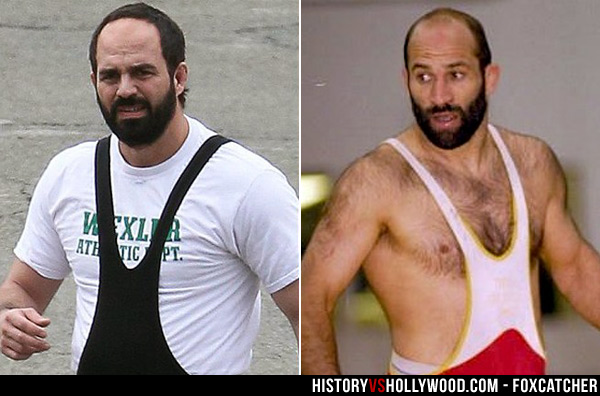
Channing Tatum plays Olympic wrestler Mark Schultz, a gifted but emotionally isolated athlete struggling to escape the shadow of his older brother Dave, played by Mark Ruffalo.
Then John du Pont enters his life.
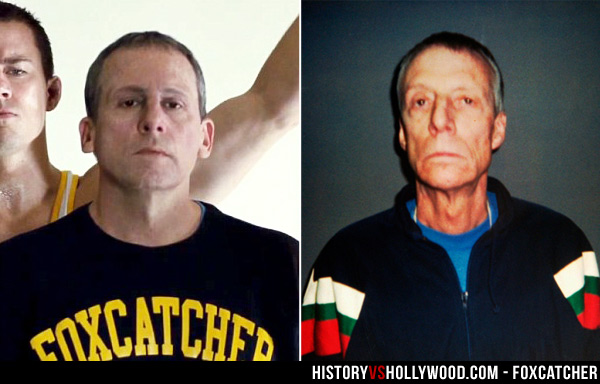
Steve Carell portrays the enormously wealthy heir as an awkward, controlling man who desperately wants to become important in the world of amateur wrestling. He offers Mark something the sport itself rarely could at the time: money, elite training facilities and the freedom to focus entirely on winning.
Eventually, Dave becomes part of the Foxcatcher program as well.
The relationship ends catastrophically when du Pont shoots and kills Dave Schultz outside his home on the Pennsylvania estate.
That murder really happened.
But Foxcatcher dramatically rearranges the years leading up to it.
Mark and Dave were not actually living at Foxcatcher together. Mark had been gone for years when Dave was killed. And the movie’s suggestion that tension surrounding Mark somehow contributed directly to du Pont’s decision to murder Dave is not supported by the real chronology.
The true story is, in some ways, even more disturbing.
Why Did Mark Schultz Become Involved With John du Pont?
Money was a major reason.
Mark Schultz was already one of the greatest wrestlers in the world.
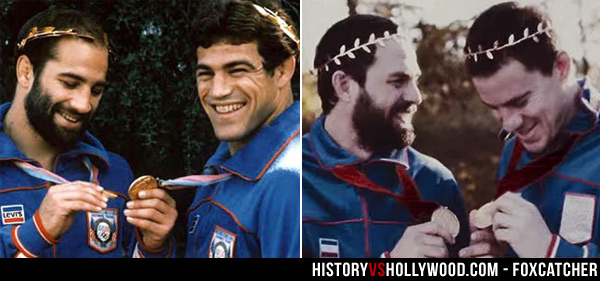
He and Dave had both won gold medals at the 1984 Los Angeles Olympics, an extraordinary achievement for two brothers.
But Olympic success did not make Mark financially secure.
Elite American wrestlers at the time often struggled to earn enough money while continuing the full-time training necessary to compete internationally.
Mark later described the system as one of the forces that pushed athletes toward wealthy private sponsors.
John du Pont could provide what wrestling organizations often could not.
He had money.
He had facilities.
And he was willing to pay elite wrestlers to train.
Mark became involved with du Pont in 1986. He later said he initially went east because du Pont offered him an assistant coaching position connected with Villanova University rather than because du Pont somehow rescued him personally, as the movie more strongly suggests.
Did Mark Immediately Move Onto the Foxcatcher Estate?
No.
The movie simplifies this considerably.
Mark initially worked as an assistant wrestling coach at Villanova.
Only later did he move onto du Pont’s estate.
According to Mark’s account, du Pont removed him from the Villanova coaching position after a party involving alcohol and underage wrestlers. Du Pont then told him that he could continue training with the Foxcatcher program if he moved onto the property.
That placed Mark much more directly under du Pont’s control.
The arrangement gave him access to excellent training conditions.
It also meant that his employer, sponsor and increasingly intrusive benefactor was almost always nearby.
Where Did the Name Foxcatcher Come From?
John du Pont did not invent it specifically for wrestling.
The enormous Newtown Square property outside Philadelphia had long belonged to the du Pont family.
After the death of John’s mother, Jean Liseter Austin du Pont, in 1988, he renamed the property Foxcatcher Farm.
The name honored his father, William du Pont Jr., who had used Foxcatcher for his racing stable decades earlier.
John eventually transformed part of the estate into an elite athletic complex.
For wrestlers, it could seem almost ideal.
There were dedicated wrestling rooms, weight-training equipment, housing and access to other world-class athletes.
Former wrestlers have remembered the facilities as exceptional.
The problem was the man paying for everything.
Was John du Pont Really Worth Hundreds of Millions of Dollars?
Yes.
Du Pont inherited enormous wealth through one of America’s most famous industrial families.
His ancestor Éleuthère Irénée du Pont founded the gunpowder business that eventually developed into the DuPont chemical company.
John’s personal fortune was at one point estimated at around $200 million.
He had enough money to build facilities, sponsor athletes and effectively purchase a place for himself inside sports communities that fascinated him.
Wrestling eventually became his obsession.
Du Pont did not possess anything close to the elite wrestling ability of the athletes around him, but money allowed him to create Team Foxcatcher and surround himself with Olympic-level competitors.
That strange imbalance — enormous financial power combined with an intense desire to be accepted as an athlete and coach — sits at the center of both the movie and the real story.
Were Mark and Dave Schultz Really at Foxcatcher Together?
No.
This is one of the movie’s biggest departures from reality.
Mark Schultz left Foxcatcher in 1988.
Dave Schultz did not arrive until 1989.
That means the brothers’ stays did not overlap.
The film brings Dave to the estate while Mark is still there because it creates a much cleaner dramatic triangle between the two brothers and du Pont.
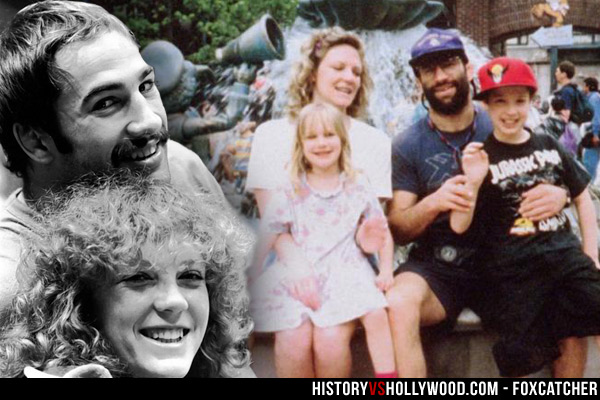
In reality, Dave spent roughly six years at Foxcatcher with his wife Nancy and their children.
By the time du Pont murdered him in January 1996, Mark had been gone for more than six years.
This changes how the murder should be understood.
The real killing wasn’t an immediate aftermath of Mark breaking away from du Pont.
That connection largely belongs to the movie’s compressed timeline.
Why Did Dave Schultz Agree to Work for Du Pont?
Foxcatcher offered elite wrestlers something extremely valuable: a place where they could train at a world-class level while still receiving financial support.
Dave was not merely an Olympic champion.
He was also regarded as an extraordinary teacher.
Wrestlers who trained with him described him as generous with his technical knowledge and unusually curious about wrestling styles from around the world.
At Foxcatcher, Dave coached other athletes while continuing his own attempt to compete internationally.
He became the center of a community of wrestlers preparing for major tournaments and ultimately the 1996 Olympic Games.
Even athletes who recognized du Pont’s increasingly bizarre behavior had powerful reasons to stay.
The training environment was excellent.
And Dave Schultz was there.
Did John du Pont Really Behave as Strangely as Steve Carell Does in the Movie?
The movie arguably tones down some aspects of reality.
People who knew du Pont described increasingly severe paranoia and erratic behavior.
He carried firearms.
He installed surveillance equipment.
He became convinced that people were hiding around his property.
Former wrestler Brian Dolph recalled du Pont believing that small wrestlers could be hiding inside the walls.
There were reports that he sent people searching for ghosts in his attic.
He owned and drove military equipment, including a tank.
He also had serious problems involving alcohol and drugs.
By the 1990s, some athletes around Foxcatcher understood that du Pont was mentally deteriorating.
Yet his money and the training opportunities he provided made it easier for people around him to tolerate behavior that, in retrospect, looked increasingly dangerous.
Did Du Pont Really Drive a Tank Around the Estate?
Yes.
This is not one of the filmmakers’ inventions.
Du Pont possessed military equipment and really did drive a tank around his property.
The tank was simply one part of a larger pattern of behavior that appeared increasingly eccentric and threatening.
Accounts surrounding Foxcatcher also describe firearms, surveillance, paranoid beliefs and bizarre confrontations.
The movie uses moments like the tank ride to show the unusual power dynamic around the estate.
Most people could not behave that way without consequences.
Du Pont’s extraordinary wealth allowed him to create an environment where his behavior could be excused, tolerated or simply avoided for much longer than it otherwise might have been.
Did Mark and John du Pont Really Use Cocaine Together?
According to Mark Schultz, yes.
Mark has said that du Pont initially asked him where he could obtain cocaine.
He later acknowledged that the two used the drug together on several occasions.
So the movie’s broader depiction of cocaine use has a factual foundation.
However, Mark disputed details surrounding the banquet sequence in which du Pont gives him a prepared speech praising his benefactor.
Mark said du Pont did make him speak publicly but denied simply reading a flattering speech that had been written for him.
As with many parts of Foxcatcher, the filmmakers took real pieces of the relationship and reshaped them into a cleaner dramatic scene.
Did Mark Really Dye His Hair Blond?
No.
In the movie, Mark changes his appearance during his increasingly unhealthy relationship with du Pont.
The real Mark Schultz specifically said he never dyed his hair.
It’s a small alteration, but it serves a clear storytelling purpose.
The physical transformation suggests that Mark is being absorbed into du Pont’s world and losing part of his own identity.
That symbolism works on screen.
It just didn’t happen in real life.
Did Mark Really Coach John du Pont as a Wrestler?
Not the way the movie depicts.
Foxcatcher shows Mark helping du Pont prepare for competition and reinforces du Pont’s fantasy that he is not simply a sponsor but a legitimate wrestler and coach.
Mark later rejected that portrayal.
He said he never taught du Pont wrestling techniques or coached him through matches.
Du Pont did participate in masters-level wrestling competition and wanted to be perceived as an athlete.
But the film exaggerates Mark’s role in supporting that fantasy.
Did the Movie Imply a Sexual Relationship Between Mark and Du Pont?
Some viewers interpreted it that way.
Mark Schultz strongly objected.
Certain scenes depict du Pont invading Mark’s physical and emotional space in ways that can be read as sexually suggestive.
After critics began describing the relationship in those terms, Mark publicly attacked the implication.
He insisted that he and du Pont never had a sexual relationship.
Director Bennett Miller’s intention, according to Mark’s recollection, was to convey du Pont’s intrusion into Mark’s boundaries rather than to state that the men were lovers.
The distinction mattered enormously to Mark, who felt the movie had created an interpretation that was not true.
Were There Other Allegations of Sexual Misconduct Around Du Pont?
Yes.
Mark’s objection to the film’s implication about their relationship should not be confused with broader allegations surrounding du Pont.
Mark described inappropriate physical behavior in wrestling settings.
Du Pont also faced accusations involving other people connected to wrestling.
A Villanova coach alleged that he suffered professional consequences after rejecting sexual advances from du Pont.
These accounts provide context for the movie’s portrayal of du Pont as someone who frequently ignored personal boundaries.
But they do not establish that he and Mark Schultz had a sexual relationship.

Did Mark Schultz Really Fail at the 1988 Olympics?
He competed successfully enough to finish sixth, but he did not win another medal.
Mark entered the Seoul Olympics hoping to repeat his 1984 gold-medal success.
He finished sixth.
Afterward, he retired from competitive wrestling and left Foxcatcher.
The movie uses the loss as an emotional collapse at the end of Mark’s dependence on du Pont.
The real sequence was less directly tied to Dave because Dave had not yet moved onto the estate.
Still, the defeat effectively closed Mark’s chapter at Foxcatcher.
Were There Warning Signs That John du Pont Could Become Violent?
Many.
Accounts of his behavior before Dave’s murder make the eventual tragedy especially disturbing.
Du Pont’s brief marriage in the early 1980s ended amid serious allegations of violence.
People around Foxcatcher later described his paranoia worsening.
He increasingly carried guns and sometimes threatened people.
Alcohol and drug use appeared to intensify the instability.
Former athletes later acknowledged that they should have recognized how dangerous the situation had become.
Kurt Angle, who trained with Dave Schultz, recalled an environment in which du Pont’s bizarre conduct grew increasingly difficult to ignore.
The problem was that Foxcatcher also provided something American wrestlers desperately needed.
That made leaving complicated.
Why Did John du Pont Kill Dave Schultz?
No definitive motive has ever been established.
That is another area where the movie creates a more satisfying dramatic explanation than reality provides.
In Foxcatcher, du Pont’s resentment toward Mark and his growing fixation on Dave seem to build directly toward the murder.
The real chronology destroys much of that connection because Mark had already been gone for years.
Dave was actually one of the people closest to du Pont.
He served as an important coach at Foxcatcher and, by several accounts, sometimes tried to manage or calm du Pont’s increasingly erratic behavior.
Dave had also discussed eventually leaving Foxcatcher, including the possibility of taking a coaching position at Stanford after the 1996 Olympics.
Whether that decision triggered the murder remains uncertain.
Even decades later, the fundamental question — why Dave? — has never received a completely convincing answer.
How Was Dave Schultz Murdered?
On January 26, 1996, Dave was outside the home where he and his family lived on the Foxcatcher property.
John du Pont approached in his vehicle.
Nancy Schultz was nearby.
Du Pont pulled out a gun and shot Dave three times.
Nancy witnessed the final shot.
She then rushed to her husband as he lay wounded and held him while calling for help.
Du Pont pointed his weapon toward Nancy as well but did not shoot her.
He then drove away.
Dave Schultz was 36 years old.
Did the Movie Recreate Nancy Schultz’s Real 911 Call?
Very closely.
Nancy cooperated with the filmmakers and helped Sienna Miller understand exactly how the killing had unfolded.
The production used wording from Nancy’s actual emergency call in the film.
Nancy also provided deeply personal materials belonging to Dave, including photographs, home movies and his eyeglasses.
Mark Ruffalo wore Dave’s real glasses during filming.
She even supplied details from the Schultz family’s home so the production could recreate parts of their life more accurately.
For Nancy, watching the finished film was understandably painful.
But she ultimately supported the project.
What Happened After the Shooting?
Du Pont retreated into his enormous mansion.
Police surrounded the property.
The standoff lasted approximately two days.
Because du Pont had barricaded himself inside and was known to possess weapons, officers could not simply rush the building.
Eventually, authorities found another solution.
They shut down the boilers supplying heat to the mansion.
Du Pont finally emerged because he needed to deal with the heating system.
Police arrested him.
The surreal sequence — a millionaire accused of murder hiding inside a giant estate while police wait outside — sounds like something created for a movie.
It wasn’t.
Was John du Pont Convicted of Murder?
Yes.
In 1997, a jury found John du Pont guilty of third-degree murder but mentally ill in Dave Schultz’s death.
He was sentenced to prison.
Du Pont remained incarcerated for the rest of his life and died in a Pennsylvania prison on December 9, 2010, at age 72.
A recent Associated Press retrospective on the prosecutor who handled the case confirms that the verdict was third-degree murder with a finding of mental illness.
How Did Mark Learn That His Brother Had Been Killed?
Mark wasn’t anywhere near Foxcatcher.
By 1996, he was coaching wrestling at Brigham Young University.
His father called and told him that Dave had been murdered by du Pont.
Mark later described becoming overwhelmed with rage, damaging objects in his office and then going home to watch television coverage of the police standoff at the Foxcatcher estate.
That real distance between the brothers is important.
The movie makes Dave’s murder feel like the final chapter of Mark’s Foxcatcher experience.
For the real Mark, Foxcatcher had been part of his past for years when it suddenly returned in the worst possible way.
Did Mark Schultz Really Become an MMA Fighter After Dave’s Death?
Only briefly.
Less than four months after his brother was killed, Mark competed at UFC 9 on May 17, 1996, in Detroit.
He was a late replacement.
Mark fought Gary Goodridge and won by TKO after roughly 12 minutes.
But this wasn’t the beginning of a lengthy mixed martial arts career.
It was his only professional MMA bout.
ESPN’s record for Schultz lists him at 1-0, with that single victory over Goodridge.
He spent much more of his post-wrestling career coaching.
What Did Mark Think of Steve Carell’s Performance?
Despite his anger about certain aspects of Foxcatcher, Mark had extremely positive things to say about Steve Carell.
He felt Carell captured du Pont’s appearance, movements, expressions and unusual mannerisms with remarkable accuracy.
Carell’s transformation was one of the film’s most surprising elements because audiences primarily knew him as a comedic actor.
Heavy makeup and a prosthetic nose helped create the physical resemblance.
But it was Carell’s controlled speech, posture and unsettling pauses that made the character recognizable to people who actually knew du Pont.
Mark essentially felt as though the real man had been recreated in front of him.
Did the Filmmakers Use the Real Foxcatcher Estate?
No.
By the time the movie was made, the original estate was disappearing.
The mansion and many surrounding structures were demolished in 2013 as the property was redeveloped into luxury housing.
For exterior shots, the production used Morven Park in Leesburg, Virginia.
Interior scenes were filmed elsewhere, including Wilpen Hall near Pittsburgh.
That means the bleak estate looming over the movie is not literally the place where Mark trained and Dave lived.
The real Foxcatcher mostly survives now through photographs, archival footage and the memories of the athletes who spent years there.
Does the Real Mark Schultz Appear in Foxcatcher?
Yes.
There is a small meta moment in the movie involving the real wrestler and the actor playing him.
During a weigh-in scene, Mark Schultz appears as the official who weighs Channing Tatum’s version of Mark.
It’s easy to miss if you don’t know what the real Schultz looks like.
The cameo places the man whose memories helped inspire much of the film directly beside his fictional counterpart.
How Accurate Is Foxcatcher Overall?
The tragedy at the center of the movie is real.
Mark and Dave Schultz really were Olympic champions.
John du Pont really used his fortune to become a major financial supporter of American wrestling.
Mark really trained under the Foxcatcher banner and became personally entangled with du Pont.
Dave later lived on the estate with his family and became one of the program’s most important coaches.
Du Pont’s behavior really became increasingly erratic and paranoid.
And on January 26, 1996, he really shot and killed Dave Schultz.
But the movie reshapes the timeline dramatically.
Mark and Dave were not simultaneously living at Foxcatcher.
Mark’s departure happened years before Dave’s murder.
Mark denied coaching du Pont in wrestling.
He denied dyeing his hair.
And he strongly rejected any implication that he had a sexual relationship with du Pont.
Those changes don’t erase the film’s achievement.
They reveal what Foxcatcher actually is.
It is less a chronological recreation than a psychological interpretation of three men whose lives became connected through wrestling, money and power.
The Real Foxcatcher Story Was About More Than John du Pont
It is easy to reduce the story to the eccentric millionaire who eventually became a murderer.
But doing that risks overlooking why athletes were at Foxcatcher in the first place.
Mark Schultz was an Olympic champion who still struggled to build financial security through his sport.
Dave Schultz was one of America’s greatest wrestlers and teachers, yet private sponsorship remained enormously valuable to his ability to continue training.
Du Pont possessed something they needed.
Money.
Facilities.
Time.
He could create a training environment that American wrestling itself struggled to provide.
And that gave him influence over athletes whose accomplishments far exceeded his own.
For years, the arrangement worked well enough that people tolerated increasingly disturbing behavior.
There were world-class training rooms.
Olympic hopefuls.
Families living together.
Wrestlers sharing knowledge.
And Dave Schultz, a man so respected throughout the sport that friends remembered him as someone who seemed to have thousands of best friends.
Then the person financing that world destroyed it.
That is what makes the real story behind Foxcatcher more unsettling than a simple tale about an unstable rich man.
Du Pont didn’t force his way into American wrestling.
His wealth made him valuable enough that the wrestling world invited him in.
And by the time everyone understood how dangerous he had become, Dave Schultz was dead.