From Order Dispute to Handcuffs: How a Fight Over Lemon Pepper Wings Landed a Couple in Jail

What began as an ordinary customer complaint over an order of fried chicken wings quickly deteriorated into a chaotic brawl inside a fast-food establishment, culminating in criminal charges and a sharp lesson in accountability. Newly released law enforcement body-worn camera footage captures the rapid unravelling of an evening that started with impatience over extra-crispy chicken and ended with a young couple handcuffed in the back of patrol cruisers.
The incident, recorded on October 19, 2025, illustrates the volatile nature of modern retail confrontations—specifically how minor service delays can violently escalate when aggravated customers bypass civil mediation in favor of physical intimidation.
The Traffic Stop and the Boyfriend’s Bewildered Defense
The confrontation spilled into police intervention when responding officers intercepted the couple in their vehicle just outside the restaurant premises. With blue emergency lights reflecting off the asphalt, an officer approached the driver’s side and instructed the driver to shift the vehicle into park and shut off the engine.
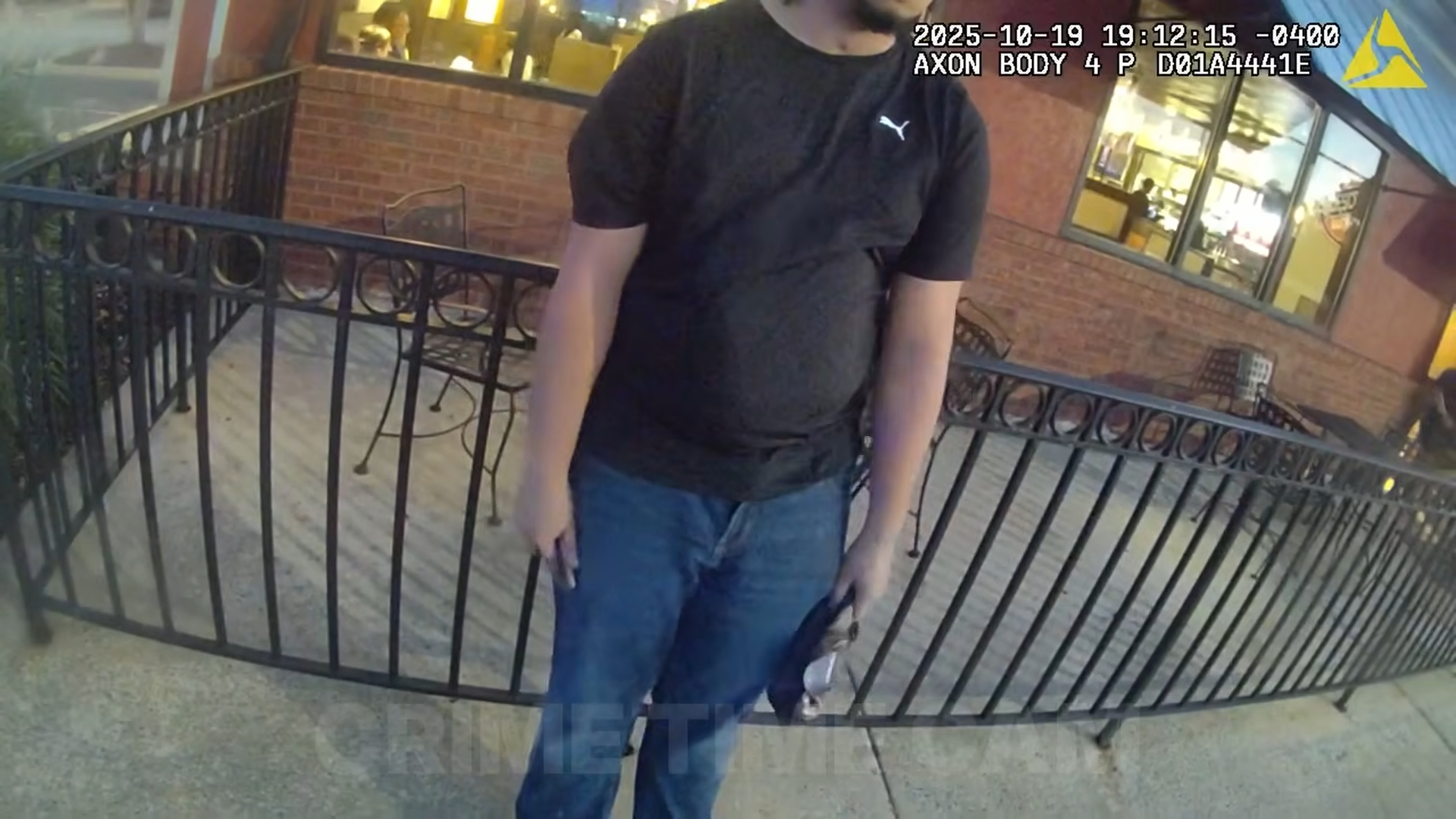
Stepping out into the cool night air, the male suspect appeared distinctly unsettled, attempting to preemptively distance himself from criminal wrongdoing. Separated from his girlfriend by law enforcement to ensure independent witness accounts, he claimed utter ignorance of the conflict’s origins. According to his initial statement to the questioning officer, he had merely walked into the dining area to check on his companion, only to find her embroiled in a heated verbal dispute with kitchen personnel over a cash refund.
The young man insisted that he had walked into an active ambush rather than initiated one. He alleged that two male employees emerged aggressively from behind the service counter, brandishing raised fists and lunging at his girlfriend. In his framing, his subsequent involvement was neither planned nor malicious, but an instinctive act of chivalry to shield his partner from male workers. However, his hesitant demeanor and fragmented timeline foreshadowed discrepancies that investigators would soon uncover.
The Girlfriend’s Narrative: Victimhood and Self-Defense
When officers turned their attention to the girlfriend, she presented an entirely different, highly impassioned account. Insisting that she was the aggrieved party, she claimed that restaurant staff had treated her with unprovoked hostility from the moment she inquired about her delayed order.
According to her statement, she had waited patiently for food that an employee had supposedly taken out to a vehicle. When she returned inside to rectify the missing items, she alleged that a male kitchen worker confronted her with abrasive language and unwarranted disrespect. Emphasizing her status as an unarmed woman facing hostile male workers, she told police that she was merely attempting to secure either her food or a financial refund.
Addressing her partner’s sudden entry, she maintained that she had no idea he had stepped inside the building until the situation had already boiled over. She claimed that upon noticing her boyfriend, the restaurant workers turned their hostility toward him, allegedly rushing out from behind the counter to assault them both. Confident that indoor security cameras would exonerate her, she repeatedly claimed that store employees had laid hands on her first, justifying any retaliation as pure self-defense.
The Male Employee’s Revelation: The “Bring Your Man” Ultimatum
A markedly contrasting reality emerged when responding officers walked inside to interview the restaurant’s kitchen staff. A male employee detailed a pattern of verbal abuse and aggressive threats that originated entirely from the customer’s dissatisfaction over specialized menu items.
According to the cook, the customer grew visibly irate over the waiting time for an order of traditional lemon pepper wings. When informed of the status of the ticket, she allegedly turned aggressive toward everyone behind the register, hurling profanities and issuing direct threats of physical violence, boasting that she would jump across the counter and beat the staff herself .
Rather than engaging in physical combat with an agitated female customer, the worker stated that he established a clear boundary: “I don’t hit females; bring your man in here”.
According to the employee, the woman took that remark as a literal directive. She stepped outside to retrieve her boyfriend, and when the worker returned to the front counter after taking a brief breather in the kitchen, the woman pointed him out, shouting, “That’s him right there”. Both individuals then allegedly stormed past the counter partition into the private kitchen area, where the boyfriend shoved the employee, triggering a chaotic melee.
The Mediator’s Eyewitness Account: The Breaking Point Behind the Counter
Corroborating the male worker’s narrative was the store’s female shift lead, who had attempted to serve as an impartial mediator throughout the ordeal. Her statement provided critical context regarding the culinary delay that sparked the outrage.
The supervisor explained that the customer had explicitly requested her wings to be prepared “very, very well-done”. In commercial frying, achieving that level of crispiness requires fresh wings to be submerged in hot oil for at least 13 minutes, in addition to order-queue delays. When the initial batch failed to meet the customer’s crispiness standards, staff dropped a brand-new batch without hesitation.
However, after roughly twenty minutes, the customer stormed the counter screaming profanities. The supervisor sent the male employee toward the back door to defuse tensions and was actively processing a complete cash refund while the replacement wings were still frying. Despite the refund being underway, the woman refused to de-escalate.
Moments later, the customer’s boyfriend breached the restaurant’s interior. Multiple employees attempted to create a physical buffer, but the couple pushed through. Recognizing that a physical confrontation was imminent, the supervisor stepped aside just as the couple began swinging punches at kitchen personnel. The staff unequivocally indicated to police that they intended to press criminal charges.
Handcuffs and Criminal Charges
Faced with consistent, independent accounts from multiple eyewitnesses that contradicted the couple’s claims of victimhood, officers moved to take decisive legal action.
Returning to the parked vehicle, the lead officer ordered the boyfriend to remove his hands from his pockets and put down his cellular phone. When the boyfriend attempted to place a phone call, officers firmly intercepted him, instructing him to turn around and place his hands behind his back.
Both the boyfriend and the girlfriend were formally taken into custody and charged with disorderly conduct and simple assault. Although both offenses are classified as misdemeanors carrying preset bail bonds, the legal consequences marked a severe conclusion to what began as a routine dinner order. Even as metal handcuffs clicked around their wrists, the pair continued to protest, unaware that their own demands to check the surveillance cameras would likely preserve the very evidence needed to prosecute them.

The Anatomy of an Avoidable Disaster
The bodycam footage of the October 2025 arrest serves as a sobering case study in modern public altercations. What could have been resolved with a complimentary meal or a routine cash refund transformed within minutes into a criminal record.
For service industry workers, the footage underscores the persistent safety hazards encountered during routine customer interactions. For the couple, it highlights the dangerous consequences of blind loyalty and impulse control failures: stepping blindly into a retail conflict—and answering an empty challenge with physical violence—rarely leads to vindication, only a one-way trip to the county jail.