He Failed Four Times. Then He Swam Across the Baltic Sea for 56 Hours
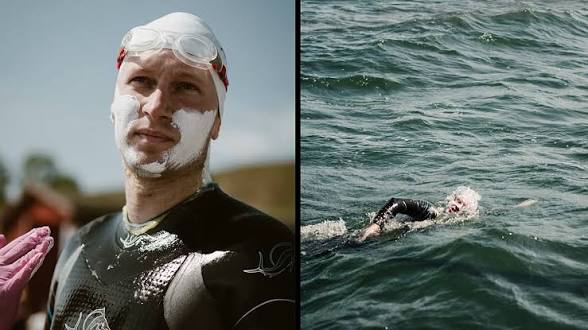
For years, the Baltic Sea refused to let Bartłomiej Kubkowski cross it.
The Polish ultra-swimmer had spent years chasing what seemed almost impossible: becoming the first person to swim continuously from Sweden to Poland across the Baltic Sea.
He failed again and again.
Then, on August 2, 2026, after more than two days without sleep, he finally walked out of the water on the Polish coast.
He had done it.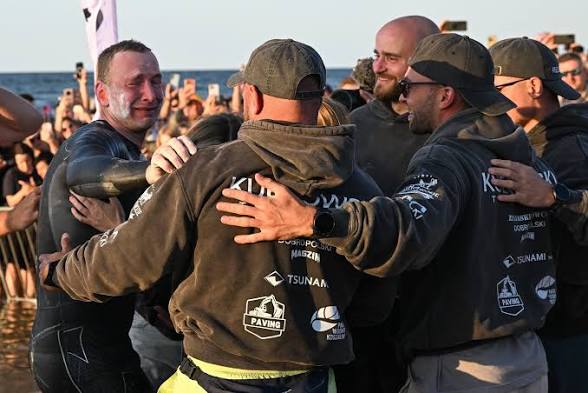
Kubkowski completed the roughly 160-kilometer journey from Kåseberga, Sweden, to Dziwnów, Poland, in about 56 hours, becoming the first person to complete the Sweden-to-Poland Baltic crossing by swimming continuously.
And perhaps the most remarkable part was that this was not his first attempt.
It was his fifth.
The Baltic kept beating him
Kubkowski had been trying to conquer the route for years.
During his early attempts, he repeatedly pushed deeper into the Baltic before his body or the conditions finally forced him out.
He swam roughly 114–115 kilometers during his first attempt, before returning the following year and reaching about 117 kilometers.
In 2023, he went even farther.
He covered approximately 130 kilometers, with his team eventually pulling him from the water as severe conditions — including snowfall — made the challenge increasingly brutal.
But the closest he came before 2026 was the attempt that nearly broke him.
In August 2025, Kubkowski spent around 55 hours in the Baltic, covering approximately 159 kilometers of the planned 170-kilometer route.
He was just 11 kilometers from the Polish coast.
Then the weather deteriorated.
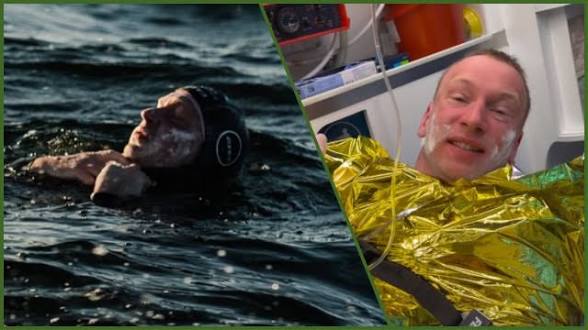
Exhaustion took over.
His team made the decision to pull him from the water.
He had come agonizingly close — but still had to leave without completing the crossing.
For most people, that might have been the end.
For Kubkowski, it became another reason to come back.
The fifth attempt was different
On Friday, July 31, 2026, Kubkowski entered the Baltic near Kåseberga on Sweden’s southern coast.
The rules were brutally simple.
He could not sleep.
He could not stop.
He could not climb onto the support boat.
The boat could accompany him, monitor his condition and provide food and fluids, but Kubkowski could not physically touch it. Nutrition and hydration were passed to him while he continued swimming.
For more than two days, his body kept moving through the open sea.
The distance was enormous.
But the real enemy was not simply the kilometers.
It was exhaustion.
After dozens of hours without sleep, Kubkowski reportedly experienced periods of confusion and even hallucinations. His team continued monitoring him as he fought through the physical and mental strain.
Still, he kept swimming.
One stroke.
Then another.
And another.
56 hours later, history
On Sunday evening, August 2, Kubkowski finally reached the Polish coast.
He climbed onto the beach at Dziwnów under his own power.
That detail mattered.
For the achievement to count, he had to leave the water without physical assistance and remain standing without help. He managed to do exactly that despite being completely exhausted.
The crowd waiting on shore erupted.
After spending roughly 56 hours in the Baltic, Kubkowski had finally accomplished what had eluded him through four previous attempts.
The man who had repeatedly been defeated by the sea had finally beaten the sea.
But this was never only about him
Kubkowski’s challenge also had a humanitarian purpose.
His Ultra Baltic Swim was carried out in support of Cancer Fighters, a Polish charity supporting children with cancer.
By the time he reached the Polish coast, the campaign had raised more than 790,000 Polish zloty, equivalent to roughly $210,000, according to reports.
That transformed the swim from an extraordinary sporting challenge into something much bigger.
Every kilometer represented more than a personal goal.
Every hour in the freezing Baltic was also helping raise money for children fighting cancer.
A victory built on failure
Kubkowski’s story is not really about one incredible swim.
It is about what happened before it.
He failed.
Then he tried again.
He failed again.
He went farther.
He got closer.
He came within 11 kilometers of success and still had to be pulled from the water.
And then he returned for a fifth attempt.
This time, he refused to let the Baltic have the final word.
After approximately 160 kilometers and nearly 56 hours without sleep, Bartłomiej Kubkowski finally reached Poland.
He didn’t just cross a sea. He crossed the line between “almost” and “done.”
And he did it while turning one of the most punishing endurance challenges imaginable into a fundraiser for children with cancer.
Respect, Bartłomiej.