Hit Man: The Real Story of Gary Johnson, the Professor Who Pretended to Be a Killer for Police

Richard Linklater’s Hit Man opens with a premise that sounds like the setup for a dark joke.
Gary Johnson is a quiet psychology professor who lives alone with his cats and doesn’t exactly project danger.
Then police discover that he has an unexpected talent.
Gary is remarkably convincing when pretending to be a professional killer.
Soon he is meeting people in restaurants, parked cars and hidden-camera setups while wearing different clothes, changing his voice and adopting entirely new personalities. His job is simple: convince people looking to have someone murdered that he is the contract killer they need — then record enough evidence for police to arrest them.
Glen Powell plays Gary as both an awkward academic and a charismatic collection of fictional assassins.
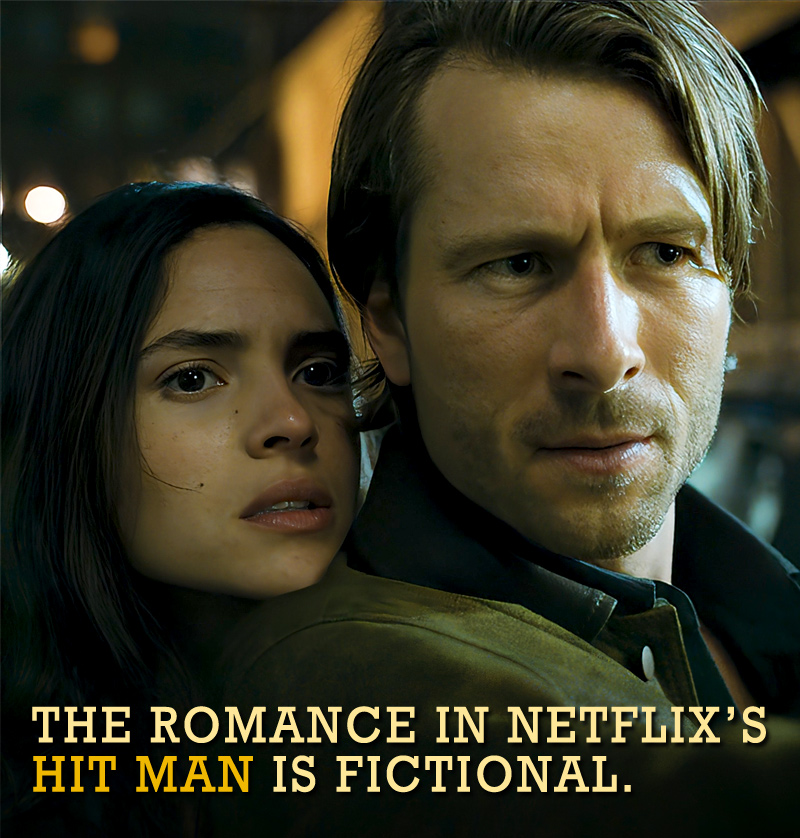
Then Adria Arjona’s Madison enters the picture.
She wants her abusive husband dead.
Instead of setting her up for arrest, Gary tells her to take the money and leave.
That’s where the movie begins moving very far away from reality.
The real Gary Johnson really was a mild-mannered man who became one of law enforcement’s most effective fake hit men.
He really taught psychology.
He really created different identities to manipulate potential clients.
And there really was a woman he decided not to arrest after learning that she was trapped in an abusive relationship.
But Gary did not fall in love with her.
He did not become a murderer.
And the increasingly dangerous crime-romance that makes up the second half of Hit Man belongs almost entirely to Linklater and Powell’s imagination.
Is Hit Man Actually Based on a True Story?
Yes — but the movie itself gives audiences a warning about how seriously to take that claim.
Its opening describes what follows as a “somewhat true story.”
That’s probably the most accurate description possible.
Gary Johnson was real.
The unusual undercover occupation at the center of the movie was real.
But the film takes a relatively small piece of his life and imagines what might have happened if one assignment had spiraled completely out of control.
Linklater and Powell based the screenplay on journalist Skip Hollandsworth’s 2001 Texas Monthly article, also titled Hit Man.
One major change is location.
The movie places Gary in New Orleans.
The real story unfolded primarily around Houston, Texas, during the 1990s.
The film also updates Gary’s world to the present day rather than recreating his actual period of undercover work.
Was Gary Johnson Really a College Professor?
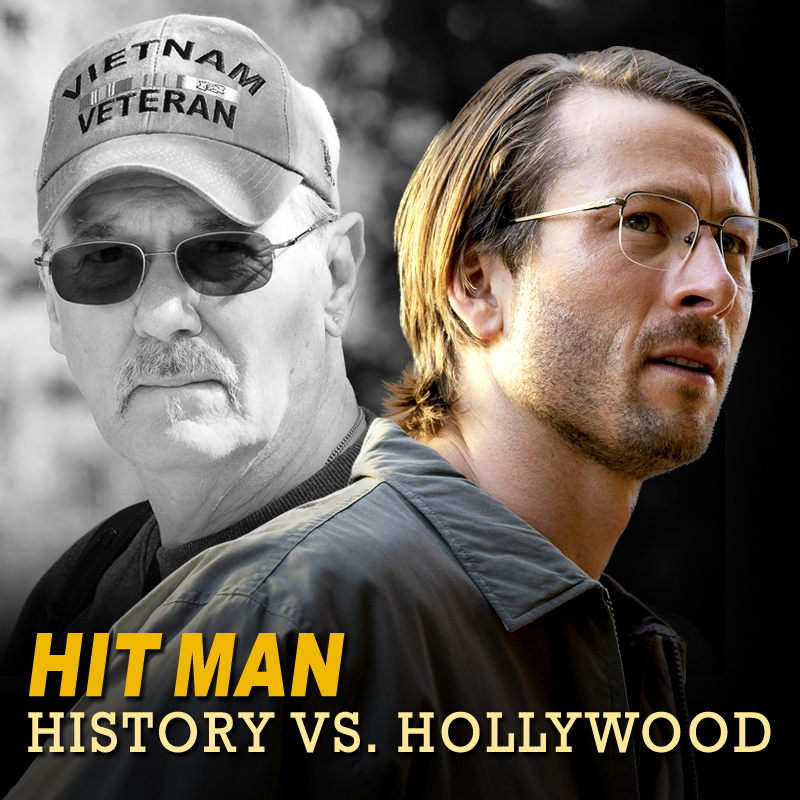
Yes, although teaching wasn’t his primary career.
The movie turns Glen Powell’s Gary into a mild-mannered professor who seems almost comically removed from the world of professional killers.
That contrast had a real-life foundation.
Johnson taught night classes twice a week, including courses involving human sexuality and general psychology.
His main job, however, was with the Harris County district attorney’s office.
Much of his ordinary work was surprisingly technical.
Johnson helped prosecutors by duplicating and improving audio and video recordings that could be used as evidence in criminal trials.
Then there was the much stranger part of his job.
Whenever law enforcement around Houston encountered somebody searching for a contract killer, Gary could be called in to play one.
Did He Really Pretend to Be Different Types of Hit Men?
Absolutely.
This is one of the film’s most entertaining ideas, and it came directly from Johnson’s actual abilities.
Johnson understood something important about undercover work:
There was no single personality that would convince everyone.
A wealthy client might imagine a professional assassin differently from a street-level criminal.
Someone nervous might need reassurance.
Someone arrogant might respond better to intimidation.
Gary adjusted.
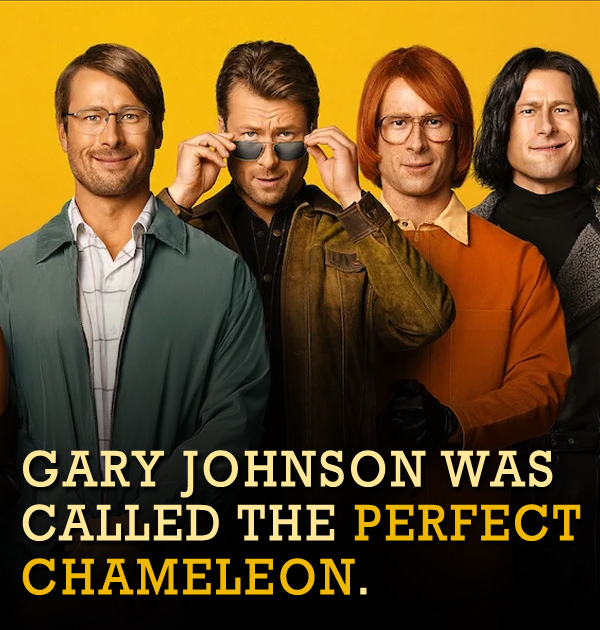
People who worked around him described him as an exceptional chameleon who could quickly figure out what kind of person a potential client expected to meet and then become that person.
The movie takes that talent much further.
Powell’s Gary uses elaborate wigs, accents, clothing and completely different personalities — from polished professionals to terrifying oddballs.
Linklater has acknowledged that the real Johnson used some disguise and role-playing, but not with the almost sketch-comedy level of transformation seen in the film.
Powell and Linklater deliberately exaggerated that element because it supported the movie’s larger question:
If Gary can convincingly become anyone, how much of his ordinary personality is simply another role?
How Successful Was Gary at Catching People Who Wanted Someone Dead?
Extremely successful.
During roughly the decade before Hollandsworth’s 2001 article, Johnson said more than 60 people hired him believing that he was an actual killer.
Those encounters reportedly resulted in about 60 arrests.
The irony behind his work was that many clients apparently assumed hiring a professional murderer would be relatively easy.
Linklater has repeatedly pointed out how strange that cultural belief is.
Movies and television have created the image of the anonymous professional assassin: an icy stranger who accepts money, kills someone and disappears.
In reality, trying to hire someone you don’t know to commit murder creates an obvious opportunity for police.
Johnson’s career depended on people believing the movie version of hit men was real.
He simply stepped into the fantasy they already had in their heads.
Was Madison Based on a Real Woman?
Very loosely.
This is where Hit Man takes its most important piece of reality and uses it as the doorway into fiction.
In the movie, Madison Masters approaches Gary’s hit-man persona, Ron, because she wants her controlling husband killed.
Gary senses something different about her.
Instead of encouraging Madison to hand him money and incriminate herself, he tells her to keep the cash and use it to escape her marriage.
The basic idea really happened.
Hollandsworth described an unnamed woman who approached the real Johnson about having her boyfriend killed.
Gary researched her before their meeting.
What he learned changed his approach.
According to the account, the woman was being abused and appeared genuinely frightened of her partner.
Rather than proceed with the usual sting operation, Johnson tried to help.
He referred her toward social services, therapy and resources that could help her leave the relationship and enter a women’s shelter.
Johnson later described it as the one occasion when he essentially became softhearted instead of making an arrest.
Did Gary and the Real “Madison” Fall in Love?
No.
This is the dividing line between the true story and the movie’s main plot.
Gary helped the woman.
Then their story ended.
There was no secret romance.
She did not continue believing that Gary was a professional assassin named Ron.
Gary did not become trapped between his real identity and the killer persona he had created.
None of the dangerous romantic triangle that follows occurred.
Linklater and Powell saw the real incident and asked a simple storytelling question:
What if Gary saw her again?
From that point, they allowed the movie to leave history behind.
Powell has explained that this single anecdote gave them the emotional story the original article did not have. Instead of making a collection of undercover sting operations, they could explore what happened when a man who spent his life playing different people fell in love while pretending to be somebody else.
Did Gary Johnson Ever Murder Anyone?
No.
This is especially important because the movie’s ending might leave viewers wondering whether Gary’s real life took the same astonishing turn.
It did not.
The murders and cover-up are fictional.
Linklater and Powell intentionally push Gary’s transformation into territory the real Johnson never entered.
Netflix even addresses this directly in material accompanying the film because early audiences were asking whether Johnson had actually gotten away with murder.
He hadn’t.
The filmmakers added those events because they wanted their fictional Gary to become increasingly comfortable inside the dangerous identity he had created.
The real Johnson’s career was based on pretending he could kill.
There is no evidence that he actually did.
Was Gary Really the Lonely Cat Owner Shown in the Movie?
There is considerable truth here.
Johnson had been married and divorced three times.
His second wife described him as quiet and solitary.
And yes, the cats were real.
Their names were Id and Ego, an almost suspiciously perfect choice for a man who taught psychology and spent part of his life shifting between different identities.
The movie makes Gary younger and considerably more conventionally glamorous by casting Glen Powell.
That wasn’t what made the real Johnson effective.
His advantage was almost the opposite.
He looked ordinary.
Potential clients did not see a Hollywood assassin entering the room.
They saw a normal-looking man.
Then Gary started talking.
His ability to convince them mattered far more than looking dangerous.
Did Richard Linklater Know the Real Gary Johnson?
Linklater did have personal contact with Johnson while developing the project, although he later clarified that their interactions were by telephone rather than face-to-face meetings.
He had been interested in Hollandsworth’s article for years but struggled with how to turn it into a feature film.
The real story provided a fascinating character and a series of undercover encounters, but not necessarily the kind of central dramatic arc a movie needed.
That changed when Glen Powell became involved.
Powell believed they could treat the article as a starting point rather than an instruction manual.
The two writers focused on the abused woman Gary had decided to help and began imagining everything that might happen afterward.
Johnson died in September 2022, shortly before filming began.
He never saw the completed movie.
Hit Man ends with a dedication to him.
Why Did Linklater and Powell Change the Story So Much?
Because the real story and the movie are interested in slightly different questions.
The true Gary Johnson is fascinating because of his job.
How does an ordinary man become so persuasive that dozens of people openly discuss murder with him?
How does he figure out exactly what those people expect a killer to look and sound like?
The movie takes that idea and turns it inward.
Gary teaches psychology and talks to his students about identity.
Then he experiences his own experiment.
As Ron, he is more confident.
More sexual.
More dangerous.
More spontaneous.
Madison falls for Ron — but Ron doesn’t technically exist.
The deeper Gary moves into the role, the more the movie asks whether his supposedly fake personality might actually represent qualities he has been suppressing.
That philosophical idea mattered enough to Linklater and Powell that strict historical accuracy became much less important.
The real Johnson gave them the premise.
The fictional Gary gave them the story.
How Accurate Is Hit Man Overall?
The easiest answer is to divide the film in two.
The foundation is real.
Gary Johnson existed.
He worked with law enforcement around Houston.
He taught college classes.
He lived with cats named Id and Ego.
He was unusually talented at impersonating contract killers.
Dozens of people attempted to hire him.
And one abused woman really did cause him to abandon the normal sting procedure and help her instead.
The thriller-romance is fictional.
Gary did not begin dating that woman.
He did not maintain a secret romantic identity as Ron.
The murders that follow were invented.
The cover-up was invented.
And the film’s transformation of Gary from someone pretending to be dangerous into someone capable of actual violence belongs entirely to the screenplay.
That makes Hit Man different from many “based on a true story” movies.
It doesn’t gradually alter reality while pretending everything happened.
It more or less tells viewers from the beginning that it plans to cheat.
The Strangest Part of Hit Man Is the Part Hollywood Didn’t Invent
By the end of Hit Man, Gary’s story has become so outrageous that the real events can almost feel ordinary by comparison.
They weren’t.
For years, an unassuming employee of the Harris County district attorney’s office regularly sat across from people who believed they were hiring him to end another person’s life.
They discussed payment.
Methods.
Targets.
Gary listened.
He adapted his personality.
He told them whatever they needed to hear.
And when the conversation provided enough evidence, police moved in.
More than 60 people reportedly fell for it.
The movie invents the love affair and the bodies because those elements make for an irresistible dark comedy.
But the most remarkable idea was already sitting inside Skip Hollandsworth’s article.
Gary Johnson didn’t need to look like a killer.
He only needed each client to believe that he looked like their idea of one.
Richard Linklater and Glen Powell simply took that talent and asked what might happen if Gary eventually started believing in one of those characters himself.