Shania Twain Was 22 When Her Parents Died — Then She Had to Become the Parent Her Younger Siblings Needed

At 22, Shania Twain was supposed to be thinking about herself.
She had left her hometown in northern Ontario and was trying to build a future in music. She was young enough to imagine that the hardest decisions ahead might involve auditions, songs and whether she could somehow turn talent into a career.
Then one phone call changed the direction of her life.
In November 1987, Twain’s mother, Sharon, and stepfather, Jerry Twain, were killed in a head-on collision with a logging truck.
Suddenly, the aspiring singer was not simply a grieving daughter.
There were younger siblings back home.
There was a house.
There were bills.
There were legal and financial problems she had never expected to understand at 22.
And there was no parent left to handle any of it.
So Twain left the life she had been trying to build and returned home.
For a period that rarely fits neatly into the glamorous story of her later superstardom, the future Shania Twain effectively became both mother and father to the younger members of her family.
She Had Already Been Trying to Escape a Difficult Childhood
Long before Nashville knew the name Shania Twain, she was Eilleen Twain, growing up in Timmins, Ontario.
Money was often painfully tight.
Music was not simply a hobby in the household. Twain began performing at an unusually young age, sometimes singing in bars and other venues where the money she earned could help with family expenses.
Her mother believed fiercely in her talent.
Twain, however, has said that as a child she did not necessarily dream about fame in the way people might imagine.
Music was something she could do.
Eventually, it also became a possible way out.
As she got older, Twain moved away and began trying to create an independent life.
Then, at 22, she learned that both parents were gone.
The loss was devastating enough by itself.
But Twain did not have the luxury of grieving only as a daughter.
The family still needed someone to keep everyday life moving.

She Went Home Because the Children Could Not Simply Be Split Up
Twain returned to the family home in Timmins.
One older sibling was already living independently, but three younger siblings were still at home and needed stability.
Twain has spoken in recent years about the practical reality confronting her.
The children needed to remain together.
Someone needed to figure out what happened to the house.
There were financial affairs connected to her parents.
There were insurance and legal issues.
There was a mortgage.
None of those responsibilities cared that the person now dealing with them was only 22 and had just lost both parents.
Older accounts of this period describe Twain doing the kind of work normally associated with a parent: paying bills, dealing with the mortgage, doing laundry and getting the younger children to school.
Her own grief had to exist alongside chores that could not wait.
Breakfast still had to happen.
School still started in the morning.
Bills still arrived.
That is what changed Twain’s life most dramatically.
She did not simply lose her parents.
She inherited responsibilities they had been carrying.

Music Suddenly Looked Less Important
After the accident, Twain questioned whether there was any point in continuing with music.
Her mother had been one of the strongest believers in her career.
For years, much of the dream had been shared.
Now the person who had pushed her toward the stage was gone.
Twain was also facing a much more immediate problem.
A music career is uncertain.
Her family needed predictable income.
Trying to become a recording star could require traveling, auditions and long periods with no guarantee of a paycheck.
That was difficult to justify when younger siblings were depending on her.
For months, Twain focused on surviving the new reality.
Eventually, however, someone close to her suggested a possibility that could solve both problems at once.
There was a resort looking for a singer.

Deerhurst Resort Gave Her Something Nashville Couldn’t: A Regular Paycheck
The job was at Deerhurst Resort in Huntsville, Ontario.
It was not the version of stardom Twain had once imagined.
The resort staged elaborate entertainment for vacationers, and Twain would perform in revue-style productions rather than stand onstage presenting herself as the country artist she hoped someday to become.
But Deerhurst offered something far more valuable at that moment.
Regular work.
A steady paycheck.
And the possibility of moving her family close enough that she could continue caring for them while earning money as a performer.
Twain auditioned.
She got the job.
Then she relocated the family so she could work nights and still maintain the stability the children needed.
For the next several years, Deerhurst became the unlikely bridge between family survival and the career that was still waiting somewhere in the future.
At Night, She Became an Entertainer
The contrast was extraordinary.
By day, Twain had responsibilities more like those of a young parent.
At night, she walked onto a resort stage.
The productions required her to sing different styles of music and take part in theatrical numbers far removed from the country-pop image she would later create.
One famous story from this period involves a talent scout eventually finding the future superstar performing in a revue where she was dressed as a poodle.
It hardly sounds like the beginning of the woman who would later sell tens of millions of albums.
But those years were training.
Twain learned how to perform night after night whether she felt inspired or not.
She learned how to work an audience.
She learned different musical styles.
Most importantly, the job allowed her to keep the family together.
The music career she had nearly abandoned became the thing that helped support them.

She Had Little Time to Grieve
Looking back, Twain has acknowledged how difficult it was to process the loss while carrying so much responsibility.
There was always another practical problem requiring attention.
She was dealing with grief, but also money.
She was missing her parents, but also worrying about the household.
She was still barely into adulthood, but she could no longer behave as though her decisions affected only herself.
Years later, she would have opportunities to reflect on what that period had done to her.
At 22, reflection was a luxury.
She had to keep moving.
That helps explain something about the enormous determination Twain later brought into the music industry.
By the time Nashville truly opened its doors to her, she had already survived circumstances far more serious than a bad review or a rejected song.
The Superstar Came Later
Eventually, Twain’s family responsibilities became less consuming as her siblings grew older.
Her own career could move forward again.
She adopted the professional name Shania Twain, made her way into Nashville and ultimately created a country-pop career unlike almost anything the genre had seen before.
The Woman in Me transformed her into a major star.
Then Come On Over turned her into a global phenomenon.
Songs such as “You’re Still the One,” “That Don’t Impress Me Much” and “Man! I Feel Like a Woman!” became permanent pieces of pop culture.
To audiences discovering her in the 1990s, Shania looked almost impossibly confident.
She was glamorous.
Funny.
Independent.
In complete control of the stage.
But that version of Shania Twain had been shaped by a young woman who had already learned what it meant to have no easy option.
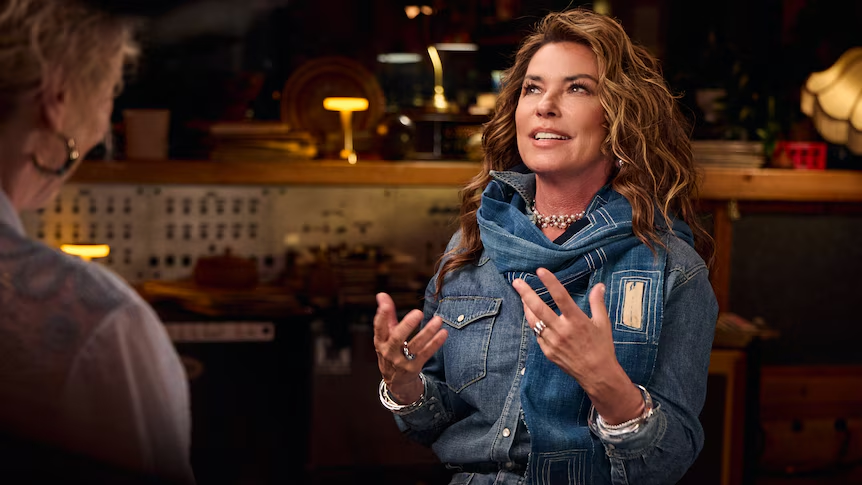
At 22, Her Dream Had to Wait
The most revealing part of Twain’s story may be what she did when success was not guaranteed.
She could have continued chasing music elsewhere and hoped someone else would solve the problems back home.
Instead, she returned.
She dealt with the mortgage.
She dealt with bills and household responsibilities.
She helped make sure the younger children went to school.
Then, when money became increasingly urgent, she took a resort job that allowed her to earn a dependable paycheck without abandoning them.
It was not the glamorous beginning of a superstar career.
It was something more basic.
Survival.
At 22, Shania Twain lost the two people who had been running her family.
She did not suddenly know how to replace them.
She simply understood that the younger children could not be left without someone willing to try.
Long before millions of fans saw a fearless woman command an arena, Shania Twain had already learned how to become the person everyone else needed when there was nobody left to call.