The Hunger Games Looks Very Different as an Adult — These Darker Details Were Hiding in Plain Sight

When many fans first encountered The Hunger Games, the story was easy to read as a gripping survival drama.
Katniss Everdeen volunteered to save her sister. Children were sent into an arena. Alliances formed, romances complicated everything, and a rebellion slowly began to take shape.
But returning to Panem as an adult can feel like watching an entirely different story.
Beneath the action, Suzanne Collins built a world filled with political manipulation, economic inequality, trauma, exploitation and the kind of social control that younger audiences may not fully recognize the first time around.
The result is one reason The Hunger Games continues to hold up years later: the older the audience gets, the darker some of its most familiar details become.
The Games Are Really a Brutal Form of Reality Television

The Hunger Games are horrifying because children are forced to kill one another.
But there is another layer to the cruelty: everything is packaged as entertainment.
Katniss and Peeta quickly learn that surviving the arena is not only about fighting. They must also perform for an audience.
Their romance becomes part of that performance.
Sponsors can influence who receives food, medicine or other help, meaning tributes are encouraged to create compelling public personas while their lives are in danger.
The Gamemakers manipulate events as well.
When Katniss becomes too comfortable in one location, for example, a manufactured forest fire pushes her toward other tributes.
Seen through adult eyes, the resemblance to reality television becomes difficult to ignore.
The contestants may appear to be making independent choices, but unseen producers can shape the environment, encourage confrontation and turn human suffering into a narrative designed to keep viewers watching.
Panem simply takes that familiar formula to its most horrifying extreme.
Katniss and Peeta Quietly Reverse Familiar Gender Roles

The central relationship also becomes more interesting with age.
Katniss occupies the role traditionally assigned to the male hero.
She hunts.
She supports her family.
She is practical, guarded and skilled at survival.
Peeta, meanwhile, is emotionally expressive, artistic and far more comfortable discussing love.
He decorates cakes and later paints, while Katniss excels at trapping animals and firing a bow.
Even their rescue dynamic is reversed.
Peeta repeatedly needs saving, whether he is wounded inside the arena or later captured by the Capitol.
Katniss is often the one fighting to bring him home.
For younger viewers, those qualities may simply feel like part of who the characters are.
For adults, it becomes clearer how deliberately the story challenges conventional expectations about masculinity and femininity.
Panem’s Districts Resemble Real Parts of America

The districts can initially seem like imaginative pieces of dystopian world-building.
Look more closely, however, and many resemble recognizable regions of the United States.
District 12 has particularly strong ties to Appalachia.
Coal mining defines its economy, while wooded hills and chronic poverty evoke parts of West Virginia and Kentucky.
Other districts have similar geographic identities.
District 4 is associated with fishing and the Pacific coast.
District 7’s lumber industry suggests the Pacific Northwest.
District 11 produces agricultural goods and carries strong echoes of the American South.
The troubling part is how dependent each district is on a single industry.
The Capitol benefits from those resources while the people producing them often live with scarcity.
Panem’s geography therefore becomes part of a larger story about wealth, labor and who actually benefits from a country’s resources.
Katniss Is Not Simply Sad — She Is Traumatized
As a teenager, Katniss’ behavior after the first Games can sometimes look like ordinary emotional turmoil.
As an adult, her symptoms are much harder to miss.
She has survived extreme violence.
She has watched children die.
She has killed to remain alive.
Then she is sent home to a society that expects her to smile for cameras and continue performing.
In Catching Fire, even hunting can trigger memories of the arena.
By Mockingjay, Katniss uses repetitive statements about herself to stay grounded when intrusive thoughts threaten to overwhelm her.
Peeta experiences his own severe psychological damage after the Capitol alters his memories.
His repeated “real or not real” questions become a way of rebuilding his understanding of reality.
The series does not simply show heroes returning from battle.
It shows people trying to function after experiences their minds cannot easily absorb.
The Career Tributes Reveal How Unequal the Games Really Are

The Capitol insists that every district participates in the same system.
But the competition is never truly equal.
Children from wealthier districts such as 1, 2 and 4 are trained for years before volunteering.
They arrive stronger, more prepared and far more familiar with combat.
Poorer tributes often enter with none of those advantages.
The Careers therefore represent something larger than intimidating opponents.
They expose how supposedly equal institutions can favor people who begin with more resources, better training and stronger connections.
There is also a cruel irony.
The Careers are privileged compared with Katniss.
But they are still children being exploited by the Capitol.
Their advantages improve their chances inside the system without freeing them from it.
District 11 Carries Some of the Series’ Darkest Historical Echoes
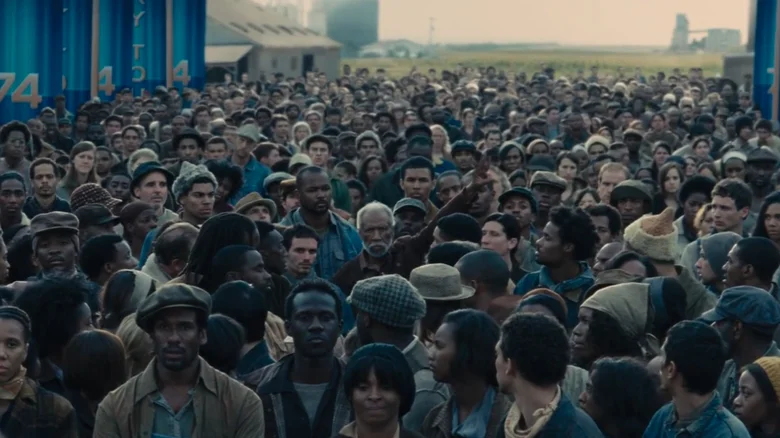
District 11 becomes particularly disturbing on an adult rewatch.
Its residents perform agricultural labor under severe restrictions.
Many are Black.
The goods they produce primarily benefit the Capitol rather than their own community.
In the films, workers are shown gathering cotton, making the historical parallels even more pronounced.
Residents can also face brutal punishment for small violations, including taking food.
After Katniss and Peeta visit the district in Catching Fire, a man publicly salutes Katniss and is violently punished by Peacekeepers.
What may look like generalized dystopian cruelty to a younger viewer carries much heavier historical associations for adults familiar with slavery, racial violence and state repression in American history.
Finnick’s Story Is Far Darker Than His Charming Introduction Suggests

Finnick Odair first appears as confident, flirtatious and almost impossibly glamorous.
That image hides one of the bleakest stories in the franchise.
Later, Finnick reveals that after becoming a victor, President Snow forced him into sexual exploitation by threatening people he loved.
His many supposed romantic encounters in the Capitol were not simply evidence of a carefree celebrity lifestyle.
They were coerced.
The revelation becomes even more disturbing because Finnick won his Games at only 14.
The Capitol did not merely use victors as propaganda.
It continued controlling their bodies and private lives long after the arena ended.
Gale’s Romance Looks Less Romantic With Age

The famous Katniss-Peeta-Gale triangle also changes when viewed from an adult perspective.
Gale’s jealousy can initially seem like a standard part of a young-adult romance.
But Katniss has just survived a televised death match.
Her apparent romance with Peeta was partly a survival strategy, and the two also formed a genuine bond through shared trauma.
Gale frequently seems more focused on whether Katniss will choose him than on the extraordinary emotional burden she is carrying.
Later, their deeper incompatibility becomes impossible to ignore.
Gale increasingly accepts civilian deaths as a necessary cost of revolution.
Katniss does not.
Their relationship is ultimately destroyed by that moral divide, especially after weapons connected to Gale’s strategy are used in an attack that kills Prim.
The romance does not fail merely because Katniss prefers another man.
It collapses because the two develop fundamentally different ideas about what violence can be justified.
Haymitch’s Drinking Is Part of a Much Larger Pattern

Haymitch is frequently introduced as the drunken mentor.
That can play almost like dark comedy at first.
But his drinking becomes much sadder when the reason behind it is understood.
He survived his own Games, only to have people he loved killed after he defied the Capitol.
Alcohol becomes one way he attempts to live with trauma that never disappeared.
Other victors cope through drugs.
The District 6 tributes in the Quarter Quell are known as Morphlings because of their dependence on the narcotic.
Johanna Mason later struggles with addiction after being tortured.
Victory, the series repeatedly shows, does not mean freedom.
Many winners leave the arena only to spend the rest of their lives trying to numb what happened there.
The Peacekeepers Do the Opposite of Their Name

The term “Peacekeeper” sounds reassuring.
Their behavior is anything but.
As rebellion grows, they become increasingly militarized and violent.
They enforce the Capitol’s authority with weapons, beatings and intimidation against largely powerless civilian populations.
The contradiction is deliberate.
Calling them Peacekeepers allows the government to frame repression as public safety.
Adults may recognize the broader political idea immediately: authoritarian systems often use comforting language to disguise coercive power.
Panem Itself May Be a Warning About Environmental Collapse

Even the world beneath the story becomes darker when examined closely.
Panem exists after the collapse of the North America we know.
Katniss refers to earlier disasters including fires, floods and droughts.
Wars over dwindling resources followed.
The result was the society that eventually became Panem.
That background means the series is not only warning about dictatorship.
It also imagines what could happen when environmental catastrophe, resource shortages and political conflict combine.
That detail can easily fade behind the drama of the arena.
As an adult, it becomes much harder to ignore.
And perhaps that is why The Hunger Games remains so effective.
The franchise never relied only on the question of whether Katniss would survive.
Its deeper question was always what kind of society would create the Games in the first place — and why so many people would accept them as normal.
Teenage viewers may see an extraordinary heroine fighting an evil government.
Adults are more likely to notice something more uncomfortable.
Panem works because inequality has become routine, suffering has become entertainment, trauma is ignored and violence is repeatedly justified in the name of order or victory.
That is what makes returning to The Hunger Games years later so unsettling.
The arena was never the only frightening part.